Politics & Government
'Texas Sovereignty Act' Would Let State Decide Which Federal Laws To Enforce, Reject
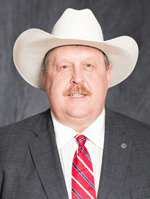
Cecil Bell Jr., a Republican from Magnolia, Texas, envisions a special committee to decide whether federal laws are enforceable in Texas.



AUSTIN, TX — If you can't beat 'em, make them unenforceable in Texas.
A state lawmaker known for his opposition to gay marriage wants to craft legislation that would allow Texas to essentially opt out of federal laws and court decisions based on the state's own interpretations of constitutionality.
Cecil Bell, Jr., a Republican from Magnolia, Texas, also has treaties and presidential orders covered in his proposed legislation, having those federal moves fall under similar scrutiny before Texas decides to adhere to them.
Find out what's happening in Austinfor free with the latest updates from Patch.
“I think it is important for patriotic Americans to recognize the strength and necessity of our Constitution," Bell was quoted as telling the House Select Committee on State and Federal Power and Responsibility. "It is also important that we defend that Constitution.”
Guided by that vision, Bell crafted his proposed House Bill 2338, also dubbed the Texas Sovereignty Act.
Find out what's happening in Austinfor free with the latest updates from Patch.
Detractors of Bell's proposal looked to history for guidance in opposing the measure during a committee hearing on Thursday. Said Democratic State Rep. Chris Turner: “If I am remembering my history correctly, I think nullification was more or less decided in the time of Andrew Jackson — and it was certainly decided after the Civil War — that we don’t have the ability to nullify federal law,” Turner said, as quoted by the Austin American-Statesman. “If states have the ability to nullify any federal laws they want, then we don’t have a nation anymore."
“Any law which violates the life, liberty and private property of the people is not pursuant to the Constitution and is not legitimately part of the Constitution,” Badnarik told the Statesman.
At Thursday's public hearing Barbara Harless of the Texas Citizens Lobby also endorsed Bell's measure, framing it through a prism of freedom and liberty as a safeguard to protect Texas residents from illegal federal rules, including the U.S. Supreme Court ruling establishing a right to abortion, she said.
“We elect you guys to stand up for us, to stand up against the federal tyrant,” Harless was quoted by the Statesman as having said during the hearing.
Kathie Glass is another supporter of the Texas Sovereignty Act, saying at the hearing that Texans are wary of a seemingly overreaching federal government: “Wouldn’t it be great if the federal government was not supreme over Texas, and we didn’t have to obey federal bureaucrats, judges, legislators and presidents when they get out of line?” Glass mused. “Wouldn’t it be great if Texas can treat Supreme Court opinions as just that, opinions, and not edicts that we must obey?”
All told, roughly 20 people spoke in favor of Bell's HB 2338.
So who would be the arbiters of federal guidelines deemed not enforceable in the Lone Star State? It would be up to an envisioned 12-member Joint Legislative Committee on Constitutional Enforcement that would be equally split between House and Senate members. This special committee would study the legality of federal rules based on a reading of the U.S. Constitution as understood “...at the time of the framing and construction … by our forefathers," the Statesman reported.
Once a federal actions is deemed by the committee as violating the Constitution, their findings would be sent to the governor for approval. Then, the federal action would be declared as having "no legal effect in this state," thus not enforceable by state or local officials.
There's more: The Texas attorney general would then be charged with prosecuting anyone who would try to enforce the banned federal law, rule or court opinion, the Statesman explained.
Badnarik likes the proposal, which could set up the state to effect a secession from the U.S.—a move that's not possible under current guidelines, but a vision on which a surprising number of Texas pin their hopes. The current geopolitical climate could accelerate such secession, Badnarik said at the hearing.
“With the probability of a worldwide economic recession and the possibility of war with Russia and Korea, I think it’s time once again for Texas to reassert its independence," he said, as quoted by the Statesman. "Secession, also known as independence, is moral, legal, commonplace, desirable and very, very possible here in the state of Texas."
A vote wasn't taken on Bell's proposed bill on Thursday. A identical bill in the other legislative chamber, Senate Bill 2015 authored by State Sen. Brandon Creighton, a Republican from Conroe, Texas, has not been acted upon, the Statesman reported.
In what is now seen as a barometer of popularity of an issue, a Facebook page was created to help drum up support for the Texas Sovereignty Act. True to form given its secessionist theme, the Facebook page is adorned with the Gadsden flag—the one depicting a coiled rattlesnake and emblazoned with the words "Don't Tread on Me"—as its cover photo.
A video narrated by noted secessionist James Trimm is featured prominently on the page, acting as primer behind the push for separation from the U.S. In calling for secession, Trimm says constitutional adherence has strayed from the original intent, calling the government today as a "...federal leviathan that has grown out of control."
The Texas Sovereignty Act is emblematic of an ever-growing resistance largely among Texas Republicans to follow federal guidelines, particularly those established to oversee abortion, gay marriage and other issues anathema to conservative ideals.
Bell's latest attempt is something of an offshoot of the 2015 Supreme Court ruling that banned states from inhibiting gay marriage predicated along civil rights. It was shortly after that Supreme Court ruling that Bell introduced his Rep. Cecil Bell Jr. (R-Magnolia) on Wednesday introduced House Bill 623, which he’s calling the “Texas Preservation of Sovereignty and Marriage Act.”
Efforts to circumvent the Supreme Court decision allowing for gay marriage have been recently revived in rebuke of the federal ruling. The Texas Senate this week approved a bill that would allow county clerks to deny same-sex couples marriage licenses if doing so violated their sense of morality. The bill next goes to the House, where it faces an uncertain future.
See also: Texas Senate Approves Bill Allowing County Clerks To Deny Same-Sex Couples Marriage Licenses
HB 623 would have amended the Texas Family Code to prohibit the use of taxpayer funds for the “the licensing or support of same-sex marriage,” as the Texas Observer reported at the time. It would've also barred government workers from recognizing, granting or enforcing same-sex marriage licenses, with anyone violating those rules barred from collecting “a salary, pension, or other employee benefit.”
In its annual compendium of best and worst state legislators, Texas Monthly magazine relegated Bell to the latter category the same year he tried to get his marriage sovereignty/preservation bill passed.
"We don’t begrudge Bell his honest opposition to gay marriage, but filing four bills on the subject amounts to swatting at a fly with a sledgehammer," the magazine wrote. "The fate of gay marriage lies with the U.S. Supreme Court. Everything else is just noise. Bell contended throughout the session that he was protecting Texas’s sovereignty. But rudimentary civics tells us that a state law can’t nullify a Supreme Court ruling; Bell’s bill would have merely delayed gay marriage in Texas for a short time at most."
But a lot has happened since 2015, which, somehow, given the avalanche of intervening events, seems so long ago. As talk of secession picks up steam, as politicians are increasingly resistant to federal rules amid their own abundant slate of hot-button issues, the growing frustration of some Texas lawmakers—an exasperation inadvertently aided along by attendant global turmoil—anything can happen as it relates to the Texas Sovereignty Act.
In Texas and beyond, given all that's happened, surprise is no longer a plausible option.
>>> Photo of Cecil Bell Jr. via Texas State Directory, uppermost image via Shutterstock
Get more local news delivered straight to your inbox. Sign up for free Patch newsletters and alerts.