Politics & Government
Texas Speaker Calls For Confederacy-Endorsing Plaque To Be Removed From Capitol
Erected at the height of the Jim Crow era, etched message on plaque contends Civil War wasn't fought to preserve slavery.


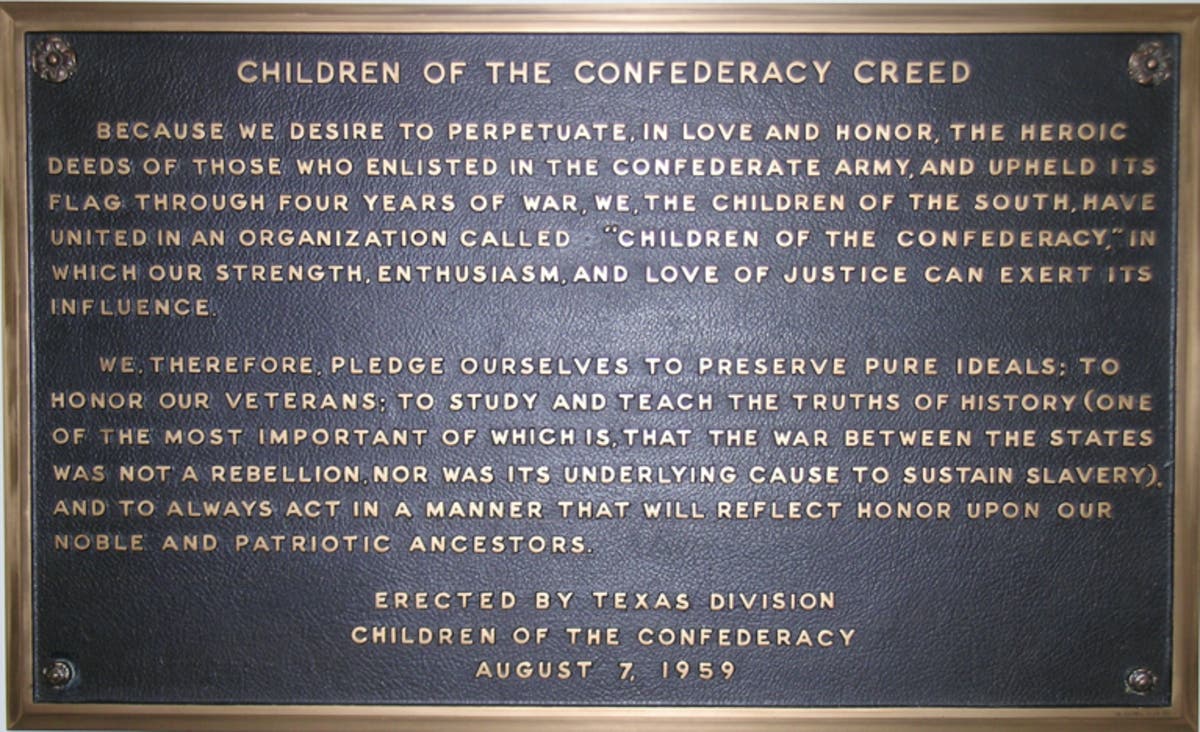
AUSTIN, TX — Republican speaker of the Texas House of Representatives Joe Straus has added his voice in a growing chorus calling for removal of a Confederate plaque on a Texas Capitol wall that espouses the Southern aims of the Civil War.
Straus penned a letter to the state board overseeing historical monuments and markers at the Texas Capitol asking for the plaque to be removed as soon as possible, announcing his move on Facebook. "The plaque says that the Civil War was not an act of rebellion and was not primarily about slavery," Straus, a San Antonio conservtive, wrote in his letter. "This is not accurate, and Texans are not well-served by incorrect information about our history. Those of us who serve on the State Preservation Board should direct staff to identify the steps necessary to remove this plaque as soon as practicable."
Straus took his call further, calling for all references to the so-called Lost Cause be reviewed. "We have an obligation to all the people we serve to ensure that our history is described correctly, especially when it comes to a subject as painful as slavery," he wrote.
Find out what's happening in Austinfor free with the latest updates from Patch.
Straus's call for the plaque's removal comes on the heels of a similar urging last month by Rep. Eric Johnson, a Democrat from Dallas. Johnson told the newspaper he was "thrilled" to hear about Straus's initiative in calling for the plaque's removal as well.
"I just have to applaud him for being such a honest and thoughtful leader and just doing the right thing here," Johnson told the newspaper. "I'm confident it's coming down."
Find out what's happening in Austinfor free with the latest updates from Patch.
Patch recently took an appraisal of all the markers, monuments and markers honoring the Confederacy at the Texas Capitol—including the plaque that describes the Civil War as a fight not centered on the preservation of slavery. There are about a dozen such tributes—markers, statues and portraits honoring soldiers and generals who fought to preserve slavery for the South—throughout the Capitol grounds and inside the rotunda.
Related stories:
As Nation Grapples Over Confederacy Symbols, Texas Fiercely Protects Theirs
University Of Texas At Austin President Orders Removal Of Confederate Statues
While officials at cities across the country wring their hands over over what to do with remaining tributes to the Confederacy, Texas officials (particularly conservatives controlling the state Legislature) have made no similar overtures about removal. After University of Texas at Austin officials recent removal of Confederate monuments on campus, Gov. Greg Abbott painted the move as one motivated by attempts at historical revision. Removing such statues "...won't erase our nation's past, and it doesn't advance our nation's future," Abbott said.
Lt. Gov. Dan Patrick echoed the sentiments in a radio interview. "Gosh, our universities are supposed to be where we learn about history and not repeat those moments of the past, and there was no discussion here,” he said, as reported by the Texas Tribune. “What are we going to do with Gettysburg? Are we just going to tear down every statue in Gettysburg? I mean we can go on and on and on and on."
Ironically, the plaque is the least obtrusive of the nods to the Confederacy dotting the landscape of the Capitol grounds, dwarfed by massive exterior monuments and lavishly painted portraits of key figures of the South—including a large painting of Jefferson Davis that hangs prominently in the state Senate chamber. While the tacit endorsement of the Southern cause is inescapable throughout the grounds given the monuments and paintings, one really needs to look for that out-of-the-way plaque discreetly affixed on the first floor corridor of the Texas Capitol.
But it's its etched message that's proved especially polarizing. Prescient in predicting the current debate about why the Civil War was fought, its makers diminish the role that slavery preservation played as motivation: "We, therefore, pledge ourselves to preserve pure ideals," the plaque mounted at the height of the Jim Crow era reads.
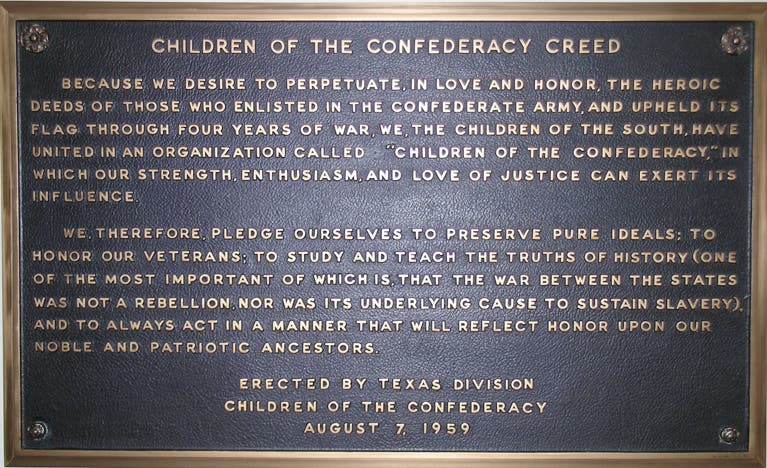
Mounted just 40 steps from his office, the plaque reads, in part, "To study and teach the truths of history (one of the most important of which is, that the war between the states was not a rebellion, nor was its underlying cause to sustain slavery)."
The highest-ranking lawmaker in the state Legislature, Straus wields considerable influence in engendering discussion. That power notwithstanding, it's unclear whether his request will effect the plaque's removal. While the Preservation Board is final arbiter on altering state-owned property, the plaque was erected via a legislative resolution, and its removal might require consensus among the various lawmakers as a result.
The plaque was erected at the height of the Civil Rights movement in 1959 by a group calling itself the "Children of the Confederacy." Part of the group's creed rests on the notion that the perpetuation of slavery was not an underlying cause of the Civil War, in contradiction to the stated reasons for secession that included "...the unnatural feeling of hostility to these Southern States and their beneficent and patriarchal system of African slavery."
(Get Patch's Daily Newsletter and Real Time News Alerts. Or, if you have an iPhone, download the free Patch app.)
Get more local news delivered straight to your inbox. Sign up for free Patch newsletters and alerts.