Community Corner
University Of Texas Officials Honor Victims Of First U.S. Campus Mass Shooting 50 Years Ago
Hundreds gather in sweltering heat to re-dedicate memorial honoring victims of a sniper's attack from the iconic clock tower on campus.


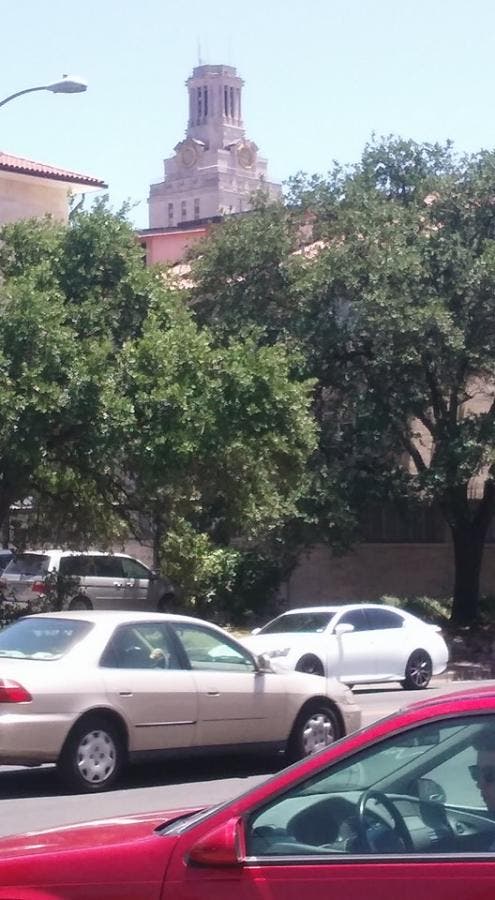
AUSTIN, TX -- Fifty years ago, the term "mass shooting" hadn't yet been coined. And yet, that evil visited the University of Texas at Austin campus half-a-century ago, a tragedy marked by school officials Monday in re-dedicating a memorial for victims of the massacre.
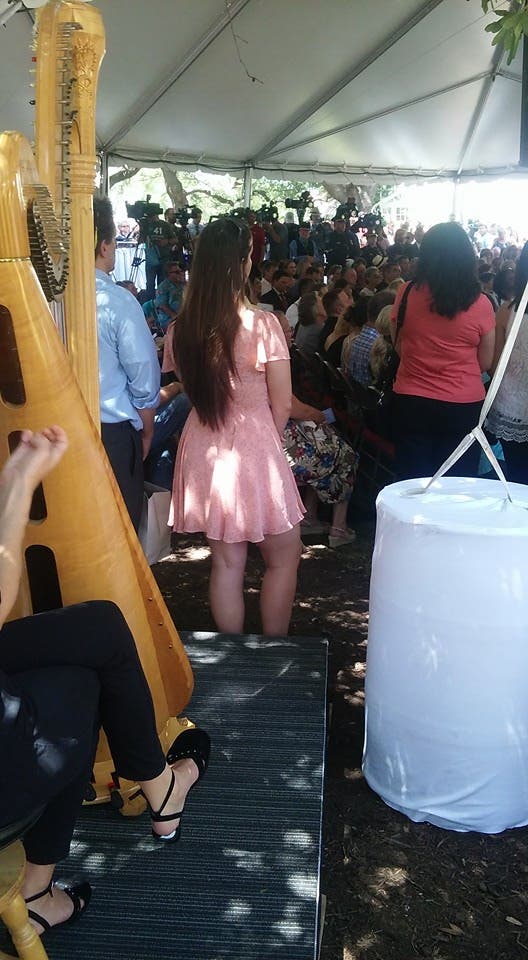
Under sweltering heat reaching 100 degrees, dignitaries joined survivors in remembering the first mass shooting on a university campus in the U.S. that took place in 1966. Outside the perimeters of a tent under which they gathered, adjacent the memorial garden honoring survivors of the shooting, members of the public descended upon the scene to listen to speakers' remembrances of that tragic day.
Located just north of the Main Building -- the UT Tower that is the most prominent point of the campus, with a huge clock atop it -- the Tower Garden was dedicated in 1999 in memory of victims of the mass shooting. A plaque in the garden commemorates that dedication.
Find out what's happening in Austinfor free with the latest updates from Patch.
UT President Gregory L. Fenves spoke eloquently of that day. While the lives lost are a painful memory seared into the hearts and minds of those who were there that day, the focus on the good that day -- the outpouring of support for victims and the heroic action police officers -- is key to healing old wounds that are, somehow, still fresh despite time's passage, he said.
"With the memorial we dedicate today, we remember the good, the innocent and the heroic." -@gregfenves pic.twitter.com/uZjaP9xukg
— UT Austin (@UTAustin) August 1, 2016
"By focusing on the good -- on the stories of the heroes and the lives of the survivors here with us this afternoon -- we can finally begin to remember and endure our burden of the past."
Find out what's happening in Austinfor free with the latest updates from Patch.
Fifty years ago to the day, Charles Whitman arrived on campus loaded with a cache of weapons stored in a box -- rifles, shotguns and handguns. He made his way to the clock tower -- the iconic centerpiece on the 40-acre campus grounds and began his killing spree from his bird's eye view on the floor below the clock.
Before he was finally killed by police, Whitman had fatally shot 14 people on campus and wounded 32 others in a 95-minute span. Officials later found Whitman's killing spree began with the murder of his wife and mother before the mass shooting on university grounds.
At the beginning of Monday's ceremony, the clock was stopped at 11:48 a.m. -- the exact time 50 years ago that the shooting spree began. As in frozen in time, the clock will remain stopped for the next 24 hours to commemorate the tragedy. The tower is normally a beacon telegraphing sports victories or other notable university achievements -- bathed in UT orange light to convey collective joy -- but tonight darkened to commemorate the tragedy.
On the 50th anniversary of the Tower shooting, we honor the victims and all those who suffered from the tragedy: https://t.co/3c6zlXxpl2
— UT Austin (@UTAustin) August 1, 2016
The tower's clock has been stopped only one other time, to mark the first anniversary of the Sept. 11 terrorist attacks. The last time the tower was darkened was this past April after freshman dance major Haruka Weiser was murdered by a homeless teen, as she walked near the portion of Waller Creek running through campus as she headed to her dorm at night.
To honor the memory of those who died in the mass shooting, the clock will remain stopped for 24 hours. The tower normally a beacon conveying collective celebration -- bathed in orange light in highlighting sports victories or other notable achievements -- will be darkened at dusk to mark the somber commemoration.
Before introducing the other speakers, Fenves spoke directly to survivors in the crowd.
"We come to to memorialize the 17 lives lost, and we come together -- students, professors, staff members, community members and friends -- to honor you the survivors whose lives were forever altered fifty years ago," Fenves said. "I've gotten to know you over the past year and I understand half a century feels as if it were yesterday, that there will never be relief from the pain and that the scars that you live with have also scarred this great university. My hope is that today's remembrance can play at least a small role in helping you, and helping us, heal."
Fenves ticked off examples of heroism amid tragedy from that fateful day -- from the officers and medics who ran to the scene to tend to the wounded and dead to the ordinary citizens who donated blood. Expanding further on that theme, he mentioned each of the four officers in attendance who were among the seven who rushed the tower in finally ending Whitman's killing spree: Phillip Conner; Ramiro Ray Martinez; Harold Moe; Milton Shoquist.
After each officer stood as Fenves issued his roll call, audience members applauded as each one stood.
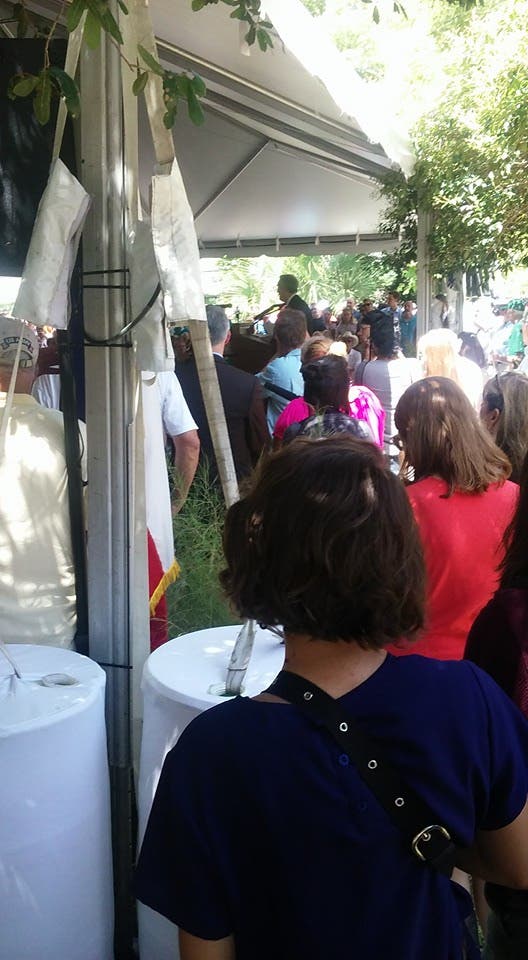
In his remarks, Fenves quoted from Shakespeare's Julius Caesar: "The evil that men do lives after them; the good is oft interred with their bones." He expounded on the relevance of the quote: "My hope today is that with the memorial we dedicate today, we remember the good, the innocent and the heroic."
He then introduced a survivor -- one who embodies all three of his referenced attributes. Claire Wilson James was shot as she walked across campus fifty years ago, and lost her unborn child as a result. The next bullet killed her boyfriend, Thomas Eckman -- the 18-year-old shot dead as he knelt over his injured girlfriend.
"Claire is the embodiment of the resiliency of the human spirit, and she is an inspiration to me," Fenves said.
As she made it to the podium to address the crowd, James received a standing ovation from those gathered gathered and was met with an embrace from Fenves.
"I've asked myself many times over the last several years: how can it help to have a memorial? But for the many people who have come to the university to see these fallen where they breathed their last, it will be reassuring and comforting. But truly it is not the stone we dedicate, but ourselves."
She asked those gathered to join her in a pledge inspired by the dedication: "I ask you to join me in making a vow to treasure the ones we walk with right now each moment," she said. "Let this memorial remain here on this campus and in our minds as a reminder to the power we have each moment to become a community of love and reverence for life."

U.S. Rep Lloyd Doggett, a former school president, was there that day, emerging from the university's business school unaware of what was happening just a few yards away, he recalled. "Because I was waling south instead of north or west, I went unscathed. At noon on a sweltering day like this, it became a tower of tragedy."
He spoke of the incomprehensible nature of the tragedy on that day: "It was as unexpected...as if some flying saucer had landed right there on top of the tower."
But today, sadly, shooting are commonplace, he added, referencing a shooting this past weekend on 6th Street that left one dead and five others wounded as just a recent example.
"Tragedies that see to involve hardly enough victims to warrant more than momentary public attention," he said of shootings that have become all too common. "Repeated moments of silence and offering our throughts and prayers is simply not enough. Let us resolve to never become callous; let us never cease in our efforts to work together to prevent such wanton violence."
Doggett was referencing the need for gun control -- a measure endorsed by the majority of Americans -- to curb violence that is almost routine. Ironically, the commemoration of the mass shooting coincided on the same day as the "campus carry" law allowing guns on campus took effect.
Fenves and other university officials have come out against "campus carry," reluctantly agreeing to comply with the law. Unlike private universities, state-subsidized universities are unable to opt out of "campus carry," a law pushed by conservatives to allow licensed gun owners to take their guns on campus as an expression of their 2nd Amendment rights.
For her part, Wilson James -- who was the victim three times over of gun violence -- silently made her own views on the matter known. She sported a button on her lapel with the words "campus carry" struck out with a single, red line across it. "We don't need guns on campus," she said during a brief chat with Patch after the ceremony ended.
After the scheduled speeches, two men -- one young, and one elderly -- read the names of each of those who lost their lives that day. In the distance, after each name was read, the bell atop the tower pealed. A married pair of musicians to the side of the stage, Rachel Browne and Eduardo Cassapia played "Gabriel's Oboe" -- she on the harp and he on the oboe.
Patch spoke to retired officer Moe -- donning a cowboy hat and western wear -- after the ceremony. He described the chaos of that day 50 years ago when he was already off the clock but returned to help his fellow officers end the tragedy.
By then a three-year veteran of the force, he was more worried about the fellow officer he spontaneously recruited as his partner -- who also was at the ceremony -- who was not only a rookie but recently married.
Moe attended Monday's ceremony to honor the dead, not for self-aggrandizement: "None one of them wants to be glorified," he said of police on duty that day. "We did our job."
As for his own motivation to help: "They were short on officers that day, and they needed help," Moe said.
Watch a video of the full ceremony by clicking here.
>>> Photos by Tony Cantu
Get more local news delivered straight to your inbox. Sign up for free Patch newsletters and alerts.