Community Corner
Austin Has 16th-Lowest Evictions Rate Among Metro Areas
New study finds rate of 2.7 percent for the Austin metro area, with higher-than-average salaries shielding it from further displacement.


AUSTIN, TX — The ongoing, brisk pace of gentrification that's swept over Austin the past few years may lead some to think it's the biggest source of evictions in the city. But according to a new study, there are other forces at play with the level of such displacement relatively low when compared to other major metro areas.
A newly released Apartment List report estimates an eviction rate of 2.7 percent for the Austin metro area, making it the 16th lowest rate among the nation's biggest cities. Beyond its importance as a statistic, the finding sheds light on a city's overall health given that evictions are a leading cause of homelessness — with research suggesting ties to poor health outcomes and adults and children alike.
In a response to questions from Patch, the study's author, Chris Salviati, acknowledged that gentrification plays a role in evictions. But the rate of such displacement is less in cities of higher median income when compared nationally. According to the Department of Numbers, Austin's real median household income in 2015 was $67,195 versus the national median of $55,755. The Texas median was $55,653 that same year.
Find out what's happening in East Austinfor free with the latest updates from Patch.
"I think that displacement due to gentrification is definitely a significant factor in a city like Austin, but note that Austin's overall eviction rate is lower than the national average of 3.3%, and Austin actually has the #16 lowest eviction rate of the 50 largest metros," Salviati told Patch.
"One of our findings is that metro-level eviction rates are negatively correlated with median incomes, meaning that cities with high median incomes tend to have lower rates of eviction," he added. "Even though these metros are generally more expensive and are experiencing fast rent growth, strong local economies with good job opportunities offset the higher costs. In contrast, evictions are more prevalent in struggling metros that were hit hard by the foreclosure crisis and have high rates of poverty."
Find out what's happening in East Austinfor free with the latest updates from Patch.
But Salviati acknowledged some pockets of Austin might be disproportionately affected by evictions when seen at ground level. What's more the gentrification trend that continues to be felt in Austin is changing the city's dynamics in ways that a study can barely capture. Another recent study by MagnifyMoney, a subsidiary of LendingTree comes close, categorizing Austin as the nation's "most changed" city. That study looked at a decade's worth of data in reaching that conclusion, its researchers said.
Related story: Austin 'Most Changed' Among Nation's 50 Major Metro Areas
Arguably the hardest hit sector of Austin is in East Austin, which has become something of a ground zero for gentrification-prompted changes. Once largely a working-class enclave populated by blue-collar workers, the enclave in the past decade or so has transformed into one of the city's trendiest areas — as attested by construction of luxury housing and the opening of high-end restaurants there to accommodate an influx of new residents arriving from other parts of the country, lured by high-paying jobs.
"It's also worth noting that this analysis is all performed at the metro level, so there are likely particular neighborhoods within Austin where evictions are more prevalent," Salviati conceded.
It's this gap between the conceptual nature of studies and the reality at street level that points to a general lack of data on the topic, the researcher agreed: "Despite the importance of this issue, there is currently a serious lack of comprehensive nationwide data on evictions," he wrote. "To better understand the severity of the evictions crisis, a new released today analyzes data from our users to explore eviction trends for the nation as a whole and estimates eviction rates at the metro level."
All told nationwide, researchers found many renters struggle to pay their rent. The study estimates that 3.7 million Americans have been affected by evictions. Additionally, evictions disproportionately impact the most vulnerable segments of the population, with less educated Americans facing significantly higher risks of eviction-fueled displacement.
Black households and those with children are among the most vulnerable, the study found. The former face the highest rates of eviction, even when controlling for education and income, according to the study. Additionally, households with children are twice as likely to face an eviction threat, regardless of marital status.
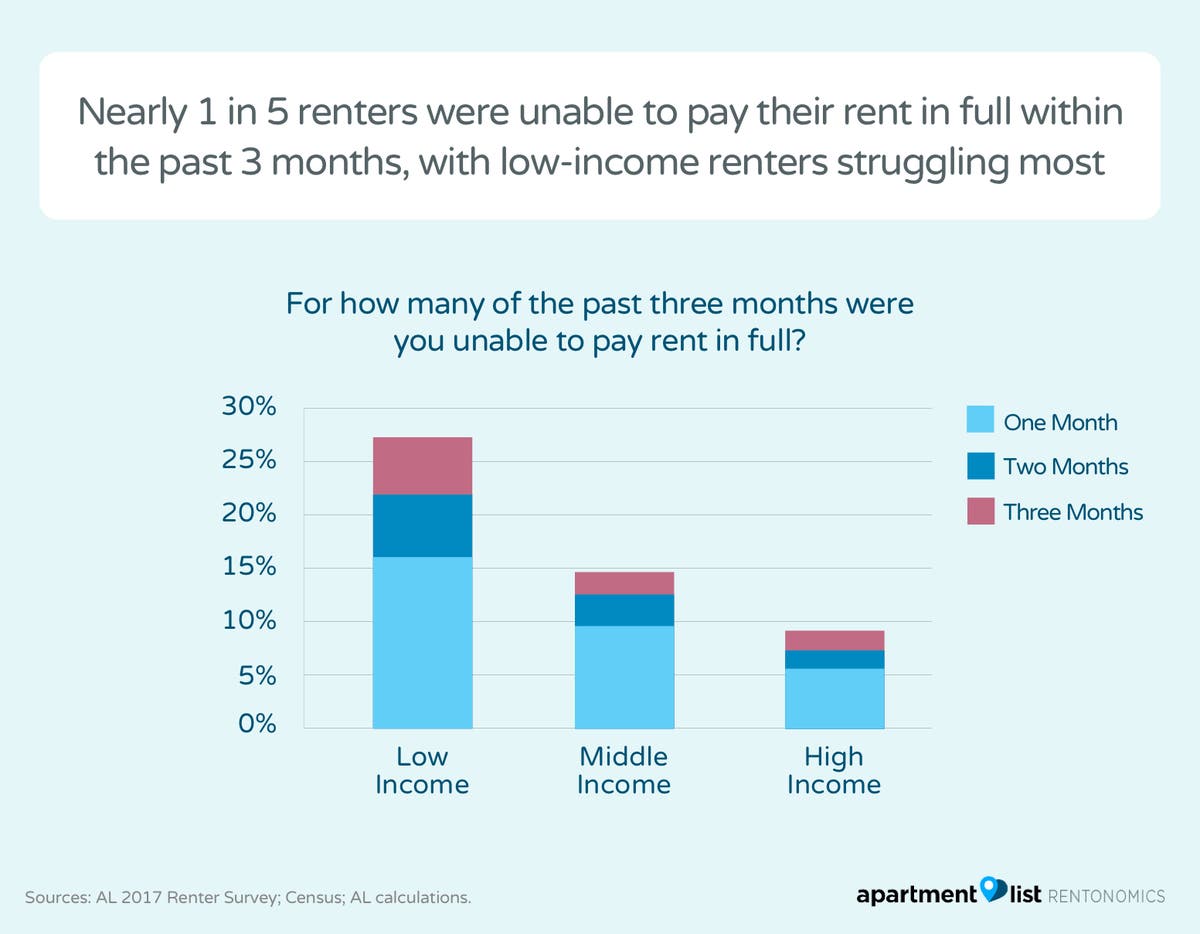
Among other key findings in the study:
- The impacts of eviction are severe and long-lasting. Evictions are a leading cause of homelessness, and research has tied eviction to poor health outcomes in both adults and children. These effects are persistent, and experiencing an eviction makes it difficult to get back on one’s feet.
- Performing a metro-level analysis, we find that evictions are most common in metros hit hard by the foreclosure crisis and in those experiencing high rates of poverty. Perhaps counterintuitively, expensive coastal metros have comparatively low rates of eviction, in part because strong job markets with high median wages offset expensive rents in those areas.
The study also found renters without a college education are twice as likely to have been evicted. "Evictions disproportionately impact those on the lower rungs of the education ladder," the study's author wrote. "We find that respondents with just a high school diploma are more than three times as likely to have faced an eviction threat in the past year than those with a Bachelor’s degree."
Yet it's single parent households that are at highest risk, with 30.1 percent reporting difficulty paying rent within the past three months, the study found. Nevertheless, married couples with children don't fare much better, with 27.2 percent struggling to pay rent, according to the findings.
"For those without children, the rates are 14.7 percent for single respondents and 13.3 percent of married respondents," Salviati wrote. "Our findings are consistent with previous research showing that, among tenants who appear in eviction court, those with children are significantly more likely to be evicted."
What this demonstrates is that child care represents an essential but often overwhelming expense for many families, even those with both parents in the house, the study found. Analysis from Care.com shows that average daycare costs for toddlers range from $8,043 to $18,815 per year. Furthermore, one-third of families surveyed reported that childcare costs take up 20 percent or more of their household income, according to the study.
Highest eviction rates in metros with widespread poverty
Of the 50 largest metros in the nation, evictions are most prevalent in Memphis, with 6.1 percent of users reporting a prior eviction, the study found. Most of the metros with the highest eviction rates are located in the South and Midwest and include Atlanta, Indianapolis and Dallas, according to the findings.
"We find that the factors most strongly correlated with eviction rates include (1) the rate of foreclosures from 2007 to 2008, during the height of the foreclosure crisis, and (2) current poverty rates," the study's author wrote.
The full report is now available here.
>>> Image via Shutterstock
Get more local news delivered straight to your inbox. Sign up for free Patch newsletters and alerts.