Neighbor News
The Cuban Mystery Noise
A mystery sonic noise is sickening personnel in Cuba. Here's a brief look at the noise itself and toxicology studies into noise.

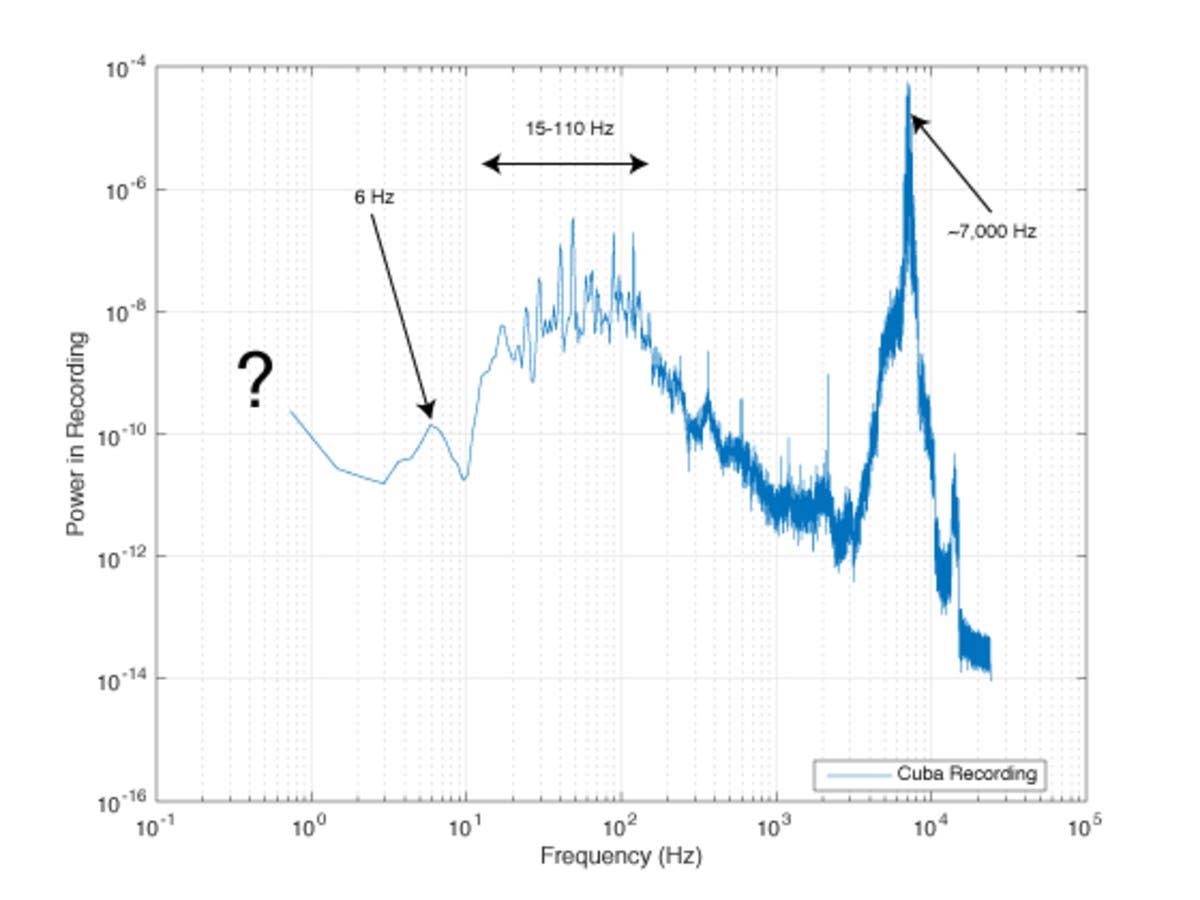
As you've probably heard by now, US personnel in Cuba were being sickened by an unknown sequence of events associated with sound. An annoying sound could be heard and then personnel started experiencing "brain injuries to hearing loss" [Reference 1]. The curiosity is how. Annoying sounds by themselves can cause hearing loss if it occurs at a certain power level over a period of time; however, the other problems reported don't occur within audible frequencies. With the publication of a recording of the noise, the opportunity to look at its mix of waves and their amplitudes becomes possible for curious forensic engineers. The article in Reference 1 included a recording of the sound; if we load it up into an analytical program for calculating the signal's frequency spectrum, an interesting picture appears. As the figure attached to this article shows, the loudest part of the noise is around 7,000 Hz. That's the high-pitched annoying sound. Interestingly though, the signal has several interesting features. There's a broadband region between 15 and 110 Hz with a significant amount of cumulative power in it despite being 40 dB less in power than the higher-pitched noise. Below that in frequency is a potentially non-significant narrowband region around 6 Hz that's weaker by another 20 dB. The cut-offs in frequency are determined by the provided audio file. The lowest frequency is fixed by how long the recording lasts, and the highest frequency is fixed by the sampling rate of the cell phone.
Before we get into what this means exactly, you need to understand that the power in the spectrum can't be taken as accurate. To begin with it was recorded with a cell phone microphone. Microphone signals are processed prior to being passed to the network, primarily to enhance the human voice and reduce the background noise. As a result, the power in the vicinity of the average human voice, 85 to 255 Hz, is going to be amplified while the other frequencies within detectability will be filtered out as much as possible. Additional filtering more tailored to the human speaker likely occurs, too. And that is not all. As Reference 1 discusses, the cell phone's recorded signal was further processed to reduce background and increase the detected noise. So in summary: TAKE CAUTION IN COMPARING HOW MUCH POWER IS IN EACH BAND OF THE SPECTRUM. This figure is of QUALITATIVE value for the POWER within the noise.
In References 2, 3, and 4, it's pretty clear that the effects of sonic noise is not a settled issue. Ultrasonic noise appears to be associated with hearing loss. Infrasonic noise appears to be associated with a host of health problems, including hearing loss, fluid flow problems within the body, skin property changes, etc. Discomfort, not damage, within one's body occurs around 5 Hz.
Find out what's happening in Houstonfor free with the latest updates from Patch.
What Reference 4 contributes to the discussion is an interesting line of inquiry that is characteristic of waves in general: mixing. If you take two waves of similar frequency and mix them, the constructive and destructive interference creates a spectrum of waves that includes the difference in frequencies, the sum in frequencies, and similar effects in amplitude. So if I take two ultrasonic frequencies that differ by an infrasonic frequency and target an area of a building, a veritable zoo of waves occur some of which could damage the human body if they manage to resonate to enough power within the space. Whether or not this could occur given the architecture of the Cuban embassy is beyond this discussion, but for those of us who are curious, this would be an interesting direction to look.
Update: The National Academy of Sciences has released a report concluding that the cause was likely microwaves [5]. The acoustic sounds experienced by personnel are thought to be caused by:
Find out what's happening in Houstonfor free with the latest updates from Patch.
"
In order to create the Frey effect hearing and sensation of pressure within the head, there are four distinct steps involving the energy conversion from radio frequency (RF) to acoustic modalities. First, the RF energy penetrates the skull and couples to the neural tissue as a function of impedance matching and absorption in the tissue, with penetrations of 2-4 cm for frequencies of 915 MHz to 2.45 GHz (Brace, 2010). This coupling, in turn, creates a rapid oscillation of temperature changes that leads to a rapid, volumetric thermal expansion and contraction of local tissues (i.e., the increase in thermal energy causes an increase in kinetic energy of atoms, pushing against neighboring atoms to create an expansion or swelling in all directions). The oscillating tissue expansion and contraction launches a thermoelastic pressure wave (Lin and Wang, 2007; Yitzhak et al., 2009). If operated at the right pulse repetition frequency, the thermoelastic pressure wave can propagate to and excite the cochlea and vestibular organs at the resonance frequency of the cranium (Lenhardt, 2003; Yitzhak et al., 2014). Intracranial focusing is possible depending on the incident angle of the incoming RF radiation. Localization and intensity effects within a room can be achieved through nonlinear beat wave effects with careful design of the RF source and antenna.
EAJ Note: None of this is going to cause the sound recorded by the witness' cell phone. References also include studies into noise experienced by personnel exposed to pesticides and aromatic solvents. These too wouldn't affect a cell phone recording. Why the cell phone recording was dismissed is not immediately apparent, am studying this report to see what the issue with it is.
References
[1] "Sound of mystery attacks in Cuba released. It’s as obnoxious as you’d expect", 10/12/2017, Ars Technica, by Beth Mole. https://arstechnica.com/scienc...
[2] "Infrasound: Brief Review of Toxicological Literature", Infrasound Toxicological Summary November 2001, Karen E. Haneke et al. https://ntp.niehs.nih.gov/ntp/...
[3] "Effects of Ultrasonic Noise on the Human Body-A Bibliographic Review", Bozena Smagowska and Malgorzata Pawlaczyk-Luszczynska, International Journal of Occupational Safety and Ergonomics 2013, Vol 19, No 2, pp 195-202.
[4] "Acoustic Weapons - A Prospective Assessment", Juergen Altmann, Science and Global Security 2001, Vol 9, pp 165-234.
[5] "An Assessment of Illness in U.S. Government Employees and Their Families at Overseas Embassies", National Academies of Sciences, 2020