Home & Garden
Radio Crackle 'Didn't Sound Right:' Captain Details Gulf Of Mexico Rescue Of 4 Men
"We were out there for a reason, and it wasn't to go fishing," Capt. Mike Regan says of a trip that ended with saving four friends' lives.


GALVESTON, TX — Capt. Mike Regan says it was a crackle on the radio that didn't sound right that got his attention.
"I don't know how I heard it," the Kingwood resident said Sunday as he recounted the events that led to him and his crew rescuing four menwhose boat had sank in the Gulf of Mexico 100 miles southeast of Galveston on Friday. No one was injured in the incident, according to a news release from the U.S. Coast Guard's 8th District office.
Regan, captain of the Reelentless, a 35-foot Sea Hunter, was heading back to Galveston with friends after a storm turned the previously calm Gulf into an angry, choppy mess with 6- to 8-foot waves and 20-knot winds.
Find out what's happening in Across Americafor free with the latest updates from Patch.
"We were 85-ish miles out," said Regan, who turned 30 on Sunday. "It was raining by then, and everyone was talking. I was paying attention to the motors and the radar."
But the crackle was just enough to get his attention. "It didn't sound right, so I shut the boat down and told everyone to be quiet." And over the wind and pounding waves, he heard it again, a faint call: "Mayday, mayday, mayday." It was from the crew of the Reel Hazard, a 26-foot catamaran that had capsized in the storm.
Find out what's happening in Across Americafor free with the latest updates from Patch.
The Reelentless trip had begun like any other fishing trip, Regan said. He and four friends — Brad Gilman, Mark Baker, Josh Pitts and Jeremy Jodzio — had headed out on Thursday to fish for amberjack, wahoo and yellowfin tuna. Regan, who fishes commercially, had been watching the weather forecast and a window of good weather with calm seas was predicted for Thursday through Friday, he said. As they left the dock, Regan decided to turn around and go back for four gasoline cans he had in the back of his truck.
"The guys were laughing at me when I came back to the dock," Regan said. "But I knew we were going to be doing a lot of trolling, so I figured why not have them for backup."
It was a decision that proved fateful in the end, he said, one of many small things that happened that led him to one conclusion: "We were out there for a reason, and it wasn't to go fishing," he said.
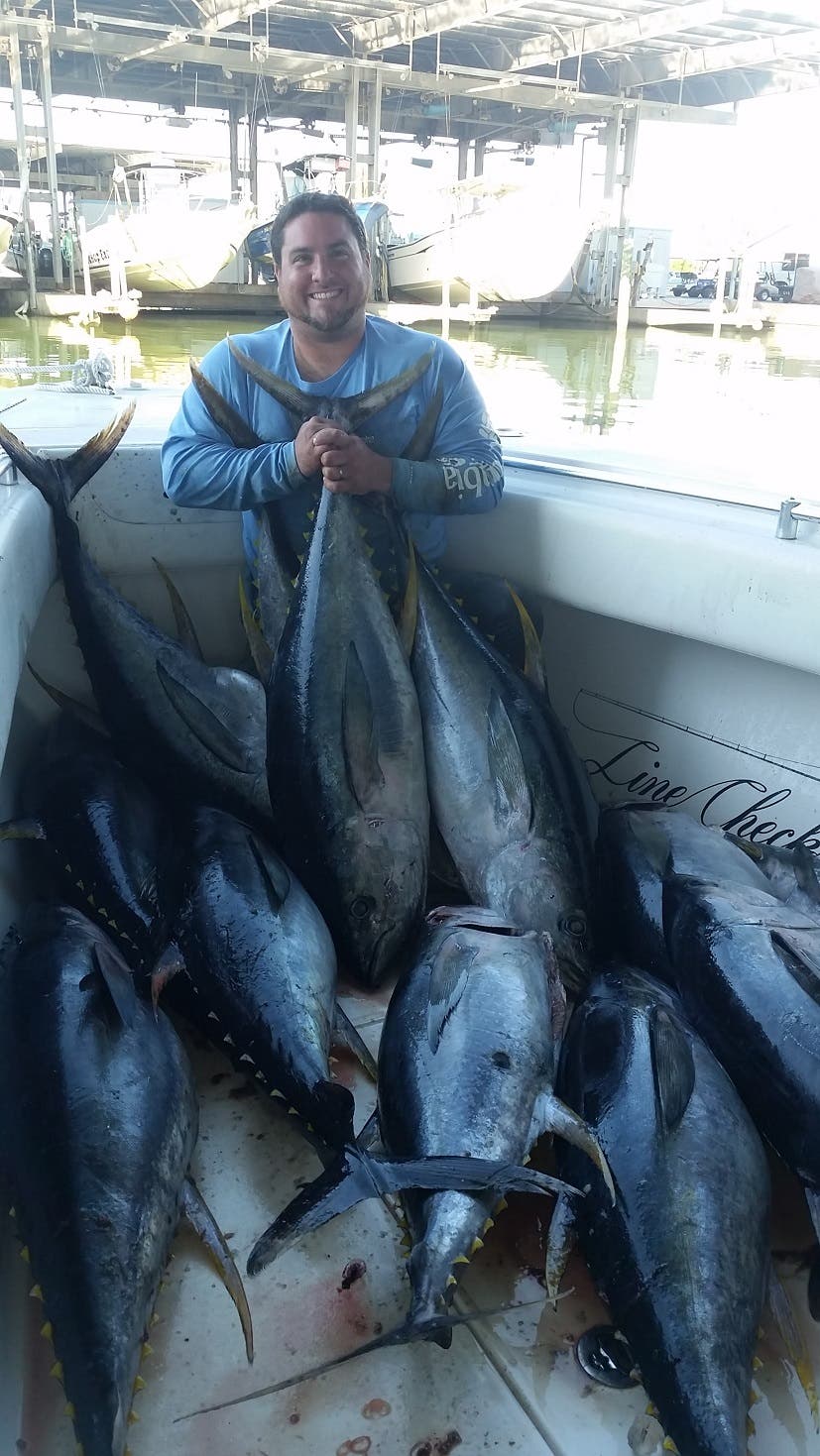
Normally on a two-day trip like that he'll come back with a full fish box. "Last time we came back with over a thousand pounds of yellowfin tuna," Regan said. And while boats all around them were catching plenty of fish, "we couldn't buy a bite."
"It was one of the worst fishing trips I've ever had," he said. "We had a 500-pound mako right with us, and it was eating, but it wouldn't eat anything we threw at it. We threw meat on a hook, but it ignored it."
"(But) if that mako had taken the bait and we chased it, we would have never been near enough to hear (the mayday call)," Regan said. "Later, (after the rescute) it all became clear."
The gulf was flat calm on Thursday. "We get out there and it's the Pond of Mexico," he said. He and his crew fished an area called the East Flower Gardens, along the edge of the continental shelf. It's a prime area for wahoo — a long fish with small fins and a mouthful of teeth that is prized for its tasty flesh — this time of year. But with no baitfish nearby, the Reelentless headed farther out, eventually going about 140 miles offshore, Regan said. When that stop turned up nothing, "we decided to slow-boat it back to the Gardens," he said.
They arrived about sunrise, fishing in the same area as the Reel Hazard and several other boats. But with the bite still eluding them, Regan headed off in a different direction to chase amberjack. "An amberjack in the boat is worth way more than a wahoo in the water," he said.
That's when the waves started kicking up, reaching 6- to 8-footers by midmorning.
"We knew there were going to be boats out there in trouble," Regan said. "Usually you see storms like this coming, but this just came up fast," faster than forecasters had expected, as the storm was predicted to arrive on Saturday.
Most of the time the Gulf of Mexico is calm, and if the forecast predicts a window of really calm weather like what had been predicted for Thursday and Friday, you can count on the weather being calm, Regan said, and a lot of fishermen will jump on the opportunity to go out. But this storm caught everyone by surprise.
"One of the captains who's been fishing there for years said he's never seen anything like it. He got caught in a microburst (thunderstorm) on the way back. There's a video of part of that storm and you can hear the wind whistling like a hurricane," Regan said. On the way back, the radar "was so red from some of the storm cells I couldn't see some of the other ships on the radar."
"It was as close to a perfect storm as the gulf could throw at you," Regan said.
(A screenshot of radar taken by another fisherman and posted to Facebook shows the storm at the time of the rescue.)
With the weather deteriorating and a handful of fish in the boat, Regan said he decided it was time to head in. They hadn't been underway long when he heard the crackle and picked up the mayday call.
Because the call was so faint, "I knew whatever's happening is happening here," Regan said. So they set off in search of the crew, following the same general path back to their port but making some adjustments, trying to pick up the signal better.
"We kept talking to them the whole time," Regan said. "Apparently they could hear us loud and clear, but we couldn't hear them."
What Regan didn't know at that point was the captain of the catamaran had already alerted the Coast Guard and friends on land to their predicament.
The Reel Hazard was equipped with an EPIRB — an Emergency Position Indicating Radio Beacon — which is designed to send up a signal from a boat that sinks to help in locating the vessel and anyone who needs to be rescued. Shortly after the EPIRB distress signal was received at 12:30 p.m. Central Time, the Coast Guard received a call from a family member of the boat's captain and owner, telling the Coast Guard they had received text messages from the distressed crew from their satellite messaging device, the inReach by Delorme.
"That thing was amazing," Regan said. "Every time they sent a text message it gave their GPS position," and it sent the messages instantly. The boat's captain had opted for the inReach over a satellite phone, Regan said, and it made all the difference in this situation.
"My satellite phone wasn't working out there. You had to stand there for 5 minutes waiting for it to connect to the satellite," he said. "In that situation you don't have 5 minutes."
Regan estimates he heard the mayday call at roughly 1 p.m. It took the Reelentless 20 to 30 minutes to locate the life raft with the Reel Hazard crew, and as soon as they got the four men on board he called the Coast Guard to let them know they had rescued the group.
All of the men were wearing life jackets, he said, but they were cold from the esposure to the weather, so Regan's crew pulled everything out of the storage area on his center console boat so the four rescued men could get out of the elements and get warm. The water temperature was in the 60s, he said, and the air temperatures had been in the 50s, "cold enough that you needed to be bundled up while you were running, but warm enough to strip off your slicker while you were fishing," he said. The wind from the storm and being soaked to the skin made it unpleasant.
The group, as it turned out, were friends from their marina. "(His) boat is a couple of slips down from mine," Regan said. He praised his friend's preparations as well.
"(He) did a really great job of making sure everyone was ready to ditch," Regan said. "One guy had waders on, and he had him take them off. The guy pulled the waders off and 45 seconds later he was thrown out of the boat." Waders are a one-piece item that combines overalls and boots and is waterproof to keep someone dry while fishing; the downside is waders can fill up with water, and could have pulled the man under the water in seconds.
Catamarans are often viewed as more stable because they balance on two hulls that run parallel. On calm seas that's certainly the case, but Regan said a following sea — where the waves are coming from behind the boat — poses problems for that style of boat. "The wave shoved them bow-first into the preceding wave," causing water to pour into a storage area, making the boat heavy on one side. That made the boat turn sideways, and the next wave rolled the boat over, Regan said.
The life raft didn't initially deploy, causing the Reel Hazard crew several anxious moments, but finally did, he said. But the sight of Regan and friends was a huge relief, Capt. Derrick Greene, who was not running the Reel Hazard but was aboard the boat when it went down, told TV reporters later.
With the four men safely aboard and sheltered — "it's not the most comfortable ride but they were safe," Regan said — they made their way back to the Galveston Yacht Club, a trip that took nearly six hours because of the storm.
"If you've ever been body boarding, you know how it feels when the wave picks you up and smacks you down," Regan said. "It was doing that to the boat. You might be going 20 knots and (the backward suction of) the building wave would pull you down to 3 (knots)."
That extra fuel Regan brought proved crucial.
"I burned almost every bit of that 400 gallons," he said. "There was a real thin envelope of how long do we stay out here looking (for the life raft) because the first rule of survival is everyone's got to survive. Two boats in trouble out there wouldn't have done anyone any good."
The last-minute decision to run back and get the extra gasoline gave them the cushion needed to get everyone home safe, he said.
By the time they arrived at the marina about 8 p.m. Central time, word of the ordeal — and the rescue — had gotten out, and TV stations were waiting to talk to the men. But most of them were just happy to be back on land and headed home. Regan got back to Kingwood, a 90-minute drive from Galveston, about midnight, he said.
"There wasn't one point that I thought we weren't going to make it back," Regan said, "but yes, I was butt puckered."
It wasn't the fishing trip he was hoping for, he said, but he realizes they were out there for a reason.
"I had the catch of the year," Regan said. "I brought my friends home."
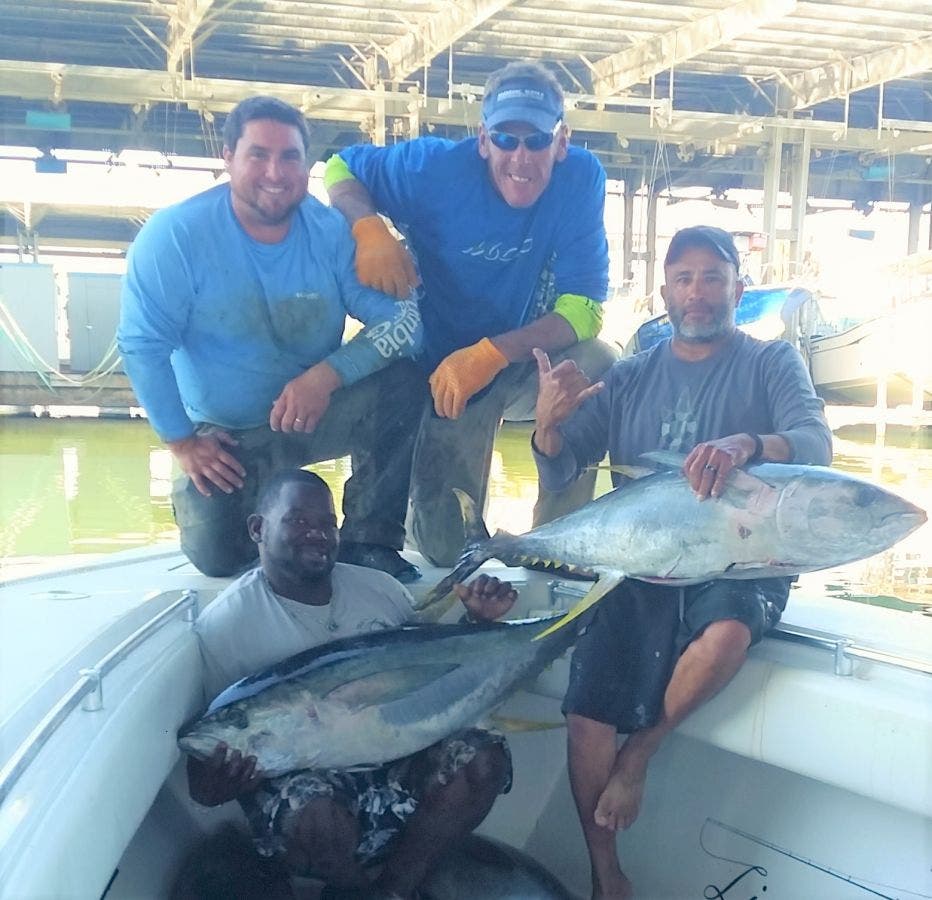
Capt. Mike Regan with friends, including Capt. Derrick Greene, who was among those rescued from the capsized catamaran. Photo courtesy of Mike Regan
Editor's note: An earlier version of this article incorrectly referred to the satellite messaging service as a SPOT messenger. The article has been corrected to reflect the correct device.
Get more local news delivered straight to your inbox. Sign up for free Patch newsletters and alerts.