Politics & Government
Watch Jeff Sessions Defend Trump's Response To Charlottesville Violence
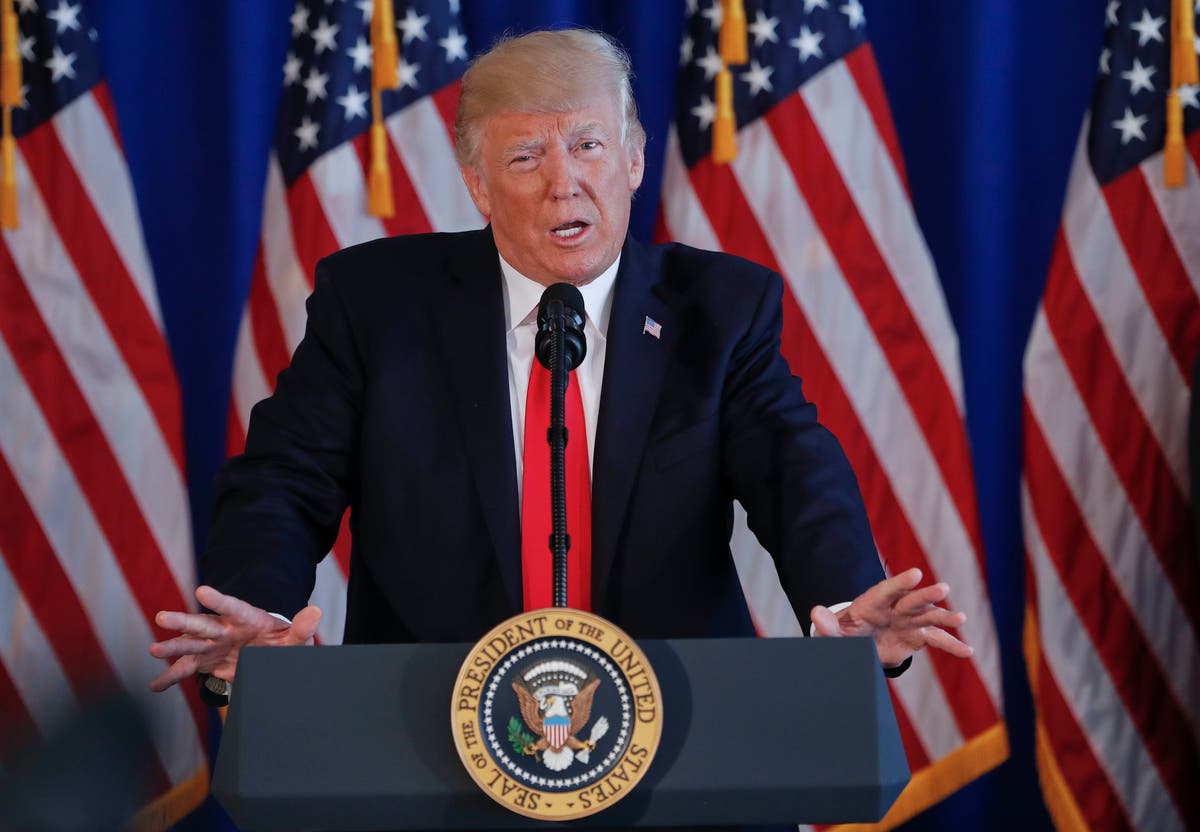
Trump condemned "in the strongest possible terms this egregious display of hatred, bigotry and violence on many sides, on many sides."

WASHINGTON, DC — After violence erupted at a white nationalist rally in Charlottesville, Virginia over the weekend, Jeff Sessions called the incident "domestic terrorism," but struggled to defend President Donald Trump's initial response.
Both sides of the aisle have called on Trump to explicitly condemn white supremacists and hate groups involved in the deadly, racially charged clashes in Charlottesville. Trump, who has been at his New Jersey golf club on a working vacation, will return to Washington on Monday — a one-day visit — to sign an executive action on China's trade practices. He will likely also face questions — and criticism — for his initial response to Saturday's violence, for which he faulted bigotry on "many sides."
Attorney General Sessions said Monday the incident satisfied the criteria to be labeled domestic terrorism. (For more information on this and other White House stories, subscribe to Patch to receive daily newsletters and breaking news alerts. If you have an iPhone, click here to get the free Patch iPhone app.)
Find out what's happening in White Housefor free with the latest updates from Patch.
He told ABC's "Good Morning America": "You can be sure we will charge and advance the investigation towards the most serious charges that can be brought, because this is an unequivocally unacceptable and evil attack that cannot be accepted in America."
Sessions said he expects to hear more from Trump after meeting with him Monday, as well as officials from the FBI. The president added a late-morning meeting with Sessions and FBI director Christopher Wray to his Monday schedule.
Find out what's happening in White Housefor free with the latest updates from Patch.
"We will not allow these extremist groups to obtain credibility," Sessions told "CBS This Morning."
AG Sessions: "And yesterday, his own spokesman explicitly condemned by name--"
Charlie Rose: "But that's the spokesman, not the president." pic.twitter.com/ySxo5kcA2C
— CBS News (@CBSNews) August 14, 2017
In the hours after the incident, Trump addressed the violence in broad strokes, saying that he condemns "in the strongest possible terms this egregious display of hatred, bigotry and violence on many sides, on many sides."
Speaking slowly from his New Jersey golf club while on a 17-day working vacation, Trump added: "It's been going on for a long time in our country. Not Donald Trump. Not Barack Obama. It's been going on for a long, long time."
For one business leader who has been working with the White House, Trump's lack of specificity inspired a personal protest: Merck CEO Kenneth Frazier cited the president's reaction as the reason he's decided to resign from the president's manufacturing council. Trump immediately attacked Frazier by name on Twitter.
The White House statement Sunday went further than Trump did. "The president said very strongly in his statement yesterday that he condemns all forms of violence, bigotry and hatred and of course that includes white Supremacists, KKK, neo-Nazi and all extremist groups." It added: "He called for national unity and bringing all Americans together."
The White House did not attach a name to the statement. Usually, a statement would be signed by the press secretary or another staffer; not putting a name to one eliminates an individual's responsibility for its truthfulness and often undercuts its significance.
Trump's top advisers later struggled to explain Trump's position, offering different responses.
Trump's national security adviser, H.R. McMaster, said Sunday that he considered the attack to be terrorism. On Saturday, Trump had not responded to reporters' shouted questions about terrorism.
"I certainly think anytime that you commit an attack against people to incite fear, it is terrorism," McMaster told ABC's "This Week." ''It meets the definition of terrorism. But what this is, what you see here, is you see someone who is a criminal, who is committing a criminal act against fellow Americans."
The president's homeland security adviser, Tom Bossert, defended the president's initial statement by suggesting that some of the counter-protesters were violent, too. When pressed during a contentious interview on CNN's "State of the Union," he specifically condemned the racist groups.
The president's daughter and White House aide, Ivanka Trump, tweeted Sunday morning:
1:2 There should be no place in society for racism, white supremacy and neo-nazis.
— Ivanka Trump (@IvankaTrump) August 13, 2017
Virginia Gov. Terry McAuliffe, a Democrat, said he spoke to Trump in the hours after the clashes and that he twice told the president "we have to stop this hateful speech, this rhetoric." He said he urged Trump "to come out stronger" against the actions of white supremacists.
Republicans joined Democrats in criticizing the president for not specifically calling out white nationalists. Republican Sen. Cory Gardner, of Colorado, said on NBC Sunday that "This isn't a time for innuendo or to allow room to be read between the lines. This is a time to lay blame."
White nationalists assembled in Charlottesville to voice their frustration against the city's plans to remove a statue of Confederal Gen. Robert E. Lee. Counter-protesters massed in opposition.
Alt-right leader Richard Spencer and former Ku Klux Klan member David Duke attended the demonstrations. Duke told reporters that the white nationalists were working to "fulfill the promises of Donald Trump."
Trump's initial comments drew praise from the neo-Nazi website Daily Stormer, which wrote: "Trump comments were good. He didn't attack us. He just said the nation should come together. Nothing specific against us. ... No condemnation at all." The website had been promoting the Charlottesville demonstration as part of its "Summer of Hate" edition.
Charlottesville Mayor Michael Signer, a Democrat, slammed Trump's stance toward hate groups, saying on NBC's "Meet the Press" that he hopes Trump "looks himself in the mirror and thinks very deeply about who he consorted with."
"Old saying: when you dance with the devil, the devil doesn't change, the devil changes you," Signer said.
Trump, as a presidential candidate, frequently came under scrutiny for being slow to offer his condemnation of white supremacists. His strongest denunciation of the movement has not come voluntarily, only when asked, and he occasionally trafficked in retweets of racist social media posts during his campaign. His chief strategist, Steve Bannon, once declared that his former news site, Breitbart, was "the platform for the alt-right."
By JONATHAN LEMIRE, Associated Press
Photo credit: Andrew Harnik/Associated Press