

A while ago in this space I suggested that our Ashburn, planned and rational community that it is, makes a poor venue for the ghosts that seem to abound in other nearby places. I got a terse, maybe slightly menacing reply by email: “Then u don’t know Ashburn.”
Oh, my. Does someone know something I should know? Do even unearthly entities somehow use the Internet now? In any case, I hope my interlocutor contacts me again and, if he/she/it does, I’ll be sure to report about it in detail.
In any case, October being the appropriate month for the supernatural, I went exploring, by car and electronically, to find the most appropriate place for rousing Halloween stories. That place is surely Oatlands, a few miles south of Leesburg on Route 15. [Editor's note: The plantation does have a starting Oct. 24 afterall.]
Find out what's happening in Ashburnfor free with the latest updates from Patch.
Oatlands, for those who don’t know it, was one of the large plantations hereabouts, about 3500 acres, founded by one George Carter in 1798 and until the Civil War a large supplier of wheat and wool to the local economy. By 1850, Elizabeth, widow of George, was the largest slave owner in Loudoun County, counting 85 chattel servants, of whom 26 were under 13 years old.
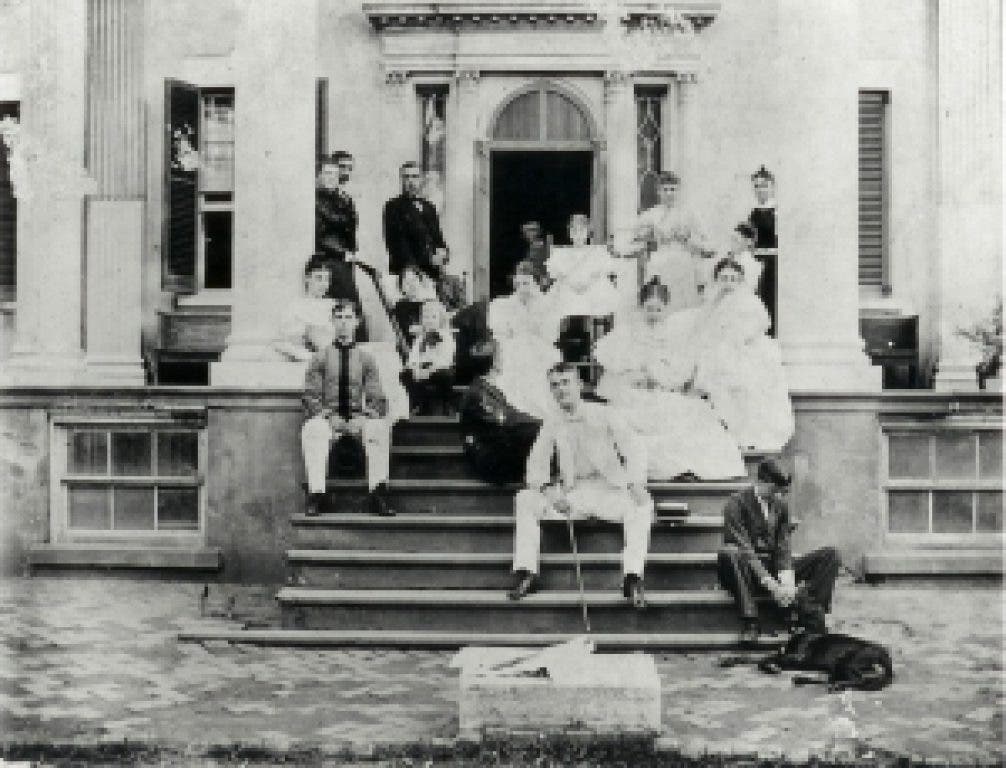
Emancipation pretty much ruined things for the Carters. The property eventually became a summer retreat for wealthy Washingtonians, traveling here and back on the Washington and Old Dominion Railroad. Now the property is much reduced, only 260 acres, mostly an impressive Federal-style manor house, originally built in 1804, and a few outbuildings. It is part of the National Trust and open to visitors.
Find out what's happening in Ashburnfor free with the latest updates from Patch.
That wonderful colonnaded building is where our story begins. Last summer I met with Kirsten Edwards, a cheerful young woman with the look of a marathoner who is the Curator of Collections and Education at the historical site. Right away she informed me that, really, she was something of a skeptic when it comes to ghosts.
But . . .
“One of the most common occurrences is the doors locking,” she told me. “We have three doors, and they will randomly lock. The big front door has an old-fashioned lock that we don’t usually use. One day when three of us were here decorating for Christmas, a guide went out with a tour. When she came back, the key had been turned. None of us had touched it.”
“One day,” she went on, “ there was a wedding here, with people coming in and going out all day. We left the side doors open, but every 20 minutes or so they would be locked. It didn’t happen when we stationed someone to watch them, but as soon as they were unattended, the locks went on again.”
I suggested that maybe there might be an unhappy soul about who didn’t like weddings, but Edwards said she didn’t know of any such romantic story. Certainly there were some deaths in the house. When an investigatory medium visited the place a few years ago, Edwards said, “She walked through the house and was able to tell me things that were happening here without prior knowledge.”
There are also uncanny whisperings. In fact, a few years ago a team of psychic investigators, the Partnership for the Exploration of Paranormal Phenomena and Research (PEPPR) – I can't help thinking “ghostbusters” – did a study of Oatlands and with sensitive audio equipment recorded such phrases as “please go ahead and enlighten me,” “I know they are coming” and the cryptic, “maybe yo.” I was privileged to listen to the recordings they made, but in my benighted state all I could hear was a little rustling.
As late as the 1970s a team of archeologists who were housed on the third floor while working on the grounds reported footsteps every night. Other phenomena are a persistent smell of roses and a room upstairs that is peculiarly cold all the time.
Why do people everywhere, in every era, have experiences like the ones described here? One possibility, of course, is that they refer to some preternatural reality. But another is that, when as children we learn about the inevitability of death, we refuse to believe it. Death, final death, is unfathomable and finally unacceptable. So we find a kind of comfort, in spite of the fear, in the footsteps, the unexplainable events, the protoplasmic sightings.