Community Corner
The History of the White House of the Confederacy
This Richmond house began as a banker's home. It was saved from demolition and now serves as a museum.

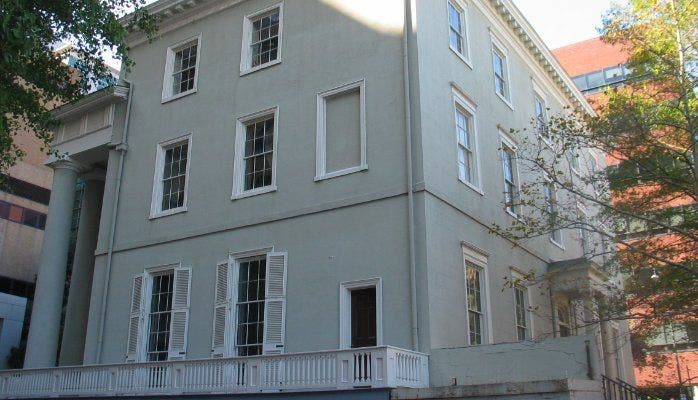
Built as a private residence during 1818 by John Brokenbrough, the president of the Bank of Virginia, the three-story structure that sits on East Clay Street has been known as the White House of the Confederacy
since 1861. Designed by Robert Mills, the building sits on top of a hill that, at the time, was part of the affluent Schokoe Hill neighborhood that overlooked the city of Richmond, Virginia. Neighbors included U.S. Chief Justice John Marshall and former U.S. vice president Aaron Burr.
The Brockenbrough family sold the property during 1844. Owned by a succession of wealthy families during the antebellum period, including U.S. Congressman and future Confederate Secretary of War James Seddon,
the building was purchased prior to the Civil War by Lewis Dabney Crenshaw. He added the third story and then sold the home to the City of Richmond. The city rented it to the Confederate government for use as
the Executive Mansion.
Jefferson Davis, his wife, Varina, and their children moved into the house during August 1861 and remained there until the Confederacy collapsed during early 1865. The trials of war tramped daily through the
house. The Davis family recorded some personal joys at the house, which included new additions to the family, but they also suffered from a variety of ailments and mourned the death of a child.
The Davis children included Margaret, the oldest, Jefferson Davis, Jr., Joseph, William and Varina Anne, who was known as “Winnie.” George Smith Patton was a neighborhood playmate of the Davis children. Patton’s
father commanded the 22nd Virginia Infantry. His son would command the U.S. Third Army during World War II.
President Davis suffered from a number of maladies even before he became the political leader of the Confederate States of America. These illnesses included malaria, facial neuralgia, cataracts in his left eye,
unhealed wounds from the Mexican War and insomnia. He and Varina also grieved over the accidental death of five-year-old Joseph. The boy had suffered a fatal head injury during the spring of 1864 after a 15-foot
fall from the railing on the east portico. His toy cannon and a Confederate artillery jacket made by his mother can be seen in the house among other period and Davis family belongings.
Due to his illnesses and the growing family, President Davis maintained an at-home office on the second floor of the house. His personal secretary, Colonel Burton Harrison, also resided in the house.
After the Civil War
The Davis family fled the house on April 2, 1865 during the evacuation of Richmond. Within 12 hours, Union soldiers were able to secure the building without damaging it. A few days later, U.S. President Abraham Lincoln toured the captured city. He spent several hours at the White House, but remained on the first floor, primarily in the small library. Lincoln believed he should not visit the more private second floor of another man's home.
During Reconstruction, the White House of the Confederacy served as the headquarters for Military District Number One (Virginia), and it occasionally was used as the residence of the commanding officer of the
department. Among the major generals who served in this capacity were Edward O.C. Ord, Alfred Terry, Henry Halleck and Edward R.S. Canby. When Reconstruction ended in Virginia during October 1870, the city obtained possession of the house and used it as one of the first public postwar schools.
The city eventually decided to demolish the building and replace it with a more modern school. Once these plans were publicized, local residents formed the Confederate Memorial Literary Society to save the
White House from destruction. They opened the house to the public on February 22, 1896 as the Confederate Museum. Since the Confederacy had used a likeness of George Washington, a Virginian, in its official seal,
the society selected the date of his birthday to open the museum.
Today's Museum and White House
By the centennial anniversary of the Civil War during the early 1960s, the governing board of the museum had determined that the White House needed to evolve from a shrine to a modern museum. Eventually,
during 1970, the name was changed to The Museum of the Confederacy. A modern structure built next to the White House opened during 1976 to better preserve and exhibit one of the largest and most comprehensive
collections of artifacts, personal effects and other memorabilia associated with the Confederacy.
Among the thousands of historical items in the museum collection are swords, guns, uniforms and papers owned by leading Confederate politicians and generals, including Davis, Robert E. Lee, Joseph E.
Johnston, John Bell Hood, Thomas J. Jackson, J.E.B. Stuart and Lewis Armistead. The museum also is the home for the provisional Confederate Constitution, the Great Seal of the Confederacy and more than 500
original wartime battle flags that were carried by the Confederate Army.
As the new building opened, the White House closed for an extensive restoration project that returned the house to its wartime appearance. It re-opened during 1988 and featured reproductions of wall coverings
and draperies along with original White House furnishings that would have been recognized by the Davis family.
The Museum of the Confederacy is located at 1201 E. Clay Street in Richmond. It is surrounded and
dwarfed by modern development associated with the VCU Medical Center. Free parking is available in the medical center’s visitor garage.