Community Corner
Remembering Herndon's History: The Garrett Brothers
A Prominent Family in Herndon's Early History


By Barbara Glakas
One prominent family in Herndon’s early history was the Garrett family, a family of three brothers and one sister. The siblings were Henry H. Garrett, Tacy E. Garrett, Benjamin Garrett and Enos L. Garrett. They were all born in Pennsylvania and eventually transplanted to the Herndon area.
The youngest, Enos L. Garrett, may have been the most notable of the siblings to Herndon’s history, as he was a man who played many roles in the Town’s beginnings, including that of Town Postmaster, Town Clerk, Town Councilman and Town Mayor.
Enos L. Garrett was born in 1841 to Enos and Sarah Garrett. The father went into the timbering business in Lycoming County, Pennsylvania. He founded Garrettsville and became its postmaster. The Garretts were Quakers. A complaint was lodged against the father when he married Sarah, a non-Quaker. The Quakers shunned dealings with those outside the society. By the early 1870s, all the Garrett children had also been disavowed from the Quaker Society.
Find out what's happening in Herndonfor free with the latest updates from Patch.
In 1863, when General Robert E. Lee’s army entered Pennsylvania, Enos (the son) answered the call for volunteers and was appointed as a second Lieutenant in the 20th Pennsylvania Cavalry. Enos came away from the war unscathed and ended his term of service in 1864.
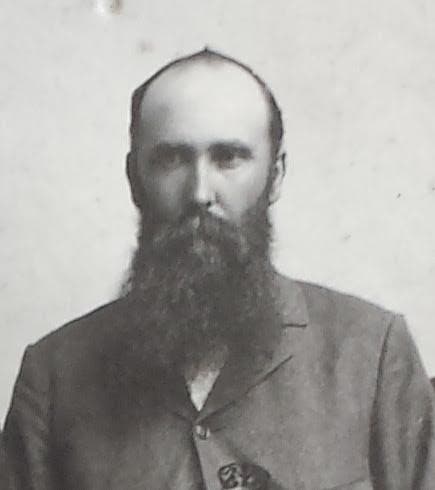
Enos L. Garrett – “Mayor Enos L. Garrett. Photo Courtesy Garrett Family.”
Find out what's happening in Herndonfor free with the latest updates from Patch.
Enos’s brother, Henry, however, was not so lucky. He successfully participated in the Battle of Gettysburg. But later, while serving as a Union Army Captain in the 8th Pennsylvania Cavalry, Henry sustained serious injuries in the Battle of Haw’s Shop in Virginia and spent time in a hospital in Northern Virginia. By 1865 Enos moved to Virginia to help his older brother recover. While in Virginia, Enos met Louisa Caywood.
Louisa Caywood was the daughter of Benjamin and Philena Caywood. The Caywoods were originally from the north – possibly New York by way of Vermont -- and were strong supporters of the Union. Although “gold fever” led many people out to the west coast, the Caywoods decided to cast their lots in Northern Virginia. In around 1850 they relocated and purchased land, mostly in Fairfax County, 200 acres of which now encompasses the southwestern portions of Herndon. Mr. Caywood was a trustee of Herndon’s first church and Herndon’s first public school.
According to the book Memories of Herndon, written by former Herndon resident Lottie Dyer Schneider (b. 1879), Louisa Caywood Garrett (shortly before she married Enos) was in the Ford’s Theatre the night Lincoln was shot in 1865. This is confirmed by Garrett family members who said that Louisa, after the shooting, was picked up and placed on the shoulder of her brother, Aaron Caywood, so that she would not be trampled. Louisa remembered seeing John Wilkes Booth fall as he jumped onto the stage.
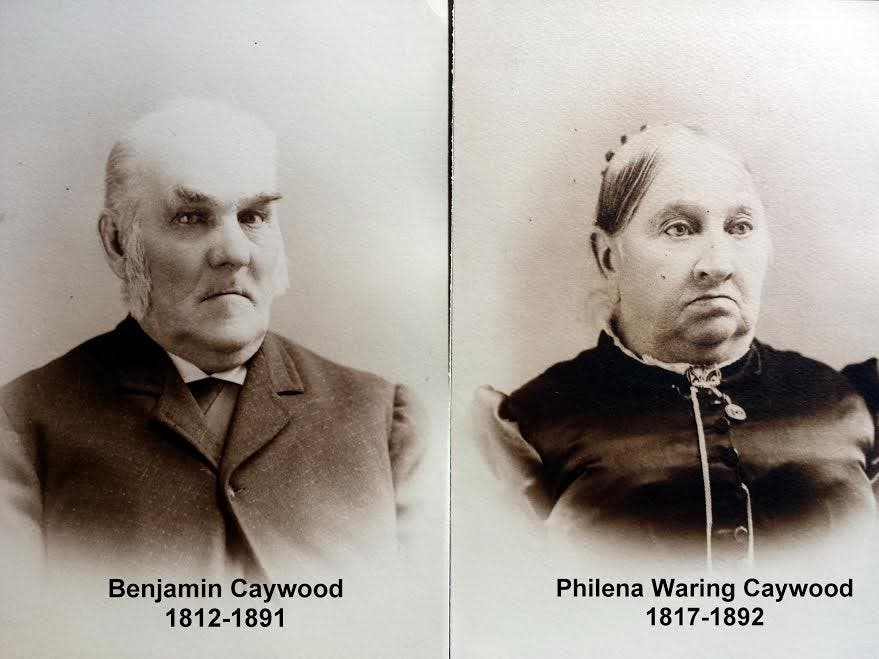
Caywood – “Bejamin & Philena Caywood, prominent Herndon residents and Enos Garrett’s in-laws. Photo Courtesy Garrett Family.”
Enos L. Garrett and Louisa Caywood were married in Herndon’s Methodist Church on Elden Street in 1865. They built a house on the southwest corner of Elden and Center Streets, the current location of the Horn Motor/NAPA parking lot. They would reside in that house for the next fifty years.
Enos and Louisa had several children: Benjamin C., Eddie, Granville, Harry, Sadie, Charles, Arthur and George. Not all the children lived through adulthood. George died as an infant. Arthur died at the age of four. Sadie died at the age of twenty six of a ruptured appendix.
Benjamin C., Eddie, Granville, Harry, and Charles all married and worked in the lumber business, eventually outside of the Herndon area. When Lottie Dyer Schneider wrote her memoir in 1966, she indicated that Granville Garrett had “died some years ago in an automobile accident” and that Harry Garrett “was the only one of the Garrett sons still living.” Harry, the last surviving child of Enos and Louisa, died in 1972. There are old school pictures displayed in Herndon’s Depot museum which show many of the Garrett children in their days at the Herndon School on Center Street.
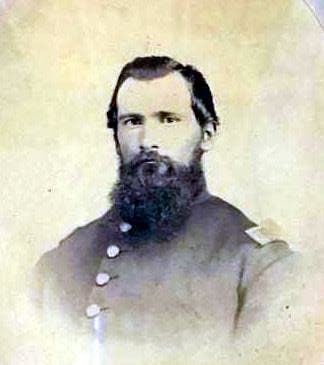
Garrett, Henry – “Mayor Henry Garrett. Photo Courtesy Garrett Family.”
Enos was a wheelwright, wagon maker and blacksmith. He also started a sawmill in the Vale area. Additionally, he served as a director of the Independent Mutual Fire Insurance Company of Fairfax County. He served as the Herndon Postmaster in 1867, succeeding his brother-in-law, Madison Whipple. Enos served as the secretary of Herndon’s Methodist Episcopal Church Sunday School in 1873. He served a short stint on the Town Council 1880 after another Councilman Ancel St. John resigned. Shortly thereafter he became the Town Clerk. Enos was elected as Mayor of Herndon in 1891 after Mayor Dyer resigned.
Enos’s prosperity attracted his siblings – Henry, Benjamin and Tacy – all of whom eventually joined him in the Herndon area, as did their mother, Sarah, several years after their father died in 1870.
Henry H. Garrett was born in 1836. After the war Henry worked for the government and also got into farming. From 1865 to 1876 he was a clerk for the Quartermaster General’s office in Washington, D.C. From 1881 to 1883 he worked as a clerk for the Paymaster. In 1870 he was living in eastern Loudoun County, in the Guilford area (now Sterling). By 1880 he had a farm in Broad Run. Sometime between 1880 and 1900 he moved to Herndon, although still a farmer. His mother, Sarah, died at Henry’s home in 1889.
In 1903 Henry Garrett was elected Mayor of Herndon. The Town records from his years as Mayor are missing, so there is no record of his accomplishments during that time period. A 1910 Herndon census showed that Henry was living on Pine Street. He died of kidney disease that same year.
An obituary in the Fairfax Herald newspaper announced Henry’s death, saying that he was a “well known citizen of Herndon … was always interested in whatever pertained to the material welfare of farmers, and was a good and useful citizen. His death will be received with regret by all who knew him.”

Charles Garrett - “Charles Garrett, one of Enos’s sons, worked as a lumber man. Photo Courtesy Garrett Family.”
Little information can be found on the Garrett sister, Tacy. She was born in 1833 and died in 1891 at the age of 58. She never married and she lived with her parents for most of her life. One Quaker record indicated that she was sick. After her father died, she and her mother, Sarah, lived with a storekeeper in Pennsylvania, acting as a housekeeper and servant. Eventually, Tacy and her mother made their way down south. It is not clear exactly where Tacy lived, but she was known to have bought a piece of her brother Benjamin’s land in Herndon in 1888. That deed said Tacy was “of Washington, D.C.”
Brother Benjamin was born in 1836. He was not known to have served in the Civil War. One descendent said Benjamin had paid $400 in lieu of military service, not an uncommon practice during that war. Federal law allowed able bodied men who were drafted to either serve, find a substitute to serve in their place, or pay a $300 fee.
In 1880 Benjamin was living on Elden Street with his brother, Enos, and was listed a machinist. He was also known to be a carpenter. That year he bought piece of land across the street from the Garrett home, on the northeast corner of Elden and Center Streets. On that land he owned (or possibly co-owned with Enos) a building called “Garrett Hall,” which was a center of social activity in Herndon at the time. Garrett Hall was rented out to various local groups, including The Gleaners who used it for “entertainments” and socials in the 1890s. The hall was also used for Town Council meetings, for Masonic Lodge meetings, and as a school space. It is unknown how long Garrett Hall remained standing and operational, but it is clear that in the late 1800s and in the early 1900s it served as one of the focal points of town, where many educational, governmental and social activities were held.
Benjamin Garrett was elected to the Town Council in 1882. He attended his first meeting in July of that year. However, after being absent from several Town Council meetings his seat on council was declared vacant and was later filled by another candidate. In an 1885 Florida state census, Benjamin and his wife were shown to be living in Florida where he became a fruit farmer. He died in 1923.
Enos became increasingly involved in Herndon, in local business and in government activities. In 1889 he joined with his wife’s brother, Aaron S. Caywood, to become a land agent. In 1896 he and his brother Henry joined with several other prominent Herndon businessmen as incorporators of the Herndon and Aldie Railroad Company. In the early 1900s he was a school trustee and a Delegate to the County Democratic Convention. In 1904 he was named alternate to the State convention. In 1909 he was the Herndon registrar. And, although he accidently chopped off the tip of one of his fingers while using a hand ax, he became one of Herndon’s checkers champions.
Enos Garrett later served again on the Town Council in 1911 and was again elected Mayor in 1913, but he did not finish the final portion of his term due to illness. As a councilman he was an active participant, serving on the Finance, Public Property and Elections committees. Standard business was accomplished, such as improvements of road ways and the addition of sidewalks in different sections of town.
However, the most significant project that was started between 1911 and 1913 was the decision to pursue the introduction of electrical lighting and power for downtown Herndon. The Council worked on a resolution. During Enos’s term as Mayor in 1913, the resolution was completed and the requests for contracts were advertised for the electrical work. Unfortunately, shortly after the advertisements were made, Mayor Garrett suffered a debilitating stroke which left him left him partially paralyzed with his speech affected. His wife, Louisa, acted as his interpreter. The acceptance of a bid for Town electricity occurred under Acting Mayor Magnus T. Wilkins.
Enos could no longer care for himself, so the family closed up their Herndon home and moved in with a son and his wife in Jetersville, Virginia, in Amelia County. After the 1915 stroke, the Garrett home on Elden Street was sold at auction, as were most of its contents. A letter from one of Enos’s grandsons recounted the closing of the Elden Street home and the auction. Enos’s Civil War sword brought $5.00, the highest bid of anything sold. The grandson wanted the service pistol that Enos had carried during the Civil War. The grandson was told he was too young a boy to have the gun. So he stole it, wrapped it in burlap, and threw it under the house, intending to return to the house to retrieve it someday. When he returned in 1950 he could not find it. The whereabouts of the pistol is unknown. The house was torn down sometime between 1957 and 1962.
Enos died in 1926 and his wife Louisa died four years later in 1930. Several members of the Garrett family are buried in Herndon’s Chestnut Grove Cemetery including Captain Henry Garrett and his wife, Katherine; Enos Garrett and his wife, Louisa; Tacy Garrett; and many of the Garrett children.
In many ways the Garrett brothers represent the story of many early Herndon families – a family that settled in Herndon after the war, either out of need or in pursuit of affordable land. They set down roots, raised their families, set up schools and churches, and involved themselves in the business and social well-being of the town and its residents.
-----------------------------------------
About this column: “Remembering Herndon’s History” is a regular Herndon Patch feature offering stories and anecdotes about Herndon’s past. The articles are written by members of the Herndon Historical Society. Barbara Glakas is a member. A complete list of “Remembering Herndon’s History” columns is available on the Historical Society website at www.herndonhistoricalsociety.org.
The Herndon Historical Society operates a small museum that focuses on local history. It is housed in the Herndon Depot in downtown Herndon on Lynn Street and is open every Sunday from noon until 3:00. Visit the Society’s website at www.herndonhistoricalsociety.org, and the Historical Society’s Facebook page at https://www.facebook.com/Hernd... for more information.
Note: The Historical Society is seeking volunteers to help keep the museum open each Sunday. If you have an interest in local history and would like to help, contact HerndonHistoricalSociety@gmail.com.
Main image: Garretts in Herndon, 1903 – “Part of the Garrett family at their Herndon home in 1903. Photo Courtesy Garrett Family.”
Get more local news delivered straight to your inbox. Sign up for free Patch newsletters and alerts.