Community Corner
The Foreign Desk: Taking Exciting New Technologies to Europe
Mason Neck resident Rob Hartwell took brand new medical and green technologies to Britain and Germany. Check out his pictures and tales from Europe.


I recently flew to England and Germany to introduce exciting new medical and green energy technologies to strategic companies in Europe, as well as to see a couple old friends. The trip was successful and memorable, and, having taken a call from Lorton Patch reporter James Cullum about the Eagle Festival while traveling on the Autobahn, he asked me to pen an article on my travels.
Observations on the transit
Find out what's happening in Lortonfor free with the latest updates from Patch.
I flew to London on a freezing Virgin Atlantic Airbus from Dulles. When the flight attendant, a rather large man walked by, the floor shook and creaked, and the outside temperature of -36 degrees was not abated by much of a heating system. A jacket and two blankets did almost nothing to improve the comfort level.
The business
Find out what's happening in Lortonfor free with the latest updates from Patch.
While in London, I took a client via my consultant in England into meet with Alliance Boots - the world’s largest pharmacy. There, we pitched an amazing technology developed at NASA to diagnose diseases including cancer, tuberculosis, diabetes and HIV via the human breath.
My client owns the commercial rights to this technology used on the space shuttle and the Mars rover, and within tbree-to-four years, every pharmacist will be able to give you a 35 second breath test to determine if you need to go see a doctor for any major disease state… and in five to 10 years, for allergies.
We also visited my old friend the Right Honorable Eran Bauer in Lincolnshire, who owns security and green energy businesses (and he lives in an estate house built in the 15th century… where amazingly, my ancestor Sir Robert Hartwell once visited).
Bauer and I co-presented technologies, and I believe Eran’s company will become a key distributor for an amazing Thermovoltaic heat capture generation technology I’m taking around the world. Our Department of Energy estimates this zero carbon footprint heat recycling technology could save 17% of all U.S. electricity costs one day.
Other meetings were set with Bayer AG, the pharmaceutical giant in Leverkusen (in between Dusseldorf and Cologne), Germany.
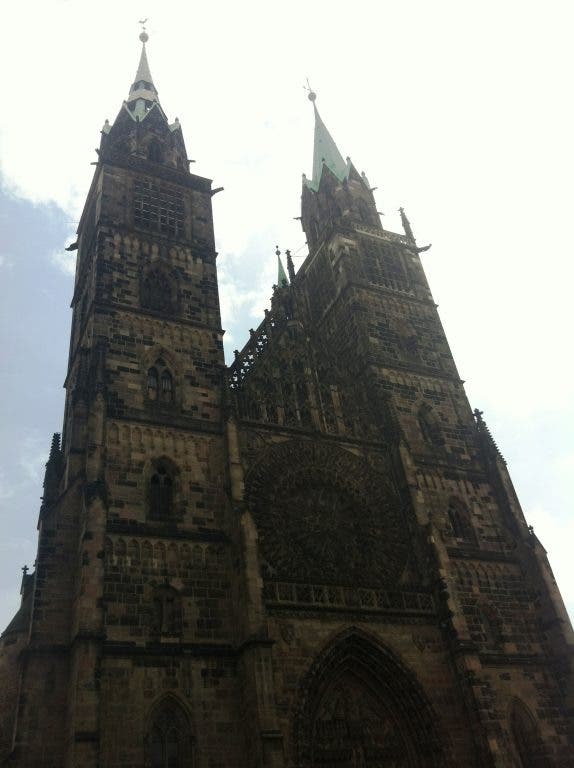
Nurnberg (or Nuremburg in English) is famous for the Nazi criminal war crimes trials after the war. However, it is a walled city with incredible history and beauty. The Pignitz River runs through it with the city center a wide cobblestoned area with thousands of shops and the famous square and Christmas market known for its warm Gluewein in colder months. The watch was invented there… today I still wear a Swiss Tissot watch I bought there in 2004.
Another 4:30 am trip back to meet with Bayer executives who were already working on cancer breath markers and discussions on also using our NASA “Nanobeak” technology for crop science and cardiovascular health ensued.
Going to Europe? Take some bread with you.
Take the airport train from Heathrow as cabs are about $80 and driving in the United Kingdom or Europe is now very expensive.
Parking meters in London are 4 pounds (or about $8) per hour and there is a tax on cars coming into the city.
In Germany, my friend and sometimes consultant Daniela Drescher pays $2500 per year for her car license… a BMW SUV; $2,000 per year for insurance; $400 for Euro pass Autobahn stickers for several countries; and her taxes are nearly $2,000 per year… not to mention gasoline is nearly three times as expensive.
Conversely, the rail system and public transportation is easy and accessible.
I flew round-trip from London to Dusseldorf for the same price of flying from Dulles to London via CheapTickets.com (about $950).
The sights
The Rhine waterfront on a Friday evening rivals Fort Lauderdale at Spring Break. Thousands of young people enjoy fine German been and Rhine wine along a stretch of perhaps 250 bars and cafes.
And on the Rhine, innumerable barges are aided in their pace by an eight knot current (about 10 miles per hour) that is fueled by the melting Alpine snow caps. I later spoke to a cab driver who told me the water is clean enough to swim in but usually far too cold… so perhaps I’ll find a remote spot in August on my return trip.
Finally, my round trip high speed train to Nuremberg and back was delightfully simple. It took about three hours (leg room, Internet, bar service) on a 130 mile-per-hour auto train from Dusseldorf to Nuremberg.
And the autobahns are straight and fast highways with posted speeds exceeding 160 kilometers per hour in some locations (about 80 mph) and with some Porsches, Audi’s and Mercedes (and a few American muscle cars) exceeding 100 mph and more. My companion on the trip, Daniela Drescher, is a fast driver, and I'll admit that my knuckles were white holding on to the above door handle a few times at only 220 kilometers per hour.
The legacy of the trip
It took 36 hours of staying up and watching movies between multiple flights to avoid jetlag, but it was worth it. And the Airbus home was not quite as cold.
Overall it was a great trip, affordable, and Europeans are seeking to invest in the U.S. in a big way, uncertain of their own economic stability and having faith in our freedom and future.
Most importantly, it would be my life’s greatest achievement to help eradicate tuberculosis in the third world and save millions of lives via an instant and affordable diagnosis. On this trip, I may have gotten us half-way there!
(The author is a life-long resident of Mason Neck and is president of Hartwell Capitol Consulting. He is also a Virginia Commissioner of the Interstate Commission on the Potomac River Basin.)