Politics & Government
VA Redistricting Measure Approved By Voters: AP
Virginia voters have approved a redistricting shift that could net Democrats four U.S. House seats ahead of the 2026 midterm elections.


Updated at 9:35 p.m.
Virginia voters have approved the special referendum to redraw the state's Congressional districts, by a margin of about 70,000 votes in the hotly contested election, according to the Associated Press.
With a handful of precincts left to count, about 1.50 million yes votes were cast to 1.43 million no votes, the state election site said.
Find out what's happening in Restonfor free with the latest updates from Patch.
“Virginia voters have spoken, and tonight they approved a temporary measure to push back against a President who claims he is ‘entitled’ to more Republican seats in Congress," said Gov. Abigail Spanberger, once the unofficial results were tallied. "Virginians watched other states go along with those demands without voter input — and we refused to let that stand. We responded the right way: at the ballot box."
The Virginia changes could boost Democrats’ chances of winning four additional U.S. House seats in November’s midterm elections that will decide control of the narrowly divided Congress. The amendment bypasses a bipartisan redistricting commission to allow the use of new districts drawn by Virginia’s Democratic-led General Assembly. But, the state Supreme Court is considering whether the plan is illegal in a case that could make the referendum results meaningless.
Find out what's happening in Restonfor free with the latest updates from Patch.
“I understand the urgency of winning congressional seats as a check on this President, and I look forward to campaigning with candidates across the Commonwealth working to earn Virginians’ trust — and their votes," Spanberger said. "Looking forward, I remain committed to ensuring Virginia's bipartisan redistricting commission gets back to work after the 2030 census, and to protecting the process Virginians voted to create.”
The Virginia redistricting referendum marked a setback for President Donald Trump, who kicked off a national redistricting battle last year by urging Republican officials in Texas to redraw districts. The goal was to help Republicans win more seats in the November elections and hold on to a narrow House majority in the face of political headwinds that typically favor the party out of power during midterm elections.
(See results table below.)
The referendum needed a simple majority to pass. It reads: “Should the Constitution of Virginia be amended to allow the General Assembly to temporarily adopt new congressional districts to restore fairness in the upcoming elections, while ensuring Virginia’s standard redistricting process resumes for all future redistricting after the 2030 census?”
As of 9:37 p.m., the votes stood as follows, according to unofficial results from the Virginia Department of Elections:
| "Yes" vote total | 1,503,058 | 51.18% |
| "No" vote total | 1,433,724 | 48.82% |
133 of 133 localities reporting.
Democrats hold six of Virginia’s 11 congressional seats, but after redistricting is enacted, the party could gain the upper hand in 10 districts, a net pickup of four seats.
More than 1.3 million people cast ballots during the early voting period, which ended on Saturday, according to the non-profit Virginia Public Information Project.
The amendment's passages triggers House Bill 29, implementing a new congressional district map in which a number of GOP leaning districts would be broken up into districts expected to be more friendly to Democrats, at least as forecast by votes in the 2025 gubernatorial election.
It’s the latest move in an escalating redistricting arms race that began in July 2025, when Texas Republican lawmakers redrew their state’s congressional map to favor Republicans at President Trump’s urging.
So far, Republicans believe they can win up to nine more House seats in newly redrawn districts in Texas, Missouri, North Carolina and Ohio. Democrats think they can win up to five more seats in California, where voters approved a similar mid-decade redistricting effort last November, and one more seat under new court-imposed districts in Utah.
Democrats hope to offset the rest of that gap in Virginia, where they decisively flipped 13 seats in the state House and won back the governor’s office last year.
But the back-and-forth battle is continuing in Florida, where the Republican-led Legislature is to convene April 28 for a special session that could result in more favorable congressional districts for Republicans.
The new plan could help Democrats win as many as 10 seats. Five seats are anchored in the Democratic stronghold of northern Virginia, including one stretching out like a lobster to consume Republican-leaning rural areas. Revisions to four other districts across Richmond, southern Virginia and Hampton Roads dilute the voting power of conservative blocs in those areas. And a reshaped district in parts of western Virginia lumps together three Democratic-leaning college towns to offset other Republican voters.
Ads for the “yes to redistricting” campaign featuring former President Barack Obama flooded the airwaves.
In February, Sens. Tim Kaine (D-VA) and Mark Warner (D-VA) criticized Trump for shifting the focus away from lowering costs for families and instead prioritizing redrawing maps. They applauded the temporary measure to preserve a fair playing field and protect Virginia's votes.
"While some states are moving ahead through partisan deals behind closed doors, Virginia is following its constitutional process and allowing voters to render the final judgment," they said.
The new boundaries would be in place in time for November’s midterm congressional elections, where just a handful of seats could determine which party controls the House for the last two years of President Donald Trump’s final term.
Under the proposal, state lawmakers would retain the power to redraw district boundaries until October 2030, when the authority would revert to the state’s nonpartisan redistricting commission.
Voters focus on fairness, with different perspectives
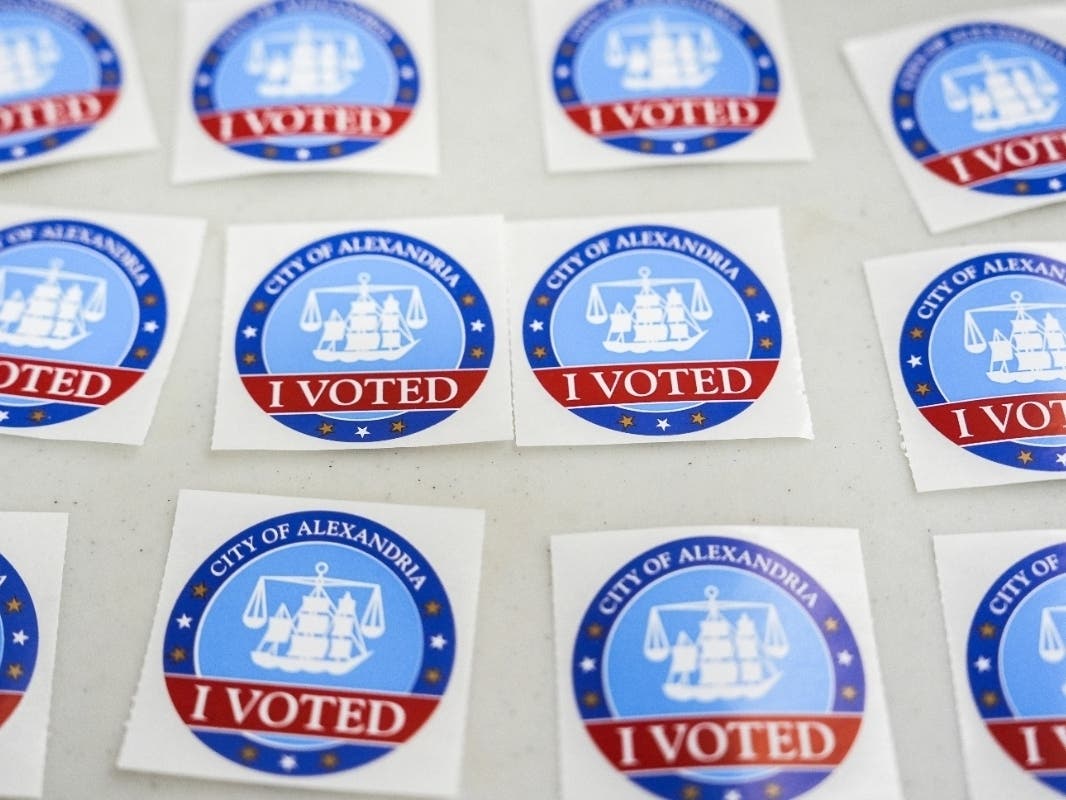
The stream of voters was steady on Tuesday at a recreation center in the Old Town area of Alexandria.
Matt Wallace, 31, said he votes regularly, but this election has additional emphasis.
“I think the redistricting issue across the country is unfortunate, that we’ve had to resort to temporary redistricting in order to sort of alter our elections across the country," he said. Wallace said he voted for the Democratic redistricting amendment "to help balance the scales a bit until things get back to normal.”
Katie Reusch, 35, said she thought the amendment was necessary to respond to the Republicans' redrawing of congressional districts in Texas last year: “You can’t just say we’re in power so we’re changing things so we stay in power,” she said.
But Joanna Miller, 29, said she voted against the redistricting measure, “because I want my vote to count in a fair way.” Miller said she was more concerned about representation in Virginia than trying to offset actions in other states.
“I want my vote and my representation to matter this fall,” she said.
That concern is particularly acute among conservative voters in the state's rural areas, many of which would be drawn into congressional districts that will be dominated by Democratic-leaning cities and suburbs.
Ruth Ann McCartney, voting in the town of South Hill, a few miles north of the North Carolina border, said she cast her ballot against the amendment.
“I look at it more, not really in terms of Republican versus Democrat,” she said. “I look at it more as we don’t have the population as northern Virginia. And as a rural area, we just need to be heard.”
Groups opposed to the measure prominently featured Spanberger and Obama in campaign materials alongside their past quotes critical of gerrymandering.
Groups supporting the proposed amendment far outraised those opposing it, according to an analysis by the nonpartisan Virginia Public Access Project.
Republicans, including House Speaker Mike Johnson and former Virginia Gov. Glenn Youngkin, actively campaigned against it, according to CNN and other reports.
Polling from earlier this month revealed a nearly even split, with 52% of likely voters saying they’re in favor of the measure.
Who gets to vote?
Any voter registered in Virginia can cast a ballot. Eligible voters may register on Election Day.
How many voters are there?
There were 6,386,877 registered voters as of March 1. Virginia voters do not register by party.
How many people actually vote?
About 3.4 million votes were cast in the 2025 general election for Virginia governor, which was the last statewide election. This was about 54% of registered voters at the time.
How much of the vote is cast early or absentee?
About 43% of total votes cast in the 2025 general election for governor were cast early or by absentee ballot.
As of Friday, nearly 1.2 million ballots had already been cast in Tuesday’s election. That’s about 80% of the total advance votes cast in the 2025 gubernatorial election.
When are early and absentee votes released?
Virginia counties and independent cities vary in terms of when they release results from early and absentee voting.
Less than a third of jurisdictions release all or almost all of their early and absentee voting results in their first vote update of the night.
Nearly half the jurisdictions release no early or absentee voting results in the first vote update.
The Associated Press contributed reporting.
Get more local news delivered straight to your inbox. Sign up for free Patch newsletters and alerts.