Crime & Safety
Washington Resold 6K Guns Used In Crimes — Here's What Happened
Since 2010, law enforcement agencies resold thousands of guns used in crimes. Here's how many turned up in new criminal probes in the state.


YAKIMA, WA — After Kyle Juhl was unable to repair his relationship with his fiancee four years ago, he took back his ring, put a Smith & Wesson 9 mm handgun to his head and squeezed the trigger. Juhl's fiancee and her mother ran from the apartment in Yakima and the bullet traveled through a wall, just barely missing a neighbor's head who had bent over to pick up her young son.
The gun Juhl fired had been seized by the Washington State Patrol years before during a criminal probe, but then sold back to the public. Juhl eventually procured the weapon unlawfully.
But while Juhl's case may be cited as a reason not to sell seized guns back to the public — a longtime practice allowed in most states — data suggests such tragedies involving resold guns are extremely rare.
Find out what's happening in Across Washingtonfor free with the latest updates from Patch.
Juhl's gun was among nearly 6,000 firearms used in crimes and then sold by Washington law enforcement agencies since 2010, an Associated Press review found. More than a dozen of those weapons later turned up in new criminal probes within the state, the yearlong AP analysis found. The analysis looked at hundreds of public records to match serial numbers.
The guns were used to threaten people, seized at gang hangouts, uncovered in drug houses, possessed illegally by convicted felons, hidden in a stolen car, and taken from a man who was committed because of erratic behavior.
Find out what's happening in Across Washingtonfor free with the latest updates from Patch.
While those dozen or so guns represent an extremely small percentage of the resold firearms, some police departments say the law shouldn't do anything to put weapons back on the street. The AP did not look at how many of the resold guns figured in crimes committed out of state, so the actual number of misused weapons could be higher.
"We didn't want to be the agency that sold the gun to somebody who uses it in another crime," said Capt. Jeff Schneider of the Yakima Police Department, which sold guns until about a decade ago but now melts them down. He added: "While there is almost an unlimited supply of firearms out there, we don't need to make the problem worse."
Similarly, the International Association of Chiefs of Police said confiscated guns should be destroyed because putting them back in circulation "increases the availability of firearms which could be used again to kill or injure additional police officers and citizens." Also, federal agencies must destroy seized firearms unless they are needed as evidence or being used by the agency.
On the other side of the debate, some law enforcement officials said the selling of guns raises money to purchase crime-fighting equipment, and if the practice were abandoned, people would just buy weapons somewhere else. In fact, a growing number of states from Arizona to North Carolina are passing laws prohibiting agencies from destroying guns.
"These guns are going to be out there," said Sheriff Will Reichardt of Skagit County, Washington. "If I destroy them all, I'm just helping Remington or Winchester's bottom line."
Phyllis Holcomb, a manager with the Kentucky State Police, which oversees Kentucky's gun sale program, said such transactions have helped equip officers with body armor and other gear.
The debate is playing out in Washington state, where the State Patrol is pushing back against a state law that requires the agency to auction off or trade most guns.
The State Patrol hasn't sold any weapons since 2014 and at one point accumulated more than 400 in the hope the Legislature would change the law and let the agency destroy them. Democratic Rep. Tana Senn of Bellevue is sponsoring such a bill.
"I know many of the police chiefs in my district chose not to sell but rather to destroy, and in their own words, 'It's so we can sleep at night,'" Senn told a legislative committee.
The National Rifle Association opposes the plan.
"The police chiefs maybe could sleep better if they went out and apprehended the criminals behind the guns and didn't worry about destroying perfectly legal firearms that are no more easy to purchase than a brand-new firearm at a firearms dealer," NRA spokesman Tom Kwieciak said.
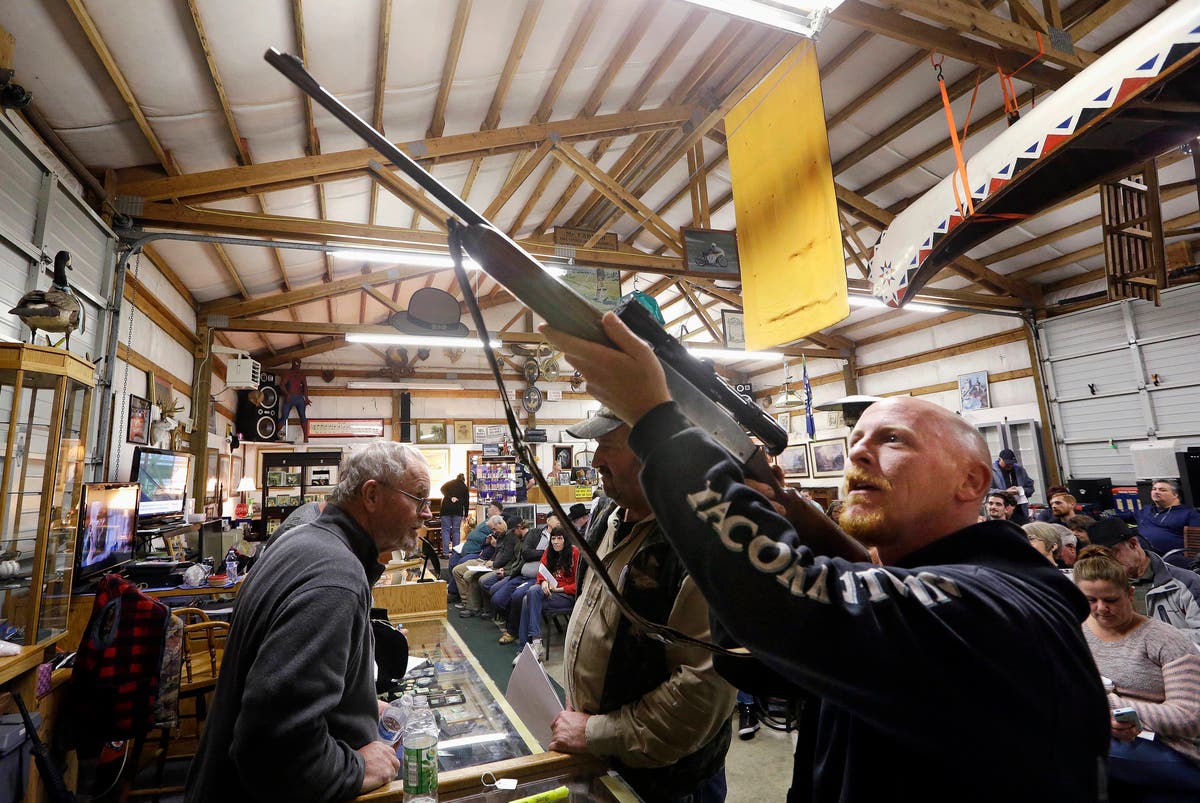
The weapons sold back to the public in Washington include Colt, Glock and Ruger pistols, 12-gauge shotguns, .22-caliber rifles and assault weapons such as AR-15 and SKS rifles. All such sales are handled through federally licensed firearms dealers, including auction houses, pawnshops and sporting goods stores. Before buyers can take their guns home, they must pass an FBI background check.
On a recent Friday night, owner John West of Johnny's Auction House in Rochester, Washington, about 80 miles south of Seattle, launched into his rapid-fire bid-calling to a packed room, selling necklaces and coins. Before he offered up the first police-confiscated gun for sale, he had a warning.
"Straight up," he told the crowd, "if you cannot possess a firearm and you can't pass a background check, just don't even bother bidding."
There is no master list of guns sold by police, so compiling one for Washington state involved dozens of public-records requests to individual agencies. The federal Bureau of Alcohol, Tobacco, Firearms and Explosives keeps track of crime guns but refused to release information from its database, so the AP collected databases from individual agencies and compared them with the sold guns.
One of the guns that ended up in a new police report was a .22-caliber handgun sold by Longview police in 2016. In 2017, a drunken Jesse Brown and a friend armed themselves with the gun and two other weapons, went to a house and threatened two young men they believed were selling drugs, police said.
Longview Police Chief Jim Duscha said that while some resold guns may be used in new crimes, "if they're going to get a weapon, they're going to get a weapon." Selling guns generates money used for drug investigations, he said.
The Seattle Police Department and the sheriff's office in surrounding King County don't sell crime-scene weapons; they hand them over to a foundry to be melted down at no cost to themselves.
For years, the State Patrol traded confiscated firearms to dealers for other gear, and the dealers then would sell the guns to the public. In one exchange in 2013, the State Patrol traded in 159 weapons and got a credit of $27,420, which it then used to buy handguns for the force.
The weapon Juhl used to kill himself was in a batch the State Patrol traded in 2012. It was purchased by a man in Yakima, who sold it to someone else, who then sold it on Craigslist. Juhl's girlfriend told police that's where he acquired it.
Juhl, 24, was not legally permitted to own or possess a gun. He received a bad-conduct discharge from the Army after serving time in prison for using the drug ecstasy and going AWOL for about two months. An Army spokesman said Juhl's criminal history was sent to the FBI's Criminal Justice Information System, but the police detective who handled Juhl's suicide said he checked the FBI's database but didn't find Juhl's convictions.
Below are details about guns sold by law enforcement that were later picked up at crime scenes:
BABY SHOT IN CAR SEAT
The Washington State Patrol traded a batch of crime guns with a firearms dealer in June 2010. The batch included a Lorcin L380 semi-automatic pistol. In April 2015, a gang member shot at a car carrying a couple and their year-old daughter. One of the bullets hit the child in the head and killed her. While searching a home frequented by the suspected shooter and many other gang members, the Kent Police Department found a Lorcin L380 semi-automatic pistol — the gun sold by the State Patrol.
TEXT THREATS
The Pierce County Sheriff's Office in April 2014 sold a list of guns at auction that included a Mossberg 12-gauge shotgun. In October 2016, Jaylen Bolar sent text messages to his mother, threatening to kill her and others. Angela Almo contacted a behavioral health center instead of the police because she knew her son had firearms, including a Mossberg 12-gauge shotgun and she feared he'd be killed in a standoff with authorities.
When the Tacoma police became involved, he denied it, but his aunt confirmed that she, too, had received threats. Robin Olson showed an officer her phone, which contained a message from Bolar asking his uncle to kill him because he was tired of living.
Bolar also threatened to kill a woman who used to be his boss. He was taken into custody, and a search of his home found two firearms in his bedroom. One was the Mossberg shotgun sold by the sheriff's office.
JUVENILES IN STOLEN CAR
The Aberdeen Police Department sold a Lorcin Model L380 pistol in February 2011. In May 2016, the Kent Police Department located a stolen vehicle parked at the Benson Village Apartments and found a gun under the seat — the Lorcin Model L380 pistol sold by Aberdeen police. The three juveniles who stole the car were convicted felons.
DRUNKEN FELON
The Kitsap County Sheriff's Office sold a Hi Point 9mm pistol in March 2014. In October 2015, the Snohomish County Sheriff's Office responded to a 911 call from a woman who said she heard what she thought was a gunshot and went outside to find her daughter's intoxicated boyfriend passed out on the front porch. When deputies arrived, they found a handgun, the Hi Point 9 mm pistol, on the ground next to the man. It was the gun sold by the Kitsap sheriff's office. A search found that the man was a convicted felon who wasn't permitted to have a gun. The deputy put the man in handcuffs and called for medical help.
PROHIBITED FROM HAVING GUN
The Washington State Patrol traded a Lorcin L380 semi-automatic pistol with a firearms dealer in June 2010. In May 2015, the Kent Police Department was investigating a 911 call and encountered four people outside the house. One of the men was prohibited from having a gun, but they found he was carrying a handgun, the Lorcin L380 semi-automatic pistol sold by the State Patrol. The gun had been reported stolen, and he was arrested.
DRUG HOUSE ASSAULT
The Aberdeen Police Department traded a JC Higgins .22-caliber rifle with a firearms dealer in February 2011. In April 2015, the Yakima Police Department responded to a domestic violence assault involving a JC Higgins .22-caliber rifle with the same serial number. The dispute involved an elderly man who had handled his wife roughly and threatened her sister. The man was charged, and police took his firearm. In October 2015, Kent police searched a suspected drug house and arrested several people wanted on felony warrants. They found a .22 caliber rifle — the JC Higgins rifle sold by the Aberdeen police.
FACEBOOK POSTS ABOUT KILLING
The Thurston County Narcotics Task Force sold a Smith & Wesson pistol in August 2012. In October 2013, the Tacoma Police went to the University of Washington, Tacoma to investigate a report of a student who was posting photos of a gun on Facebook and said he had "vivid, colorful dreams of shooting and killing lots of people last night." Police found in his backpack a Smith and Wesson pistol, the one sold by the narcotics task force.
COCAINE PARTY FAVORS
The Bonney Lake Police Department in March 2011 traded a Davis Industries .380-caliber handgun with a firearms dealer who sold it to the public. In February 2012, Kent police stopped a man for an expired registration and discovered baggies of cocaine in his car. He said they were party favors. They also found his concealed handgun, the firearm sold by the police.
THREATS TO KILL
Longview Police Department sold a Davis Industries.22 caliber pistol in August 2016. The Thurston County Sheriff's Office responded to a 911 call in April 2017 from a man who said his father headed to a house with a gun and planned to threaten the occupants. Jesse Brown threatened to kill the men who lived there and was arrested. Officers confiscated his Davis Industries .22 caliber pistol — the one sold by Longview police — and 15 other firearms.
DRUNKEN FATHER
The Thurston County Sheriff's Office sold a Mossberg, Model 590, 12-gauge shotgun in December 2014. In March 2016, the Tacoma police responded to a call by a 12-year-old girl who said she and her sister fled their home because their father was drunk and was threatening to shoot his girlfriend and threatening to beat up one of the girls because he couldn't find his gun. The police later found a Mossberg, Model 590, 12-gauge shotgun — the gun sold by the Sheriff's Office — in the bathtub.
MENTAL HEALTH EMERGENCY
The Thurston County Narcotics Task Force sold a Springfield Armory .40-caliber pistol in December 2013. In February 2014, the Seattle Police Department helped take firearms from a man who was having a mental health emergency and was at the Involuntary Treatment Act court. One of the guns was the Springfield Armory .40-caliber pistol sold by the task force.
By MARTHA BELLISLE, Associated Press
Photo credit: Elaine Thompson/Associated Press; Amber Ross/Yakima Police Department via AP