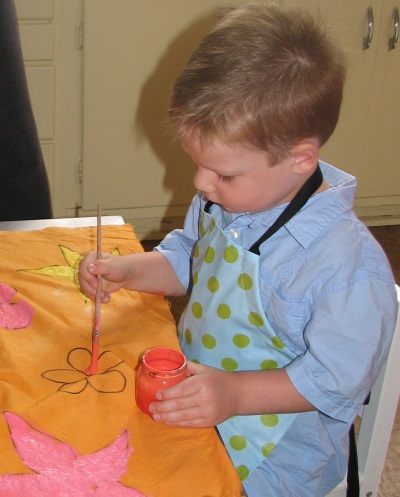


Happy chatter, children drawing, gluing, painting, tracing Sandpaper Letters, counting, spelling words, identifying Geometric Solids, matching small animal models to continents of origin, building wooden cubes, researching parts of the flag, identifying countries of South America, working on a wooden puzzle to identify the parts of the pumpkin – these are some of the activities I observed today in an Early Childhood Montessori classroom of students ages 2 ½ through 5.
What is so special about Montessori schools and how are they different from traditional systems? I am asked these questions frequently and, of course, the simplest answer is “come visit a classroom, see for yourself, and then let’s talk about what you saw.”
What parents typically see is a beautiful and orderly room, where children calmly use learning materials on a table or floor. Children may interact with the materials individually or with friends, and are almost always engaged. Teachers may not be readily seen, as they usually sit with and guide students, giving lessons as needed.
Here are some features of the Montessori classroom that are less obvious:
- Mixed aged, or family groupings in classrooms facilitate social learning.
- Every activity provides for immediate and future learning. For example: when a child traces lines on a folding cloth, their eyes track from left to right in preparation for reading, and their fingers and hands strengthen in preparation for handwriting.
- Children develop confidence and independence in self-care and in academics by using materials that are self-correcting.
- Students become engaged in learning and can practice new concepts again and again or move forward quickly, as they are ready, in both Early Childhood and Elementary learning environments.
- Students enjoy using specialized materials and are intrinsically motivated. They do not expect rewards and praise.
- The use of hands-on materials builds brain development. For example, Sensorial materials provide orderly materials related to math, such as volume, weight, dimension, seriation, and geometry. Nomenclature is provided when the child is ready.
- Structured movement classes support gross motor development, eye-hand, and eye-foot coordination. All are essential for future learning.
- Students construct knowledge about abstract concepts through the use of specialized materials for many subjects children typically do not study, such as, a study of continents, flags of the world, biology, zoology, and physics.
- Children are introduced to academics at a time in their development when learning is effortless.
- Students develop an appreciation of and respect for the natural world and for people around the world through studies of the sciences, geography, and language arts.
I think all of these things are pretty special!