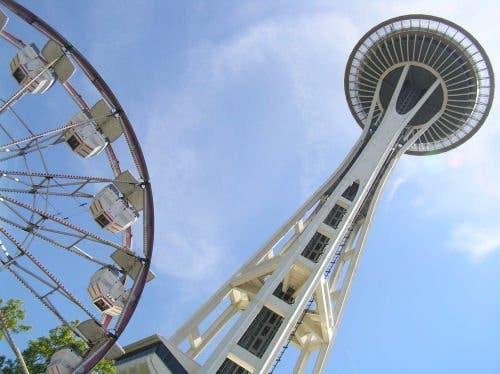
The Northwest Folklife Festival has been going for 40 years! It’s time once again for one of the biggest free festivals and one of the largest folk-arts-oriented festivals of any kind in the country.
It emerged in 1971 from a grand confluence of needs and desires. Seattle Center was looking for events that would better utilize their facilities. The National Park Service wanted to bring its services to the cities and contacted the National Folk Festival Association. The Seattle Folklore Society had the membership, contacts, and a store. Once everything aligned, Philip L. Williams of the SFS went to the City of Seattle and Seattle Center and, with their sponsorship, the Festival was born, debuting Memorial Day weekend, 1972.
From the very first it was an open, inclusive, participatory event, devoted to, as they put it, “the things that people do for their own entertainment and make for their own use.” That has remained true to this day. There were no headliners, no musician was turned down, and they welcomed buskers -- street musicians -- too. Even at the first festival they presented more folk (and folkish) artists -- over 300 -- than any other event in America. That number is now over 6,000!
Find out what's happening in Edmondsfor free with the latest updates from Patch.
While ‘old-time’, rural, and often much more socio-politically conservative musicians were instrumental (pun intended) in preserving the wide variety of traditional musical forms the festival celebrated, and celebrates to this day, the counterculture was the other driving force for its founding and success. Folklife has always had an underlying tension, which, happily, has served to keep it real and vital.
The hippies (an exasperatingly maligned group) and their allies approached folk music as rediscovery, in reaction or response to the slick, industrial music scene. These were the same people who were trying to fight pollution, simplify their lives, and reassess society’s acquisitiveness and mercenary attitudes.
Find out what's happening in Edmondsfor free with the latest updates from Patch.
The two groups had the foresight and maturity to embrace each other in the interest of the festival.
It hasn’t been all rosy all the time. Financial problems brought on by increasing costs nearly shut them down in 1998, and the recent economic conditions have hit them badly, but they successfully restructured. Folklife is now free in name only, as while they won’t toss you out for not paying, they really, really want you to buy a button per person per day. I don’t begrudge it; I’m just saying.
About 10 years ago, Folklife nearly blew away with a big late-spring storm. In 2007, the crowd subdued a man after he shot two people. Still, it is one of the best things about Seattle and the region. I’ve been to perhaps 35 of the 40 Festivals and every time find it a wondrous, blissful experience.
Why am I writing a ‘Where We Live’ article on this? Because they have always been conscious of their impacts, adopting recycling early and earnestly, reducing litter, etc. And because sustainability involves more than the natural environment, it’s about how we treat others. Folklife has always been a sterling example of how a multitude of people from all cultures and social strata can not only get along, but truly celebrate our differences and our underlying commonality.
So join us -- me and a quarter-million of my friends -- down at the Seattle Center through about 8:30 PM Monday.