Community Corner
Remembering Memorial Day Through Movies
Realistic images and stories changed the way we looked at war.
Yesterday was Memorial Day, and I’m still remembering.
My dad was in World War II, and I know many of you have had dads in other conflicts, including the Korean and Vietnam wars, as well as in Iraq and Afghanistan.
Of course, Memorial Day is about honoring the men and women who gave their lives fighting for their country. My dad survived the war, even though his experiences in a German POW camp thrilled me two decades later as a kid and scared the hell out of me as a grownup.
Find out what's happening in Edmondsfor free with the latest updates from Patch.
I also think of dad on Veterans Day in November, but lately have been reminiscing about him on Memorial Day as well. Maybe because it’s been 12 years since he’s been gone now.
Like many boys growing up, war was glamorous. John Wayne and G.I. Joe. I think part of that came from the fact that veterans who came home from WWII and Korea threw themselves into new lives, with families, and didn’t talk much about the war.
Find out what's happening in Edmondsfor free with the latest updates from Patch.
I always knew war as about death and injuries, of course. But the veracity of war didn’t really hit me and a lot of others until war movies become more realistic. It’s hard to sit through The Longest Day after witnessing Saving Private Ryan’s emotionally draining realism.
In honor of my dad, who went through war, and all of the men and women who died in U.S. conflicts, I want to list four war movies that impacted me. These are all more than simply big-screen entertainment. They were game-changers in their time, forcing those who watched them—especially those who’ve never experienced war—to gain a deeper understanding of shared sacrifices.
Here are the movies, in chronological order:
Apocalypse Now (1979): Francis Ford Coppola’s take on Joseph Conrad’s novella Heart of Darkness is a movie that gets better with age. Since the plot centers of the killing of gone-native Col. Kurtz, there isn’t much here about the honor and sacrifice of fighting for your country. At one point, the character Chef is incredulous when discovering his mission: “What? Oh, that's typical! … I'm short, and we gotta go up there so you can kill one of our own guys? … I thought you were going in there to blow up a bridge, or some (expletive) railroad tracks or something.”
This movie threw light on how crazy and misguided the Vietnam War was—in spite of its original intentions—with its raw language, realistic locales and senseless deaths.
Das Boot (1981): Wofgang Peterson’s epic WWII film about a German captain and his crew under attack vividly displayed the claustrophic terror of submarines. Although earlier movies like Tora! Tora! Tora! allowed U.S. audiences to witness the Pearl Harbor attack from the other side, Das Boot absolutely has to be seen in its original form, in German with English subtitles, to appreciate it fully.
The movie went beyond the portraying of stereotypically evil Germans to depict ordinary young men doing what ordered. Herzog’s genius was actually making viewers feel they were in a metal tube, to feel helplessness and a tightening in the chest as yet another depth charge floated silently down to its target.
Platoon (1986): This Oscar-winning movie from Oliver Stone changed my life. It was the first to really show the horror of war in such gruesome detail. I remember my stomach churning during the scene where Bunny (Kevin Dillon) is killed when a Vietcong solider sticks a rifle in his mouth and pulls the trigger. (Bunny himself, in an earlier scene, had killed a defenseless villager.) During the same skirmish, Junior (Reggie Johnson) get a bayonet in stomach while the camera focuses on his surprised look.
At the same time, the camaraderie of the grunts—especially during a scene where they dance to “Tracks of My Tears” during down time—was hard to ignore and even inspiring, like, hey, I want to do that too. Weird.
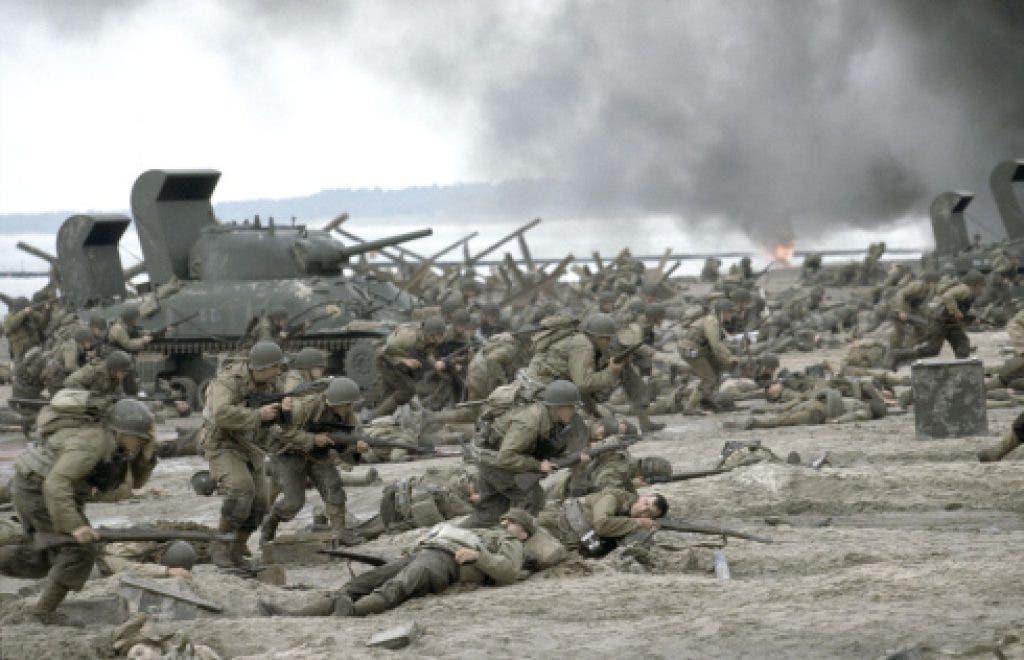
Saving Private Ryan (1998): Steven Spielberg’s account of D-Day and its aftermath was so realistic that it forced many to fully appreciate the sacrifice of ordinary Americans during WWII. I remembering seeing in the theater for the first time; there had been so much written about the first 20 minutes—the landing on Omaha Beach—that everyone in the theater was already on edge. The carnage was beyond realistic, the suffering horrible, the heroics inspiring.
Just as bad was the bookend scene at the movie’s end, when Capt. Miller (Tom Hanks) and his platoon engage in a largely hand-to-hand street fight.
How could you not put yourself in Private Mellish’s (Adam Goldberg) place when he is slowly stabbed to death? Mellish cries out “Wait, wait, wait,” like the situation’s conclusion was something that two reasonable men could agree on. Mellish’s killer replies in German, which is not translated on screen, so Mellish didn’t realize what he was saying:
“Give up, you don't stand a chance. Let's end this here. It will be easier for you, much easier. You’ll see it will be over quickly.”
Other realistic war movies worth watching: The Killing Fields, The Patriot, Schindler's List, Rescue Dawn, Zulu Dawn, Ran, Glory, Braveheart, Gallipoli, The Hurt Locker, Jarhead, Full Metal Jacket, The Thin Red Line, Inglourious Basterds, Life Is Beautiful, U-571.