Community Corner
Kids at the Fair: Then and Now
These photos from the fair in 1923 raise some interesting questions. What seemed, at first, like a quirky piece of history led me to a deeper look into what shapes a society.


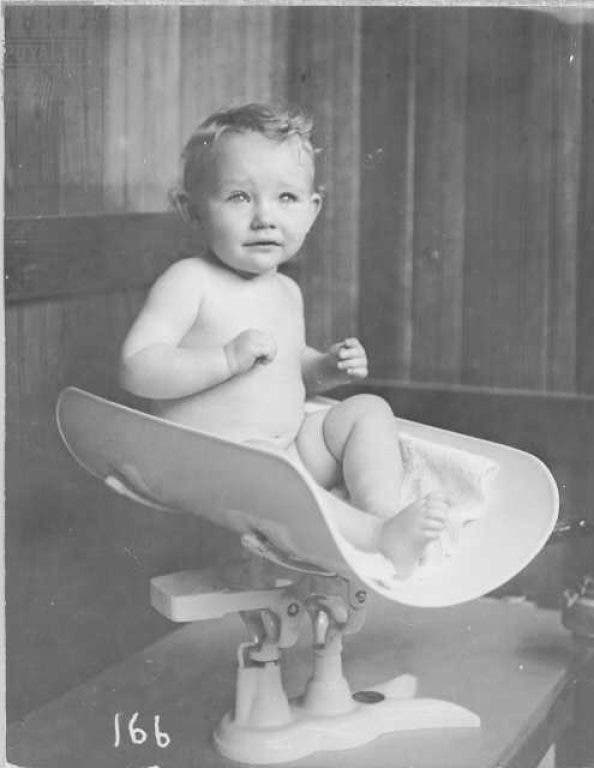

During my search for interesting topics for this week's column, I came across one of the most thought-provoking photos I have seen in the Northwest Room at the Tacoma Public Library. With the Spring Fair this weekend, this piece of local fair history is fitting. What is perhaps more fitting is the question of what we may be subjecting our children to today that will be looked at differently 100 years from now.
The pictues shown were taken on Oct. 2, 1923, when more than 700 children (ages 6 months to 2 years) were brought from all over Pierce and King counties to the Western Washington Fair for the Better Baby Contest. Forty doctors and nurses were on hand to evaluate each child according to “scientific standards” of the time. Certificates and medals were given to 61 of these children, considered the "best babies" of the year. Alice Rose McKinnon from Enumclaw turned 1 the same week she was named "Best Baby" after receiving the contest's only perfect score.
My first instinct was to check the schedule of events for the fair this weekend to make sure there was no remnants of this contest. I was happy to see that, in fact, there will only be judging of poultry and other livestock. I started looking elsewhere to see what this better baby business was all about and was interested to find that these contests were very popular in the 1920s in county fairs across the U.S. Many were even funded by the American Red Cross.
Find out what's happening in Enumclawfor free with the latest updates from Patch.
These contests were fledgling attempts at infant and maternal welfare programs. Just after World War I, factories, farms and other industries were heavily focused on making their businesses more efficient. At the same time, other organizations were looking to increase the efficiency of humans to make the country stronger. The contests were popular for more than a decade and even grew into “Fitter Family” contests in many states, although I couldn’t find any evidence that there had been family contests in our local fair.
Children were judged very similarly to the way livestock will be judged this weekend. Scores were awarded based on weight, height and other measurements, including temperament. I cannot possibly imagine the poor mother or father whose child was not given an award (consider there were about 640 babies that were sent home this way) not to mention the baby with the lowest score. It certainly gives “keeping up with the Joneses” a whole new meaning.
Find out what's happening in Enumclawfor free with the latest updates from Patch.
The high infant mortality rate during the 1920’s was also a factor in creating these contests. Each of the 700 babies at the 1923 contest in Puyallup received a free health check-up. That could account for the high participation rate, as well as parents' willingness to wait in line for hours with their naked babies in early October.
These questions led my research to the darker side of these contests, eugenics. Eugenics is the study or practice of “improving” human genetics through selective breeding and/or forced sterilization. These horrific practices are most commonly associated with Nazi Germany, but have roots as early as 1880 in the U.S. Organizations such as the American Breeder’s Association were funded by wealthy and politically powerful foundations owned by famous families, such as the Rockefellers, Carnegies and Kelloggs. The ABA actively researched and promoted a so-called scientifically ideal human. Not surprisingly, considering the time, the ideal human was white and Anglo-Saxon in origin. The ABA and other eugenics organizations were among the first to fund political movements working toward prohibiting immigration, which had been uninhibited for the most part up to this point. The movement went so far as to recommend forced sterilization for “the unfit.” (I know … I was shocked, too!)
The “then” part of this story is shocking, but what about the “now”? This best baby photo is less than 90 years old and these mothers with naked babies are standing on the same soil many of us will walk this weekend with our own children.
What might we be doing now that we will look back on in 100 years with horrified faces? Could it be the standardized tests in schools or the percentile charts at the well-baby visits? Remember during the 80s and even early 90s when children rode in the front seat without seat belts?
On a deeper note, what political movements in our current landscape will affect our society? The federal budget debate mirrors the choices our state, county and even city governments are poised to make. Will they fund programs or cut them, and what will that mean for the future? Only time will tell which of our generation's actions will look drastic down the line.
Get more local news delivered straight to your inbox. Sign up for free Patch newsletters and alerts.