Politics & Government
Turf War Between City, School District Disrupts Opening of New Enumclaw Field
Replacement costs in the future divide local leaders.
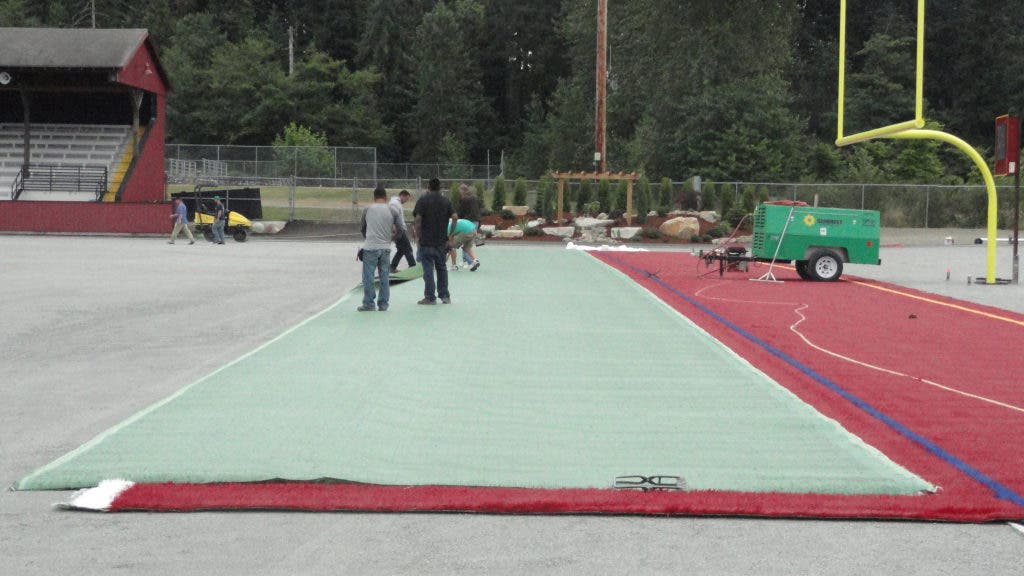
When Enumclaw decided to build a new Astroturf field, it only seemed natural turf wars might start up between the Hornets and local rivals White River and Black Diamond high schools.
But the first turf war taking place is between Enumclaw’s school district and city government.
At issue is who gets to control the facility. The key conflict is over how to replace the turf once it wears out in 10 to 12 years. If a decision isn’t made soon, the school district has hinted it conceivably could play its first home game Sept. 2 against Yelm somewhere else.
Find out what's happening in Enumclawfor free with the latest updates from Patch.
The city plans to discuss the issue again tonight, Aug. 15, in a work session starting at 7 at City Hall.
School board president Chris VanHoof is obviously disgusted with the impasse. He said it’s a shame that when the community should be
celebrating this beautiful field and the effort that went into getting it that now this bickering is going on.
Find out what's happening in Enumclawfor free with the latest updates from Patch.
“This is a time to celebrate, not be divided,” he said at a recent City Council meeting.
City Councilman Jim Hogan reminded everyone at the meeting that the new field is a gift made possible by donations. Local taxpayers did not foot the bill. But a plan needs to be in place now to maintain and replace it.
Otherwise, “in ten years we’ll lock the gates,” he said, adding that operating a turf field is not a core function of a city.
A memorandum from city attorney Mike Reynolds explains its point of view.
The city decided leasing the facility to the school district was not in its best interest because that could hurt the city-owned Expo Center’s
use of the field.
The memo goes on to say that the city owns the Expo Center and undertook the field conversion at the request of the school district. The city won’t have the funds to maintain and replace the field so the school district needs to pay a fee estimated at more than $50,000 a year. The district would give a schedule to the city by July 1 each year, saying when it needed the field. The city would make sure those dates didn’t conflict with Expo Center events.
The city does not want to have to put taxpayer money into the field. It agreed to the effort because grants and donations are paying for the
$900,000 update.
A letter from schools superintendent Mike Nelson explains its
point of view.
It says the school district doesn’t like having to pay 100 percent of the costs of maintenance and turf replacement without having some control of the facility. It wants something like a 25-year lease to make sure it can recover some of its costs. Sure, under the city’s plan third-party fees would help some, but the school district would have no say in the amount charged.
Schools also wanted their fee lowered, as it was so much more than what third-party nonprofits would pay. The city counters that third parties, such as junior football leagues, should be charged less because of their inability to pay.
The school district says if it doesn’t get the lease it wants to pay a user fee similar to what is charged at other turf fields in the area. But that would be less than what is needed for maintenance and
replacement costs.
Hogan recommended against charging too much. “Nobody’s going to use it,” he said.
Reynolds responded, “We are not going to price ourselves out of the market.”
If an agreement isn’t reached, the school district has said it could be cheaper to play somewhere else. To keep that from happening, some ideas were discussed to break the impasse.
One is to come up with a preliminary agreement so the opening game can take place, then decide on a solution later.
Another is to wait a few years before worrying about turf replacement costs and then decide.
Another is to wait until the turf wears out and then look for grants and donations again to pay for a new synthetic field at that time.
Hogan recommended a possible middle ground, with a goal of recovering 50 percent to 75 percent of replacement costs at the end of the 10 years.
City Councilman Richard Elfers spoke up at the meeting for city taxpayers, which is a smaller group than is in the school district.
“We as a city do not want to be responsible for the costs. We need to be careful not to let that happen,” he said.
After 90 minutes of discussion council members asked city staff to provide them with needed information to take up the issue again at a
work session.
“Because of this division we need to figure out what our intentions are,” City Councilman Sean Krebs said.