Politics & Government
The Cost of Looking Away
Why Democrats can't afford to ignore attacks on trans people. And why the right keeps manufacturing evidence that doesn't hold up.



“Don't you hate it when those facts interrupt?
So much more fun just to make it all up.”
- Living Colour, “Mind Your Own Business”
As public opinion continues shifting toward broader social acceptance, it is getting harder for radical conservatives to manufacture outrage to feed their culture wars. It wasn’t too long ago that they had convinced many Americans to fear that same‑sex marriage would cause the collapse of society. Still, once those rights were fully granted, it quickly became clear that the fear‑mongering had been greatly overblown. Almost eleven years after Obergefell v. Hodges granted marriage equality, no one is being forced to marry someone of the same gender, and heterosexual marriages are ending at roughly the same rate as before.
Where the Right has had success in driving today's political agenda is with the subject of how many rights transgender people should have to express themselves in society openly. While claiming that their concerns are not based on bigotry, they have applauded as the Trump administration continues to target this group. While citing no data to support their actions, the administration has banned transgender people from serving in the military and restricted access to gender‑affirming health care. To make future fact-based policymaking more difficult, the administration has eliminated questions about gender identity from federal surveys and data collection.
Find out what's happening in Fife Heightsfor free with the latest updates from Patch.
One of the reasons anti-trans rhetoric has been able to gain traction is because the idea of not feeling comfortable with the gender identity assigned at birth is a foreign concept to the vast majority of people. I'm a card-carrying liberal, and I can't claim to understand their experience. The difference between me and those espousing anti-trans rhetoric is that I understand that a person expressing themselves as a gender different from the one assigned to them at birth does not affect me in any way.
Some of the battles picked in the culture wars against trans people make kindergartners on the playground look mature. It takes the same amount of effort to say "he," "she," or “they.” Why not follow the golden rule and refer to someone as they would prefer to be addressed? How does that possibly harm you?
Find out what's happening in Fife Heightsfor free with the latest updates from Patch.
As a side note, the only pronouns that give me pause are "they/them." While Star Trek: Discovery had a scene that helped me understand the reason behind its use, it still bumps up against my grammar sensibilities. However, if someone asks me to call them "they/them," that is what they will be called. It's simply a matter of respect.
It is also bewildering to me that so much attention is paid to the clothing one decides to wear, as if styles of clothing are something encoded in our DNA. So much of gender expression is socially constructed, but many pretend that it is a crime against nature for a trans man to bind his breasts or for a trans woman to wear colorful nail polish.
Social norms surrounding clothing and appearance are also constantly shifting. There was a time not so long ago when women did not wear pants, and men did not have long hair; both are commonplace now. I took the earring out of my pierced ear when it became apparent that my act of rebellion was now mainstream.
My daughter once pulled me aside to point out that a man was wearing colorful nail polish: “Men only wear black nail polish, right, Dad?”
A man wearing any color nail polish was outside what many people considered “normal,” but growing up around my musician friends had set up a different expectation for my daughter. Normal is always relative and always learned.
But the most potent weapon in the anti-trans arsenal may be the ability to generate fear. There seems to be a widespread belief that allowing people to use the bathroom of the gender that they identify as will result in men being able to access these areas to rape women; a fear that is not supported by the evidence. Studies comparing jurisdictions with and without trans-inclusive bathroom laws show no difference in the rate of sexual offenses or safety incidents in restrooms or locker rooms.
What the statistics do show is that not having these laws endangers the safety of trans people. A trans person is over four times more likely than cisgender people to be a victim of violence, and about ten percent of transgender people report being physically attacked while attempting to use a public bathroom. Badly written laws forcing someone to use the bathroom of the gender assigned to them at birth put trans men at risk, as they are forced to use the women's room even though they may present as masculine. Even in the best of circumstances, this may quickly spiral into chaos.
Because what happens in bathrooms is extremely personal, these spaces are ripe for embarrassing interactions. While waiting to help my wife outside a restaurant bathroom in a crowded hallway, I tried to help someone by pointing out which bathroom they were about to enter, and I accidentally misgendered them. It was immediately apparent that this had made the other person uncomfortable, and I felt awful. Laws restricting access to bathrooms just add opportunities for those with unkind intentions.
When fear alone is not enough, those marketing transphobia will add shock to the mix. They do this most effectively by redefining "Gender Affirming Health care" to falsely mean castration or other forms of genital mutilation. This obscures the fact that, in reality, only about 25% of transgender people have any type of reassignment surgery, and it is far more likely to be top or chest surgery. The vast majority are satisfied with expressing themselves without going under the knife.
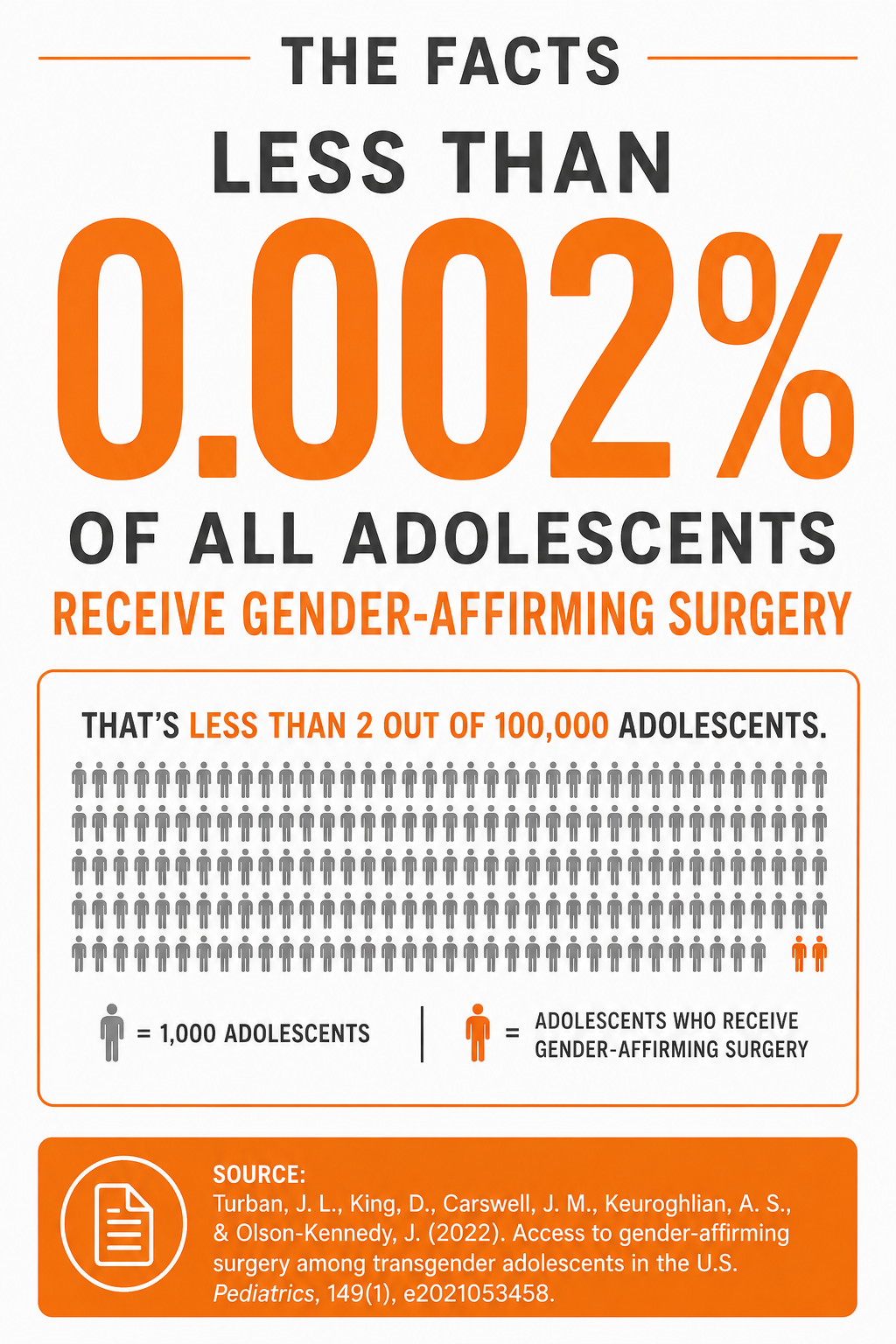
To amplify the outrage, scenarios have been created that have too many people believing that schools, which can't even dispense a Tylenol without parental permission, are secretly performing gender‑assignment surgery without parents’ knowledge or consent. This narrative also flies in the face of real‑life data showing that genital reassignment surgery is rare to nonexistent for minors:
- Children aged 12 and under: 0%
- Adolescents aged 13 to 14: 0.0001%
- Older teens aged 15 to 17: 0.0021%
As with adults, the vast majority (96.4%) of surgeries are chest procedures, and even that number is inflated by including cisgender adolescent boys treated for the overdevelopment of male breast tissue. This is a reminder that sometimes gender‑affirming care is needed to affirm the gender one was assigned at birth.
With the facts working against them, those opposed to rights for trans people are left with stunts in their arsenal. Taking the lead on this in recent headlines is Enes Kanter Freedom, a former NBA player who was cut loose from the league after eleven seasons. Mocking the circumstances of trans people, he has stated that he now identifies as female for the purposes of playing basketball and has declared himself eligible for the draft.
Smartly, the WNBA declined to play ball and simply stated that he will not be eligible, avoiding any further explanation that would only serve to fuel the manufactured controversy. This has not stopped others from trying to add their own kindling, including some who have brought their protests into the arena.
After an incident where a team co-owner berated fans holding signs opposing transgender athletes competing in girls' and women's sports and another where fans were told to cover shirts expressing their viewpoints on the subject, an anti-trans law firm sent a warning letter to the WNBA commissioner stating that the league’s actions could result in legal filings. The lawyer says that, in her opinion, the fans' civil liberties were violated, stating, apparently without sarcasm:
"The fans should be able to go and be respected in voicing their viewpoints."
The hypocrisy of this statement exposes the weakness of her argument. Trans people would simply like to live their lives and be respected for who they are. Shouldn’t that be given at least as much consideration as those who want to spread their bigotry?
Back in the early 1990s, when I used to help escort patients into abortion clinics that were being blockaded by right-wing groups, I witnessed an interaction that has stuck with me for all of these years. There was a trans woman who dressed like a woman going to a Black church for Easter service. As she stood with her arms interlocked with other people defending the clinic, she struck up a conversation with one of the people on the opposing side.
At some point, the right‑wing protester referred to the way she presented herself as a “choice.” Her voice was full of emotion as she replied:
“You think this is a choice? Do you really think I would choose to dress in a way that puts me in danger of physical violence? That I would choose to make every aspect of my life more difficult? I would gladly choose to not be this way, but this is who I am.”
Of course, I think about this interaction when people like Kanter Freedom grab the headlines with actions they claim are in defense of women’s rights, but simply are an accepted form of bigotry. But the memory really hits me when I hear strategists preach that Democrats should avoid this issue because it supposedly loses them votes with middle America, as if it is all right to look the other way when a group is under attack.
For the most part, Democrats did not choose this fight, but it is one that conservatives have learned to use to their advantage. Instead of letting these attacks against a vulnerable group go unanswered, the party needs to find a way to cut through the fear and expose the lies being told. The radical right doesn’t have to make the effort to understand trans people, but they shouldn’t be allowed to spread fear or prevent them from openly expressing themselves for who they are.
Carl Petersen is a former Green Party candidate for the LAUSD School Board and a longtime advocate for public education and special needs families. Now based in Washington State, he writes about politics, culture, and their intersections at TheDifrntDrmr.