Health & Fitness
King County Warns Of Coronavirus Trends Heading Into The Holidays
"The virus clearly has the home field advantage right now, and we need to step up our game big time."


SEATTLE, WA — An upward trend in coronavirus activity, which King County officials have warned of since before fall began, is still moving in the wrong direction, renewing public health concerns heading into the holidays.
Dr. Jeff Duchin, health officer for King County, hosted a news conference Thursday, as case counts and hospitalizations continue to climb, and the 14-day positivity rate in the state's most populous county nears 3 percent.
"We clearly need a COVID-19 reboot," Duchin said. "We expected it would be more challenging to manage COVID-19 during the fall and winter, as we spend more time indoors and the environment changes, but the virus clearly has the home field advantage right now, and we need to step up our game big time."
Find out what's happening in Kirklandfor free with the latest updates from Patch.
In mid-October, Duchin said there could be "a very dark time ahead," if King County's trajectory continued. On Thursday alone, the county reported 221 new cases, nearing figures seen during the first two peaks of the outbreak. For more than five weeks, the daily number of new illnesses has steadily risen. Officials say the higher counts are not merely the result of more testing and indicate a clear increase in transmission.
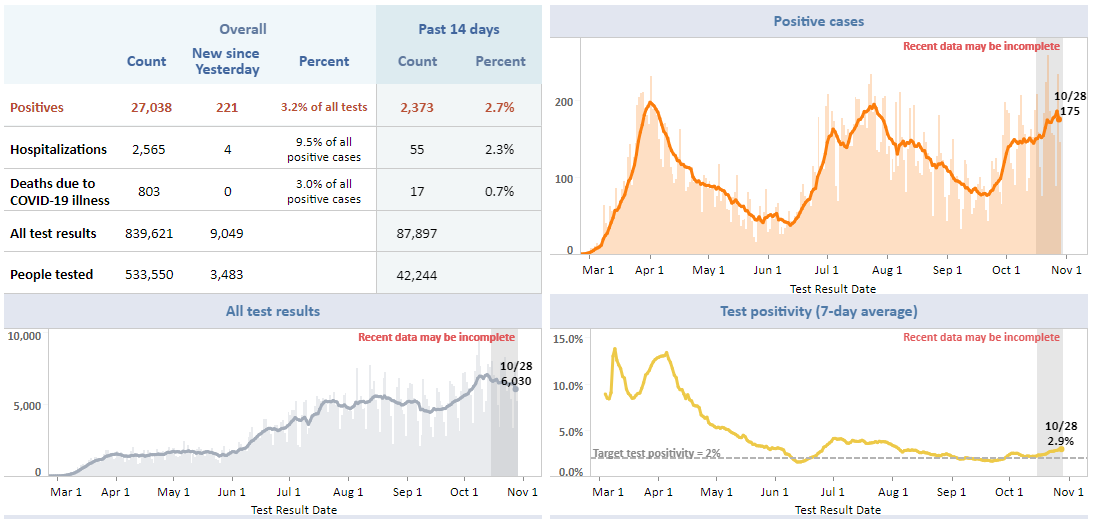
"We are now averaging between 170 and 190 cases reported each day over the past week, which is about two and a half times what we saw in late September," Duchin said. "This is putting a significant amount of stress on our public health case and contact tracing, and the timeliness of that work."
Find out what's happening in Kirklandfor free with the latest updates from Patch.
While King County's health care system is not currently overwhelmed, and there has yet to be a spike in deaths, public health officials have noted an uptick in hospitalizations, including 138 recorded over the last month. Recent surges seen in other parts of the country have local public health authorities wary of what can happen when a surge grows beyond control.
"I'm particularly concerned about the spread of COVID-19 to more people in our community who have underlying health conditions, and older adults who are at higher risk for severe illness and death, and the impact that will have on our health care system," Duchin said. "Across the country, we're seeing surges in serious illnesses that are stressing hospitals. Wisconsin and Texas are setting up field hospitals and Utah hospitals are talking about the need to ration life-saving care. We don't want to go there."
In King County, health officials are particularly concerned over the broad range of infection sources recorded in recent weeks. According to Duchin, at least 37 percent of exposures in the last two weeks were community-acquired or travel-related. About a quarter of illnesses were acquired from within the household and another quarter linked to workplaces.
Exactly where community transmissions occur can vary widely, encompassing everything from bar and restaurant visits to large parties and smaller get-togethers among friends and family.
"When we've got as much transmission and as many cases occurring each day as we do currently, the opportunity for spread just about everywhere is real," Duchin said. "That's why I say expect it where you don't expect it. You can't tell who is carrying COVID from how they look or how they feel, because this disease can be spread before someone becomes symptomatic."
Related: How To Celebrate Halloween Safely During The Coronavirus Pandemic
Duchin also reiterated the importance of limiting all social interactions outside the household, especially when they take place indoors.
"Just about every interaction we have with one another at this point is a potential risk," Duchin said. "But the risk is greatest where there are more people gathering, for longer times, indoors and without using masks."
As the holidays approach, beginning with Halloween this weekend, public health experts are worried that just a few missteps could lead to a surge in cases that will outpace anything seen previously. The potential for that is real, Duchin said, but changing course is still possible if the community acts quickly.
"I feel that we're heading down a treacherous path, and the longer we wait, the more difficult it gets to reverse the trajectory of our increasing outbreak," Duchin said. "The upcoming holiday season greatly adds to the risk and the importance of taking action now. We don't want to let this window of opportunity, to influence the outbreak in a favorable way, close."
"We know what works to stop the spread of COVID-19, and what to do as individuals and as a community to determine the course of our outbreak. It requires that we all increase our resolve and support to protect ourselves and one another. COVID-fatigue and easing up on the necessary precautions are a recipe for failure.
Public health reminders from Dr. Jeff Duchin:
- You can't tell who has COVID-19 based on appearance. The illness often spreads from people before they look or feel ill.
- Limit the number of all activities outside the home, including the amount and length of contact with others.
- Avoid crowded indoor settings.
- COVID-19 spreads easily indoors, especially in enclosed spaces without good ventilation. That risk builds the longer time is spent in such settings and even further when masks are not worn.
- Face coverings are especially important indoors, even when with friends and family from outside the immediate household, and including when 6 feet apart.
- Open windows and doors to improve ventilation whenever possible.
- Maintain proper hand-washing, sanitization practice and regular cleaning of high-touch areas.
- More: Reducing coronavirus risk indoors: recommendations for fall and winter
With major winter holidays on the horizon, health officials are calling on everyone to consider the risk of infection associated with traditional festivities and travel.
"The holidays pose a tremendous risk to accelerate this outbreak if people get together in large groups, spend a lot of time together indoors, then come home to their loved ones, their own household members and friends, bringing the virus back," Duchin said. "The safest thing is to limit it to your household. If you are going to have holiday gatherings with others, make them as small as possible."
While quarantining for 14 days and getting tested at the end of the period can prove effective in ruling out infection in the short-term, Duchin said traveling to see family and friends can reintroduce the risk of exposure while in transit.
"It's not a good time this year for family gatherings, unfortunately, in the middle of a very large and growing outbreak," Duchin said. "I know it's a terrible stress for many of us to be apart from our families, our loved ones, I feel that as well. This situation is not going to last forever, but this is a really good year if you could possibly skip it or make it smaller."
When asked if new lockdowns, as seen recently in France in Germany, could become necessary if transmission continues to increase, Duchin said it was possible, but preventable if the virus is tamped down before it becomes necessary.
"I think there will come a time where it would be irresponsible and wrong not to consider lockdowns again — I hope we don't have to go there," Duchin said. " Clearly, if our health care system is overwhelmed, if we can't take care of people who are sick, if we can't provide life-saving treatment or treatment that people need for other serious, life-threatening medical conditions, we have to do whatever we can do to stop the spread of this virus."
Related coronavirus resources:
Get more local news delivered straight to your inbox. Sign up for free Patch newsletters and alerts.