Schools
Clover Park Bus Driver Provides Stability for Homeless Children in Flux
Jack Wilcox's job getting homeless students to their original schools each day is an example of how the school district tries to help while facing tough economic times itself.


Editor’s Note: This is part of a special report about the growing number of homeless students in the Clover Park School District. Click to read about the psychological effects homelessness has on children. Patch partnered with Investigate West for this report.
Mile by mile, city to city, darkness to daylight, Jack Wilcox earns a living combating a growing and complex problem in Washington state: homelessness.
Wilcox would appear to have job security as a bus driver for homeless students across Pierce County. In the , where Wilcox drives, the number of homeless students climbed nearly 50 percent from 253 in March 2010 to 379 this spring, according to the district.
Find out what's happening in Lakewood-JBLMfor free with the latest updates from Patch.
That growth, which tracks with a statewide and national trend, is squeezing an already tightened state and local school district budget.
A report released in December showed 21,826 homeless students statewide in the 2009-2010 school year, a 30 percent increase in three years, according to Investigate West, which partnered with Patch on this special report. That reporting period compares the numbers of homeless students reported in the 2006-2007 school year, before the recession began in December of 2007, to the most current full year, 2009-2010.
Find out what's happening in Lakewood-JBLMfor free with the latest updates from Patch.
Up with the sun
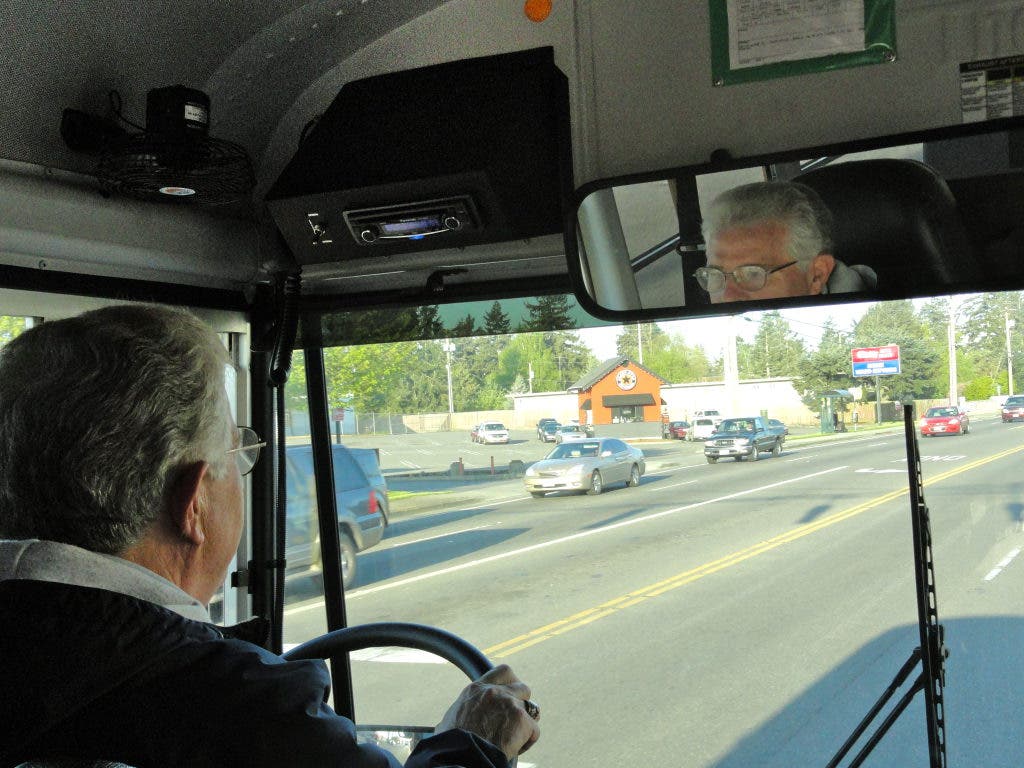
It’s about 5:30 a.m. on a Tuesday in May, and the sun is just waking up. Wilcox’s yellow bus, redesigned with fewer seats to accommodate a small busload, revs up in the district transportation depot station in Lakewood. Wilcox, 67, performs a system check, ready to pick up his first passenger 12 miles away in Spanaway, the farthest stop as he rumbles toward Mt. Rainier.
"This first kid never gives me any trouble," says Wilcox, a Lakewood resident and Lakes High School graduate. "He's shy. I tell him hello, goodbye and have a nice day."
The teenager, still morning-groggy in a purple and black button-up, creased denim jeans and Nike tennis shoes, quietly sits down and buckles up.
"You can go now, Jack,” he murmurs.
The bus gains speed, rolling out of Spanaway as the sun begins to shine through the front windshield, providing a clear view of Mt. Rainier’s beautiful white snowcap.
Costly transportation
Under the federal McKinney-Vento Act, school districts are required to identify and report homeless students and to guarantee those students transportation so they can stay at their original schools even if they have been forced to find emergency shelter outside the district. The districts are required to track how many students are living in motels, doubled up with relatives, in cars or in shelters. (Click here for a look at where Clover Park School District students were living in 2009-10, according to state figures.)
School districts can apply for federal money to help defray their homeless student costs. This year, 23 districts received the grants, most of which were between $25,000 and $35,000 and were awarded on a competitive basis.
The district has transported up to 110 kids this year, according to Delphie Nielsen, CPSD transportation director. CPSD received $30,000 through the McKinney-Vento Act, and it expects to continue receiving the same amount over the next several years, despite Washington’s share of those funds being slashed by 28 percent this year, from $1.19 million last year to $862,000 this year.
The district tries to do everything possible to ensure that students can stay in the schools they went to when they last had permanent housing, and to succeed academically. For this school year, it had spent more than $82,000 in mileage costs, drivers and contract services as of January 2011. While the grant helps offset costs, the district still finds itself struggling to finance the operation. In the 2009-10 school year, the district spent more than $175,000—not including coordination by dispatcher, school and district office staff—on transportation for homeless students.
And that doesn’t account for the entire homeless population, either.
Many families are hesitant to self-identify as homeless for fear they will be reported to Immigration and Naturalization Services, Child Protective Services or other agencies, said Barbara Smith, the district’s McKinney-Vento liaison.
Stability amid change
Wilcox’s route changes frequently. He has picked up the same student in more than one living arrangement, and his route changed five times in one week, with 22 alterations for May alone, said Paul Vigil, transportation supervisor.
"That really is the gist of the route," says Wilcox, who is used to long drives from his touring days as a bass guitarist with country music band The Shoppe. "It could be different tomorrow or the next day."
Studies show that children who lack stable housing face a host of challenges that stress their developing systems, including lack of sleep, hunger, fear, and increased levels of stress hormones such as cortisol, which can wreak havoc on young brains. (See related story . )
The rationale for keeping kids in their original school is that it helps their learning.
A small 2006 pilot study by the Washington State Department of Transportation found that while homeless kids typically had lower grades and Washington Assessment of Student Learning (WASL) scores than non-homeless students, the grades and scores were better among those homeless students who got to stay in their original schools.
With a highly fluctuating route, Wilcox still remains confident that providing a safe and positive experience to and from school will help the children.
"They need the opportunity to reach their full potential," Wilcox says.
‘Breaks your heart’
The demand for transportation, however, has exceeded the district’s resources. Nielsen said the district is forced to turn away some homeless students living in Fife and other outlying areas of the county simply because the drive time outweighs the benefit and cost. Wilcox drives about 80 miles each day in the morning and afternoon shift and it takes him three hours from departure to arrival.
The complexity of providing transportation, food, clothing and other resources to homeless students with a shrinking district budget seems abstract compared to what Wilcox overhears while maneuvering the large bus.
"I've heard conversations behind me I never fathomed,” he says. Most of them are domestic situations where a mother or father has a restraining order. The conversations make Wilcox and his wife interested in being advocates for a foster family.
“It kind of breaks your heart,” he says.
The bus remains quiet until it reaches Parkland to scoop up two brothers, 10 and 6 years old. Their dad watches them step onto the bus as they buddy up next to each other.
"You were late!" shouts Ryan, the fourth-grader, a student.
"No I wasn't," Wilcox replies.
"At 6:09 (a.m.) you weren't there," Ryan retorts.
"Ahh, not by my clock. I'm there by 6:10 a.m." Wilcox says.
The bus—like the dialogue—picks up steam as Wilcox steers to the next location.
Economic casualties
The economy can be directly tied to the increase in homelessness. Job loss is the No. 1 factor, and reduction in hours is second for homelessness in the schools, CPSD liaison Smith said. And the district is seeing younger students without permanent places to sleep at night.
“Many homeless students are coming from other communities, due to job or housing losses in other areas and we are seeing a higher number of homeless students at the pre-kindergarten level, largely due to an increase in removals from home or foster care,” she said.
The conversations between Wilcox and Ryan are steady as the bus rolls to the next stop, picking up a pair of sisters, Topanga and Sammy, students. Wilcox says they used to live in a motel but have found more suitable, temporary housing with friends. Their mom waves goodbye while one of the sisters eats a Hot Pocket for breakfast.
Five days a week, Wilcox’s bus is a revolving door of students who need transportation and stability. While they might not ride his bus by next fall, Wilcox looks forward to making a small but significant difference in each one of his passengers’ lives.
Get more local news delivered straight to your inbox. Sign up for free Patch newsletters and alerts.