Schools
Custer Parents Head to Class For English Lessons
Elementary school uses grant money from Clover Park School District to fund 10-week program to help its ELL families.
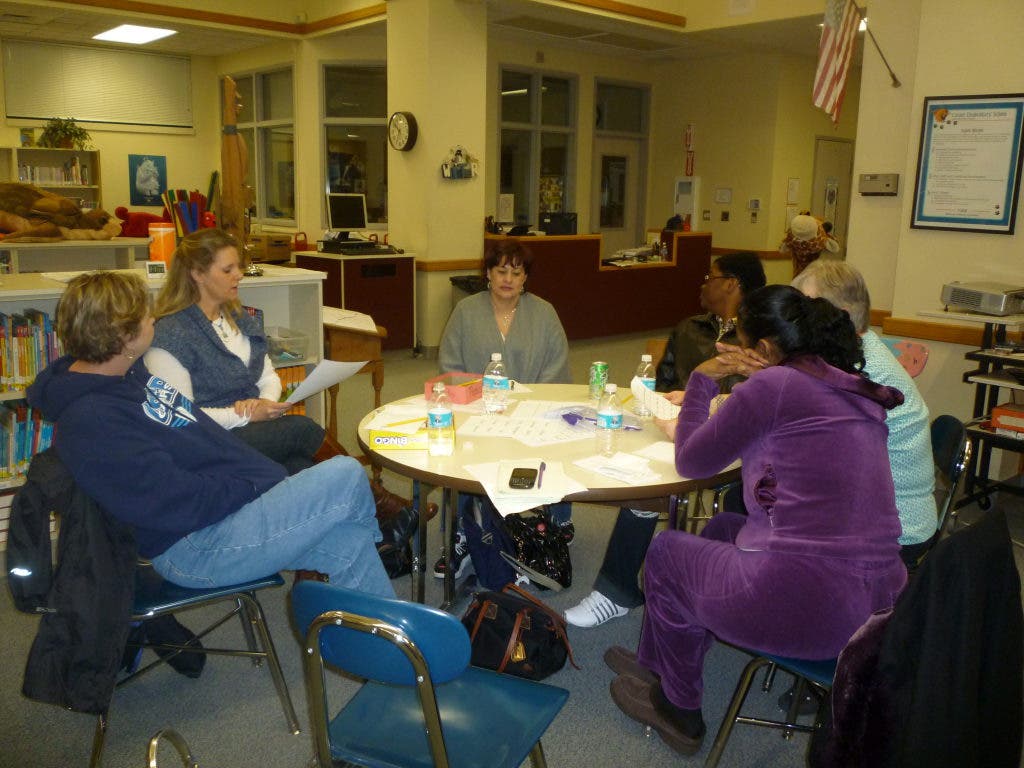
At first glance, it’s girls’ night out.
A small group of women sits at a table, talking and laughing.
But this is no cozy bistro – Custer Elementary’s English Language Learners (ELL) parent group is meeting in the school library on a chilly Thursday evening.
Find out what's happening in Lakewood-JBLMfor free with the latest updates from Patch.
The 10-week program, which concludes at the end of March, was started with Title III grant money available to schools in the Clover Park School District. Although Custer only has 21 ELL families, principal Bev Eastman and her staff saw a need.
Enter Nicole Wonner.
Find out what's happening in Lakewood-JBLMfor free with the latest updates from Patch.
The second-grade teacher had never written a grant, but her efforts resulted in Custer being one of three schools chosen to receive ELL Family Involvement funding. The money has been used to hire a teacher from the Tacoma Community House to conduct English lessons twice a week, as well as to pay for childcare, which is free for attending parents, and some food.
“I was surprised,” Wonner said. “I honestly thought no one else asked for it – I just answered the questions.”
In addition to the classes offered on Mondays and Tuesdays, parents also attend a “Talk Time” on Thursday nights, when they apply what they learned earlier that week through conversations with volunteers and other parents.
Last week, a trio of volunteers and three attendees – 10 parents signed up for the class, but the turnout varies by class – played a game in which each person circled a preferred item from a list of pairs: book or walk; winter or summer; chocolate or vanilla. Each person took a turn revealing her answers – but not until everyone else guessed what they had chosen.
That, in turn, led to questions – and some cultural lessons.
Edo Koussaw, who moved here five years ago from the African country of Togo and has one of her two children at Custer, said that she prefers takeout – a Supreme if it’s pizza night -- but is used to cooking.
“In my country, it is my duty,” she explained. “A woman’s duty is to cook, so just to give you pleasure, your family or your husband takes you out.”
During her turn, Eunice Gomez said that although she has gotten used to the cold in the 22 years since she emigrated from Mexico, she still prefers summer.
“I can take my kids to the park, and I have more energy to do things.”
The conversation was casual – but that was precisely the point. Topics ranged from fish tacos and Valentine's Day to past jobs and e-book readers, punctuated by an occasional pause or request for the definition of a word. “Wreath” and “feast” were among the new words attendees learned that night.
Gomez said that she enrolled in English classes when she first arrived in the U.S., but the single mother stopped after a year because she could no longer afford them. Television shows became her tutors, and now her five children, all of whom speak English at home, provide assistance.
The ELL classes appealed to her because, “I want to be better at grammar, and my spelling is really bad. I need to be better for my job.”
It is such determination about which the Custer staff is happiest.
“I have to say that I so admire the fact that they’re here,” said Lisa Korsmo, the reading teacher who facilitated Thursday’s discussion. “Some of them are here (three days a week) because they want to practice their English. It’s really a wonderful thing that it’s so important to them.”
Third-grade teacher Beverly Steed said she feels the “Talk Time” format puts attendees at ease.
“It’s informal –chatting, not teaching,” she said. “And it’s been a blast.”
Wonner said that the benefits have been mutual.
“It’s been really positive here at school because we’ve been able to build relationships with these parents, and some of them are timid and shy,” she said. “Now I talk to them in the hallway and ask how it’s going.”
Wonner said that if the money becomes available again, that she believes that Custer would continue the program. It hasn’t been easy coordinating everything, though, she said.
“It took a ton of volunteers here at Custer,” she said. “But for 10 weeks, not once did anyone fail me. Everyone took their strengths and I think that is what Custer is good at – we’re like a family.
“When they saw the need, everybody pitched in and did their part.”