Schools
Fake Blood and Cow Livers at District Science Expo
Record number of students from the Clover Park School District show off their passion for science at annual event funded by Intel.
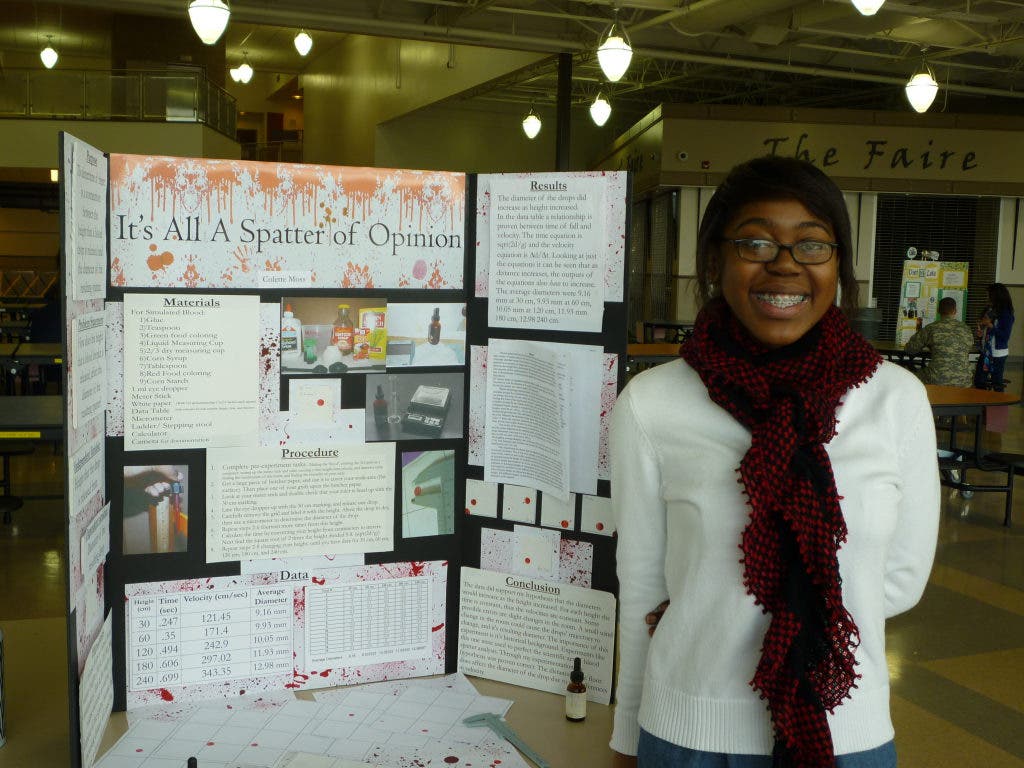


Red food coloring just doesn’t cut it when it comes to making fake blood. Colette Moss knows to add a few drops of green.
Moss, a senior at Lakes High School, represented more than 240 students from 19 schools who showcased their experiments in the Clover Park School District Science Expo on Saturday at Lakes. The sixth annual event was funded by a $10,000 grant from Intel.
Her project Blood Splatter won second place in the biology category at Lakes’ science fair in January. Moss fine tuned it for the district fair, which awards gold, silver and bronze medals and three honorable mentions in each grade.
Find out what's happening in Lakewood-JBLMfor free with the latest updates from Patch.
Moss called the expo her foray into forensics.
Although not much of a science person, Moss’ love of crime shows like "CSI" and "NCIS" has ignited her desire to become a criminologist. She plans to major in psychology and criminal justice at the University of Washington.
Find out what's happening in Lakewood-JBLMfor free with the latest updates from Patch.
“I would love to work with the police to find criminals using the psychology behind their crimes.”
That includes blood splatter.
Moss said that crime shows do not focus on the topic in their quest to solve the crime in an hour-long program so she delved more into it.
Her experiment involved dropping fake blood from differing heights, with the hypothesis that as the height increases; the resulting diameter of the splatter does, too.
Her first few concoctions failed, but Moss said she was thrilled to find a recipe for fake blood that was close to the density of real blood. All it took was a little cornstarch, corn syrup, glue and food coloring.
So why green?
“It darkens it up,” she said with authority. “If you just use red, it’s very pink. It’s not realistic at all.”
Such creativity was exactly what science fair coordinators hoped to see at the annual event, which drew more participants than ever before – 159 elementary-school entrants and 89 from the middle and high schools. A record-high 52 judges from Joint Base Lewis-McChord also volunteered their time, which Flores said made judging go a lot faster than usual.
Thomas Thompson, a fifth-grade teacher at Custer Elementary School and one of the science fair’s coordinators, said that when they started the fair in 2006, only 11 kids participated. Now, she said it’s just astronomical.
Thompson said that every student in his class has an interest in science and that he thinks the world’s problems – global warming, the price of oil, radiation in the air – piques kids’ curiosity.
“Now the kids are interested in doing more than just setting up a display and doing volcanoes,” he said. “Now they’re putting thought into it; they’re talking about variables and responding manipulatives. They’re asking, ‘if I do this, what will happen?’ and getting into scientific method and hypothesis.”
The quality of the poster boards displayed in the Lakes cafeteria reflected such interest, ranging from A Meal Fit for A Mealworm by a first-grader, Beans Love Pop by a third-grade student, Babies Are Cute … But Bacteria Isn’t” by an eighth-grader and “Courts and Disease” by a high-school junior.
Maria Flores, supervisor of math and science curriculum for the Clover Park School District and the science fair’s main coordinator, called the day a celebration and said the credit goes to the entrants’ teachers.
“It’s about how the teachers communicated it in the classroom that science is really a real-world application of all the things they’re learning,” she said. “Whether it’s math or reading, you put all that together and integrate that in science, and it will show during their science project.”
Entrants were judged on a scale of one to four in three categories: science inquiry process and display board; oral presentation; and journal/science log. Winners, who will be announced at a currently unscheduled school board celebration will advance to the South Sound Regional Science Fair at Pacific Lutheran University on April 2.
Ryan Engardo, an eighth-grader at Hudtloff Middle School, took on the affects of soda on a drinker’s liver in her project, titled “Diet Coke Vs. Coke.” She wanted to see which of the two would alter the weight of the organ more.
“I used cow liver because it’s closest in resemblance,” she said. “I didn’t want to use chicken liver, and I’m definitely not going to use human liver.” She paused. “I don’t think that’s even legal.”
Engardo soaked the livers in Coke and Diet Coke for 12 hours, pausing every three hours to strain — 10 minutes to get all the liquid out — and then weigh them. As her hypothesis suggested, the aspartame in Diet Coke caused it to have a greater affect on the liver.
And over time, white bubbles with floaty stuff on top started to form.
“It looked like a bubble bath, but not as pretty," Engardo said.
Most importantly, Engardo said, her research convinced her grandmother, a longtime Diet Coke drinker, to kick her habit.
Engardo said that she loved participating in the science fair and that while she has aspirations of becoming a famous actress, she also wants to be practical and therefore is considering a career in science, possibly astronomy.
“I love learning about space.”