Schools
Middle-School Students Tune Into College Life
GEAR UP visit to the University of Washington—Tacoma campus provides adolescents perspective on tuition, credits and recreational activities on campus.


Want to stun a room of middle-school students into silence?
Tell them how much it costs to go to college.
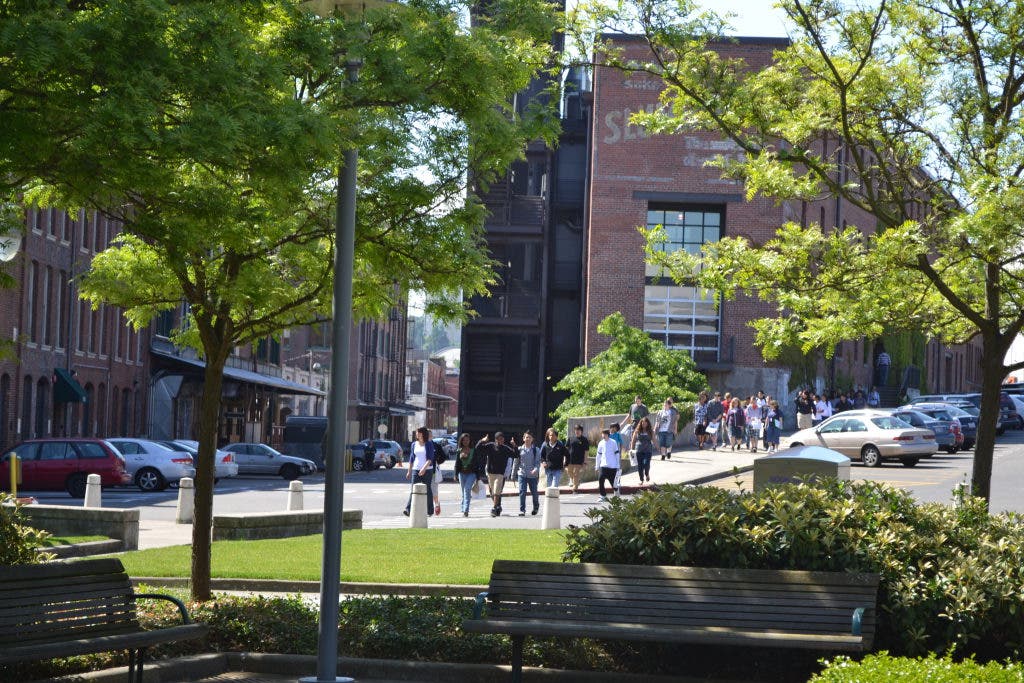
Questions about tuition, sports, the SAT– and parties– were raised by students during a visit to the University of Washington—Tacoma on Thursday.
Find out what's happening in Lakewood-JBLMfor free with the latest updates from Patch.
When Melody Ferguson, an admissions adviser and recruiter for the university, told the students that a year of tuition is currently $8,691, a hush fell over the classroom.
And then the group erupted into incredulous whispers.
Find out what's happening in Lakewood-JBLMfor free with the latest updates from Patch.
“That’s messed up,” one student hissed.
Still, Ferguson pointed out, it is a lot less than the $25,000 one student guessed.
Other topics that shocked the group: The amount of schooling it takes to become a doctor (12 years on average); the monthly cost of living on campus (about $550); and that computer-science majors are graded on their hacking abilities.
They also wanted to know if college degrees are rolled up like high-school diplomas.
No.
The visit was arranged through GEAR UP, a federal grant program in Washington state designed to increase the number of low-income students attending college. The six-gear grants helps to prepare a class of students from seventh grade all the way through their senior year of high school for postsecondary education.
About 100 students attended the two-hour morning session and then visited Bates Technical College in Tacoma. A second group of 100 kids did the same day in reverse.
Among those in attendance were aspiring surgeons, graphic designers, teachers, lawyers, professional athletes—even a politician.
“Most of you listed careers where you have to go to college,” Ferguson said. “Even football players—you can’t get drafted out of high school.”
Ferguson emphasized that colleges are looking for a “holistic or comprehensive student,” meaning that grades are just part of the package. Extracurricular activities, community service, employment and leadership also factor in.
As for sports, about which several students made inquiries, she said, “You obviously need to be a really good athlete, so you’ll need to spend a lot of time on that.”
Ferguson also told the group of mostly eighth-graders that they are already getting a leg up on college essays by learning to write fiction in their English classes. Most prompts request applicants to delve into an aspect of their life story.
“You need to learn to tell a story – sights, sounds and emotions,” she said.
The students nodded throughout—listening to the free advice.
“I like this because it shows us what we have to do to get into college,” said eighth-grader Nathan MacLeod, who has aspirations of owning his own aviation company. “We get to see all of the opportunities you can get and what college will be like.”
Ferguson said that while UW Tacoma doesn’t offer every major that the Seattle campus does—she also cited Washington State University as the best place in the state to study veterinary medicine—it adds three to four majors a year.
Lochburn teacher Synette Melluzzo said that there are definite benefits to going to a branch campus.
“This is affordable for a lot of our kids,” she said in pointing out that tuition at UW Seattle is far costlier. “If you get scholarships, you may have extra money for things like housing.”
As the students toured campus, Ferguson pointed out landmarks, design elements —such as a Dale Chihuly sculpture in the library and different aspects to course studies.
“If you like field trips,” she said, “Environmental Studies is the place to be.”
Eighth-grader Mico Enriquez, who plans to enroll in the Army JROTC program at Clover Park High School and join the military after high school, said that he hopes the visit helps him get off to a strong start in the fall.
“It’s making me think about what kind of credits are needed for college,” he said.
MacLeod said he wasn’t surprised by the cost of college—UWT is downright affordable compared to non-resident tuition at his school of choice: the University of Southern California. But the future middle linebacker for Clover Park is banking on earning a football scholarship.
“I have a 4.0 grade-point average,” he said. “I just have to keep it up."