Schools
Oakbrook Elementary Has Strong Focus On Boosting Student Achievement
Principal says staff is working hard to get test scores up.

Test score by test score, the Eagles are working hard to soar.
That was the message relayed by Principal Jeff Murrell in a presentation to the Clover Park School Board on Monday night at district headquarters.
“We’re doing all right,” he told the board.
Find out what's happening in Lakewood-JBLMfor free with the latest updates from Patch.
Oakbrook has an enrollment of 305 students in kindergarten through grade five; 3 percent of the students are English Language Learners and 19 percent are enrolled in special education. The student body is 47 percent white, 19 percent Hispanic and 13 percent multi-racial, and 48 percent qualify for free or reduced-price lunch.
The school’s mission is “to meet the individual needs of its students, empowering them to acquire the knowledge, skills and attitudes to live productively and responsibly in a diverse and ever-changing world.”
Find out what's happening in Lakewood-JBLMfor free with the latest updates from Patch.
One thing that is ever-changing right the school is the student body.
Despite Oakbrook having a 30 percent military enrollment, Murrell and his staff were caught off guard by the addition of 98 new students this school year.
“We’re usually pretty stable,” he said. “Our teachers are not used to this … We had a period where every other day, we had a second-grader walking through the doors.”
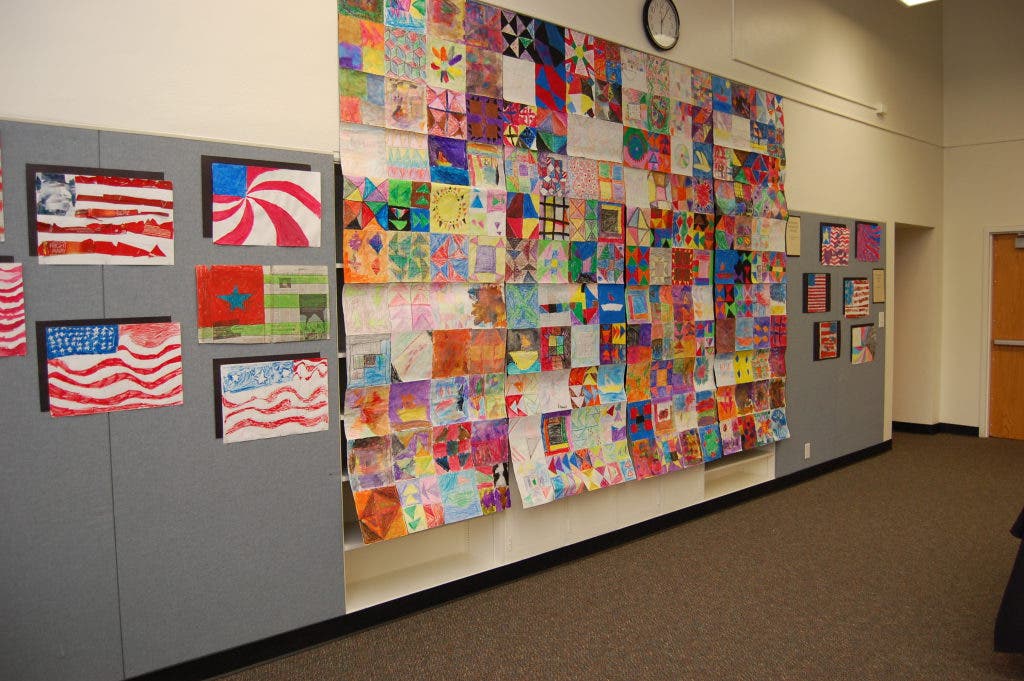
Among Oakbrook’s points of pride are academic growth on the Measures of Academic Progress (MAP), Math Benchmark Assessment (MBA) results, school wide structures for behavioral expectations, an active PTSA and integrated arts performances, concerts and galleries.
Fifth-grade reading scores on the Measurement of Student Progress (MSP) exam have improved from 69.8 percent to 75 percent between 2009-10 and last year, but third-grade scores fell from 76.7 percent to 68.3 percent and fourth-grade scores, from 69.2 percent to 63 percent, during the same time period.
“We’re utilizing all hands on deck,” Murrell said. “All available paraeducators; all financial means.”
Also of concern is that the number of students in Level 2 reading – students not making standard – has increased in all three grades since 2010. While the increase from 16 to 19 percent at the third-grade level “doesn’t seem like a lot – it still increased, and that’s a concern,” he said.
The percentages are significantly higher in the other grades. The number of Level 2 students in fourth grade increased from 2 percent in 2010 to 24 percent in 2011, and from 9 percent to 19 percent among fifth-graders.
The addition of a reading specialist two and a half days a week means that the school now has reading support available all five days.
“We’re aware of it, concerned about it, and are doing everything we’ve got,” he said.
However, Murrell pointed out, students are making steady gains on the MSP math exam. Third-grade results improved from 51.2 percent in 2009-10 to 61 percent last year, and 87.5 percent of fifth-graders made standard in 2010-11, compared with 64.2 percent the year before. Only fourth-graders have declined, from 76.9 percent to 58.7 percent.
“This is a celebration, so to speak, in math,” he said.
And the fifth-grade science MSP results climbed 38 percent over the same time for an impressive passage rate of 70 percent.
In addition to inconstant student achievement in math and reading, Oakbrook faces additional challenges in providing effective and sustainable intervention programs for targeted students during the school day, student mobility and establishing additional support and resources for the increasing number of students receiving free or reduced-price lunch.
Murrell said that utilizing data is playing a key role in increasing student achievement.
“Our teachers are jumping in, head-first, up to their knees, with the data,” he said.
Also Monday:
During the meeting, the board approved the adoption of new science materials for grades 6-12. The materials purchase includes books from three publishers – Holt McDougal, Pearson and Cengage – as well as TI-NSpire handheld calculators and science probes for TI-NSpire. The materials, which are not to exceed the cost of $900,000, cover a wide range of topics, including physics, biology and forensic science.
The board approved the purchase by a vote of 3-1. Director Jose “Pepe” Salamanca was not present, and Director Paul Wagemann cast the lone dissenting vote, citing concern that the materials do not address the religious aspect of science to counter the teachings of Evolution.
“When there’s only one message being delivered, there’s a problem,” he said, adding, “There’s a choice to be made.”
But Board President Carole Jacobs said that the materials give students the opportunity to explore, ask questions and have them answered by their teachers.
“There’s a big piece of ‘choice’ in academia,” she said.
Wagemann suggested additional material be added to the curriculum, but Superintendent Debbie LeBeau said she does not feel there is “a perfect supplement” and that the district has one primary goal in choosing instructional materials.
“Our focus these days is the state standards – and preparing students to graduate from high school,” she said.