A recent conversation with a close friend went something like this:
Friend: Kristi, why can’t I lose any weight? I have been pretty careful about what I eat and I feel like I am exercising harder than ever right now. I stepped on the scale, and I’ve actually GAINED two pounds!
Me: Are your clothes tighter?
Find out what's happening in Lakewood-JBLMfor free with the latest updates from Patch.
Friend: No.
Me: Do you feel good during your workouts? Do you feel strong?
Find out what's happening in Lakewood-JBLMfor free with the latest updates from Patch.
Friend: Yes! I did a great strength training class and I was sore the next day, but I felt really good.
Me: (silence).
Friend: I know, I know. Muscle weighs more than fat, blah blah blah. But why can’t I lose weight?
Again and again, I am blown away by our obsession with the number on the scale. Let me be perfectly honest. I find myself occasionally slipping into old habits of getting on the scale one or even two times a day and letting that determine my mood, so I understand scale addiction. However, your weight on a scale can be a terrible measuring device.
What does the scale tell us?
For some, it can be a reality check. For as many scale addicts that are out there, there are equal numbers of scale avoiders. It can give us a starting point and perhaps an incentive to do something about the number we see. Some people will avoid the scale because they know they are wearing larger sizes and they don’t like what they see when they look in the mirror. These people know they are getting heavier, but just don’t want to face the facts.
But for many, that darn scale can make or break their day. Let’s address this idea that muscle weighs more than fat:
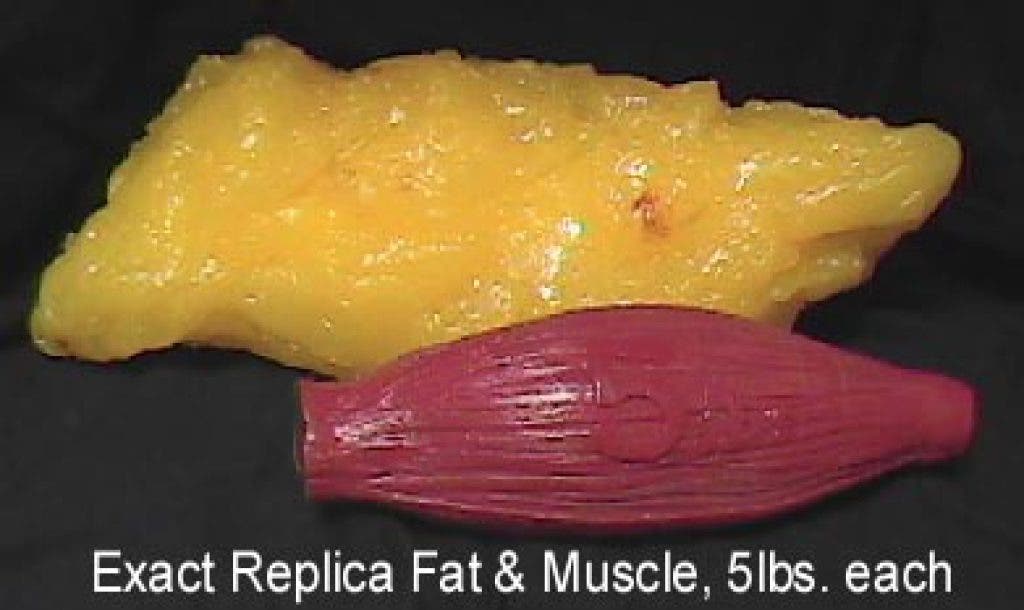
The statement is a inaccurate. A pound of fat and a pound of muscle weigh the same thing, just like a pound of feathers weighs the same as a pound of peanuts. However, muscle takes up less space than fat.
Why do some people gain weight when starting an exercise program?
It is possible that these people are gaining muscle at a faster rate than they are losing fat. This muscle gain is what you want to achieve. With an increase in muscle, you will see an increase in your overall metabolism.
A more accurate assessment of your exercise success would be to keep track of your measurements. Because muscle takes up less space than fat does (please refer to the lovely picture I have included at the top of this article), you may see a slight increase in the numbers on the scale, but a decrease in your measurements.
These are the numbers that count.
Another way to track your progress is to measure your body fat percentage. This one is difficult to do unless you have a scale that measures body composition or a trainer who can take skinfold measurements.
It’s tough to break that habit of daily weighing. My recommendation is to find additional ways to monitor your progress if you are going to continue to use the scale. It can be a helpful tool, just don’t make it your only tool.