Health & Fitness
The Basics of Baseboards
How to install new baseboards, with a little help from my husband.
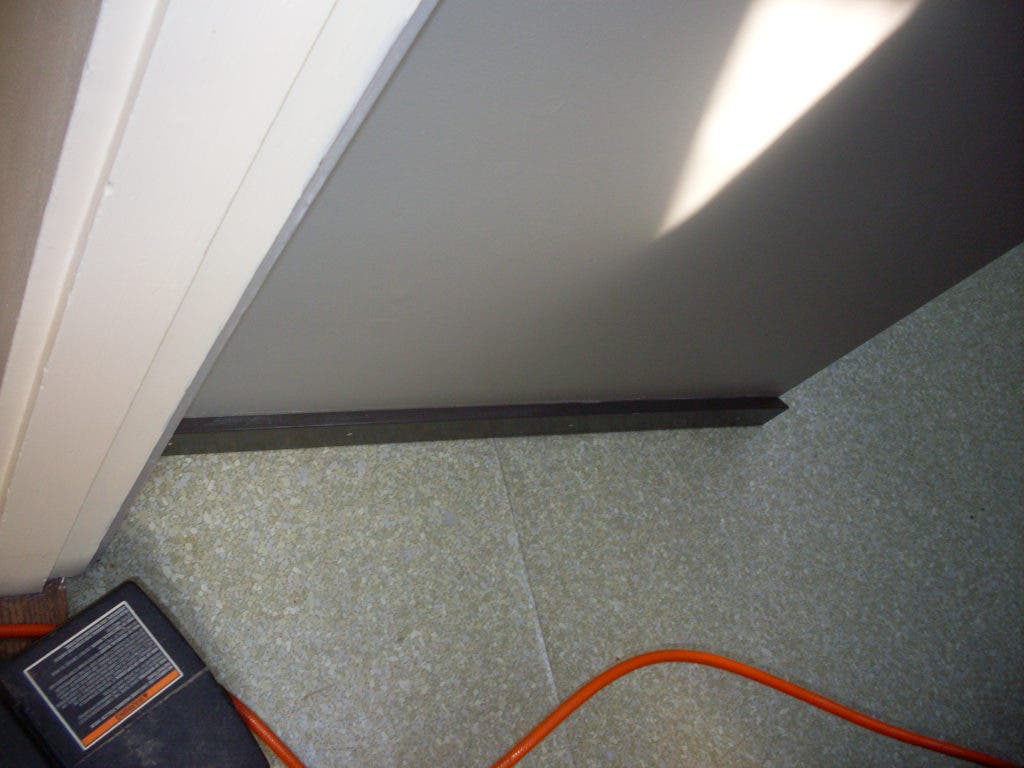
I really do have the world’s best husband. Nothing is too much for him to figure out. Not even guest-writing (with some ghost-editing) this post in addition to completing this project.
This weekend’s successful project was putting in the baseboard trim in the bathroom. Yes, THAT bathroom. The bathroom with the never-ending project list. You know the one that looked like this originally?
- Remove wallpaper
- Buy new shower curtain and towels
- Paint
- Put in new trim
Et voila! Right?
Find out what's happening in Mercer Islandfor free with the latest updates from Patch.
Wrong.
That list ended up looking like this and with just one item left:
Find out what's happening in Mercer Islandfor free with the latest updates from Patch.
- Remove wall paper
- Remove vinyl baseboard trim
- Buy new shower curtain and towels
- Scrape wall paper glue
- Clean with TSP
- Paint walls
- Paint cabinets
- Buy and install new cabinet knobs
- Repaint walls and cabinets
- Apologize to husband for getting the colors wrong
- Apologize to husband again
- Prime, paint and coat the countertops with Polycrylic
- Coat the countertops again
- And again.
- And again.
- Install new baseboards.
I have to admit I had nothing to do with any of this project beyond a little editing. (Okay, well, I did my part by re-painting them a color not-purple.) Here we go…Installing baseboards from the mouth of my babe. (Parenthetical italicized commentary courtesy of moi!)
From Brett:
I painted the trim pieces first, but in hindsight, I would have done this after measuring and cutting.
I measured the length of each stretch of wall needing the trim.
Then I cut the pieces. This sounds easy but, oh boy, not so. The trick with trim is the angles. Most commonly these are 90 degrees. Angles that go on the outside of a wall, where the trim is going around rather than inward into the 90 degree angle, need to be cut at a 45 degree angle so the part of the trim missing is the non painted side. (Ummm…I’m getting lost.)
The angles that go inward need to be cut so the non-painted side is cut out. Keep in mind during all of this that the measurement changes depending on whether it’s an inward angle or outward angle. (Wow…translator? Way too complicated for my paint impaired brain.)
I messed up one cut right away and had to stop....and say to myself, ok, lets visualize how this will work, which took me about 10 minutes. Then I had to stop and visualize each cut before I made it because materials were running short. I cut and walked inside to make sure it worked. On top of that I had two angles that were not 90 degrees but rather 2x 45 degree angles...so at each cut I had to do the same process but make my cuts at a 22.5 degree angle. (Does wine come with this?)
Nail the pieces into place with the brad-nailer (and some big machine that makes a lot of noise called an air-compressor).
Fill holes and space in corners with wood puddy and paint. That's it, easy peasy.
(So says he! That is why I love this man.)