Health & Fitness
King County Coronavirus Levels Reach New Highs
The risk of being infected with the coronavirus is higher now than it has ever been, according to King County's top health official.


SEATTLE — King County has reached a new peak in the coronavirus pandemic after more than seven weeks of climbing case counts and increasing transmission, public health officials announced Friday.
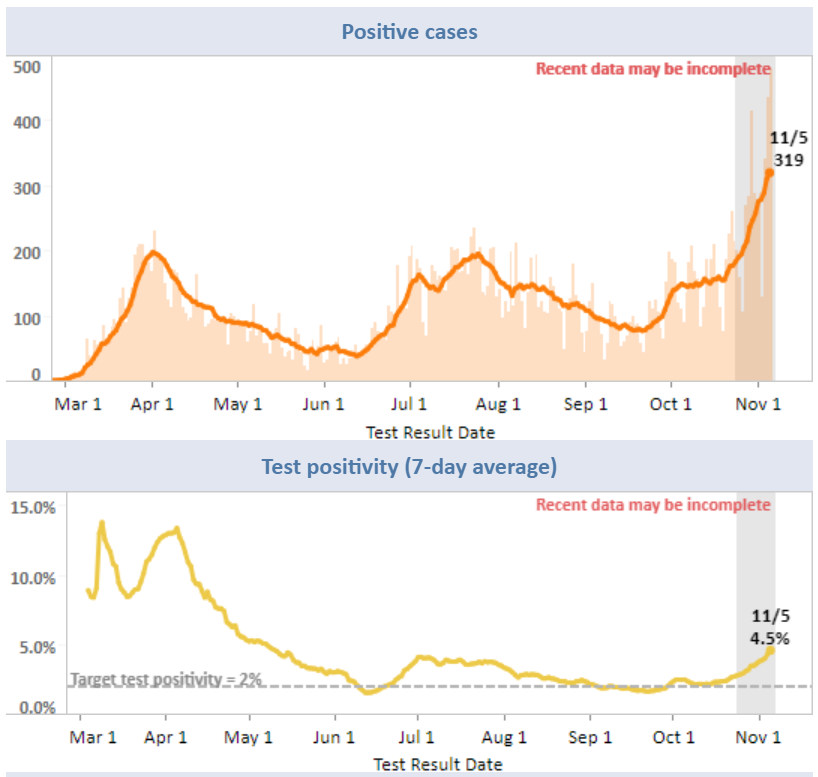
Dr. Jeff Duchin, the health officer for King County, briefed the public on the latest concerning trends Friday, after the county's average number of daily COVID-19 cases over the last seven days surpassed 300. The latest figures are more than 100 cases higher than the initial peak recorded in spring and represent a fourfold increase since late September. The county's testing positivity rate over the last two weeks is nearing 4 percent.
Public Health - Seattle & King County has reported more than 500 new cases each of the last three days, and Washington logged its highest-ever daily increase Wednesday. By Friday, the state had broken that record a second time.
Find out what's happening in Seattlefor free with the latest updates from Patch.
"Cases continue to accelerate in the wrong direction, and it's best to hit the breaks before we crash and not after," Duchin said. "Too many of us are doing too much, with too little consideration of the consequences of our actions on others. The risk of acquiring COVID-19 today is higher than it has ever been. The longer we wait, the more difficult it gets to bring case counts down."
Duchin said the increase has occurred among all age groups, and especially in younger and working-age adults —ages 20 to 60 — who account for 70 percent of recent cases. The source of infection varies widely.
Find out what's happening in Seattlefor free with the latest updates from Patch.
"We've seen broadly distributed risk factors, including household transmission, transmission in the workplace particularly among essential workers, many community-acquired and travel-related cases," Duchin said. "These are linked to social events and activities with families, friends, get-togethers, parties, celebrations, weddings and other recreational activities."
A few tips on gatherings during #COVID19: Don’t have gatherings with more than 5 people. If you do, stay home as much as possible after and get tested if you have symptoms. If someone from the gathering tested positive, consider getting tested 5-7 days after exposure. pic.twitter.com/WnbT9iAF7t
— Public Health - Seattle & King County (@KCPubHealth) November 5, 2020
While hospitalizations were slightly higher in October and there has been an uptick in deaths, Duchin said neither measure have experienced a spike, but as "lagging indicators," they can experience a rise weeks after a surge begins. When community transmission becomes more widespread, the likelihood of infections spreading to higher risk groups grows.
"What we should all be worried about is the spread of COVID-19 to more people in our community with underlying health conditions and to older adults who are at higher risk for severe illness and death, and the impact that will have on our health care system," Duchin said. "Across the country, we are seeing surges in serious illnesses that are stressing hospitals."
As the holidays approach, particularly Thanksgiving, public health experts worry that a lax commitment to proven prevention measures could set up the region for a dangerous scenario.
"If we see people continue with their usual Thanksgiving plans and gather in groups, we will undoubtedly have a very unmanageable situation coming out of that," Duchin said. "We really need people to think about this holiday, and think about how to make sure that next year everybody in the family is at the dinner table, and we don't lose people that we would have been able to celebrate with, by acting responsibly and doing everything we can this Thanksgiving."
Duchin shared a few things to keep in mind in everyday life, and as people consider holiday plans, including:
- Remember, you cannot tell someone has COVID-19 by looking at them. It can spread before people look or feel ill. Expect it where you don't expect it.
- The community must do better at limiting activities outside the home, including the number and duration of contacts with others outside the household.
- The virus spreads readily indoors, especially without good ventilation and when masks are not worn. A well-made, well-fitting face covering is critical indoors, even when you can maintain 6 feet of distance.
- The safest thing is to entirely avoid gatherings with those outside your immediate household.
- If you do gather, open windows and doors as possible to improve ventilation.
- Practice proper handwashing and regularly sanitize high-touch areas.
- Get a flu shot to help prevent strain on the health care system and prevent a mistaken diagnosis.
- If you show any potential symptoms for COVID-19, immediately isolate, get tested, and stay isolated until you have a negative result.
Duchin acknowledged the challenge, this deep into the pandemic, of keeping up a strong effort to combat the virus, both individually and as a community. But acting now and committing to long-term changes in behavior is vital to ensure recovery.
"I don't think the public, in the United States or elsewhere, has ever been confronted with this magnitude of challenge, and I think it's taking a while to sink in," Duchin said. "Folks understandably want this to go away, they want this whole mess of COVID-19 to be a bad dream, and to wake up and be able to go back to their pre-COVID lives — I certainly want that. The unfortunate reality is it won't go away, and to the extent we pretend it will, we will have worse outcomes, more suffering, more hospitalizations, more deaths."
Despite the worrying outlook, state and local public health experts agree it is not too late to change course and tamp down the virus to a manageable level before irreversible damage is done.
"We can choose our path forward, or we can let the virus choose it for us," Duchin said. "Ignoring COVID prevention is a recipe for unnecessary suffering."
Questions about COVID-19 testing? Check out our FAQ page for answers to some of the most common questions we get. https://t.co/sSTIGGGCvm pic.twitter.com/VUkLcg0TFy
— Public Health - Seattle & King County (@KCPubHealth) November 7, 2020
Washington coronavirus links:
Get more local news delivered straight to your inbox. Sign up for free Patch newsletters and alerts.