Neighbor News
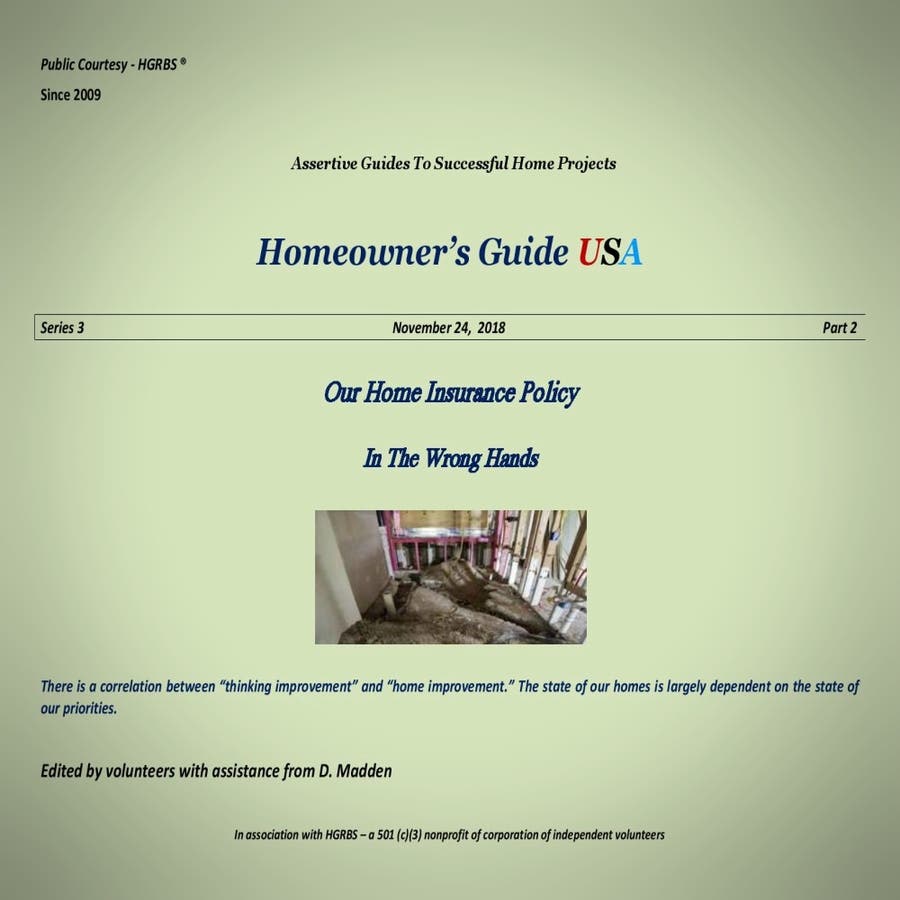
“Our Home Insurance Policy In The Wrong Hands”- Part 2
[Guide against US homeowners granting contractors right to file home insurance claims]
Introduction
HGRBS recently made available online for U.S Private Home Heads Part 2 of the special homeowner’s guide:
“Our Home Insurance Policy In The Wrong Hands – Part 2”
Find out what's happening in Seattlefor free with the latest updates from Patch.
This is the continuation and conclusion of our sharing very critical information about refining our home improvement protocol by:
- Declining permission to home improvement contractors to file insurance claims on our behalf.
- Refusing to authorize insurance funds in any form to home improvement contractors without comparable progress.
- Avoiding the temptation to authorize home insurance carriers to release funds by check or other means to contractors directly.
- Always accepting and enforcing responsibility to make deserved disbursements personally.
These recommended preventative measures are necessary for private home heads to resort to because home improvement contractors, although predominantly legitimate in all required respects, have corrupt elements. This unfortunate factor necessitates an across the board treatment of all contractors (with the exception of those who are “tried and proven” in their respective vicinity as trustworthy).
Find out what's happening in Seattlefor free with the latest updates from Patch.
A Noteworthy Account of Foul Play
Although there are many accounts of improprieties by detrimental home improvement contractors on a daily basis, there is one reported a while ago which merits attention. In this case, a contractor was arrested for reportedly using deceptive business practices to defraud nine innocent private home heads in North Carolina of their insurance funds. Despite the fact that this report does not itemize the nature of insurance payment in each case, there is mention of the contractor accessing payment via the “Assignment of Benefits (AOB)” approach. This occurs when the resident gives written permission to contractors to file insurance claims on his/her behalf. Invariably, this includes direct payment from the home insurer to contractors entailed.
Reportedly, this was a means by which this contractor was able to access insurance monies. However, there are also indications that residents who did not give such authorizations, filed insurance claims personally, received the funds (by check or other means), then paid him. Nevertheless, residents disbursed funds to the contractor for roofing (and perhaps ancillary work) without first conducting a proper service validation/thorough reputation check. [Browse Google for “Service Booklet-HGRBS” for details about doing this wisely]
In the end, according to the report, the contractor either did not start or abandoned each project after receiving payment.
*HGRBS researched the company name and individual via publicly accessible data. Neither the contractor nor the company he represented was licensed with the North Carolina Licensing Board of General Contractors. In NC, roofers are legally required to be licensed and regulated by this government entity when the projects are $30,000 or above. However, all projects for this particular contractor were far less. This is the reason volunteers were unable to validate his legality. By law, he had a legal right to be in business although he evidently did not have that leeway for using this legal advantage to be a residential predator.
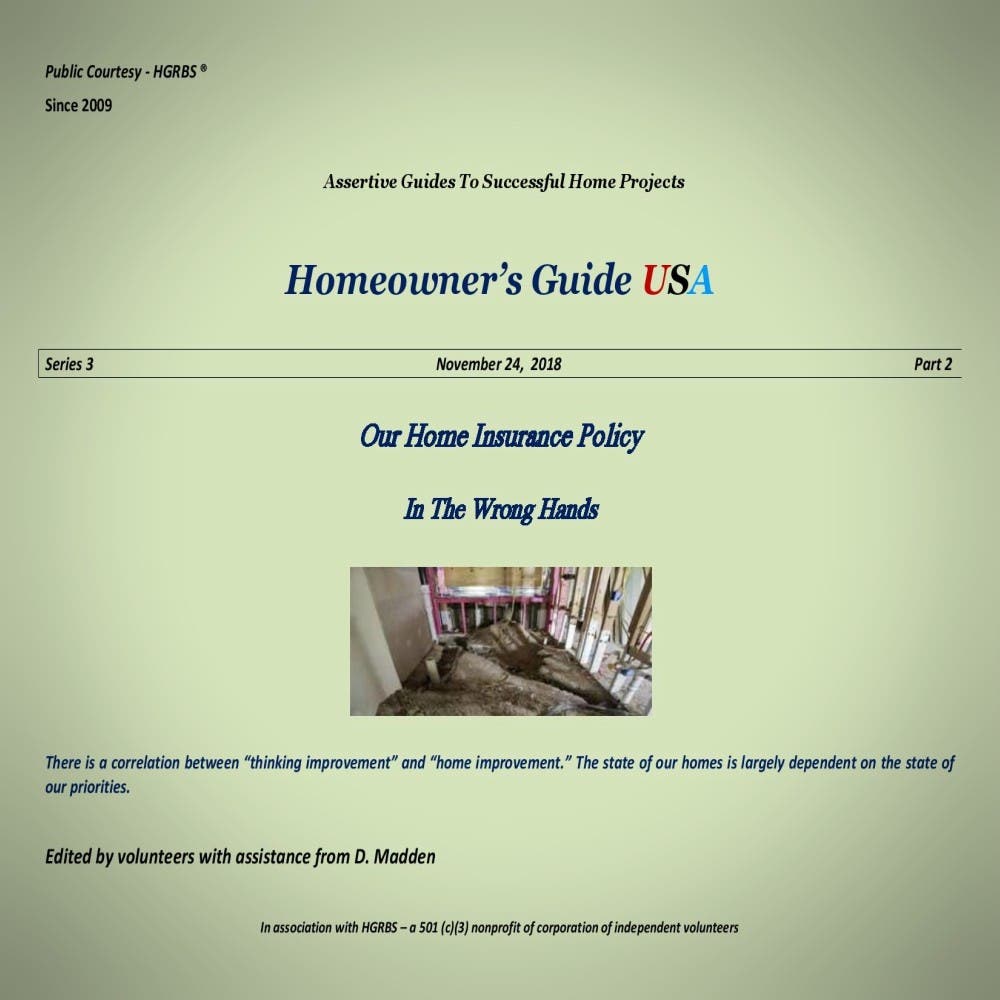
Part 2 – Our Home Insurance Policy In The Wrong Hands
HGRBS new homeowner’s guide “Our Home Insurance Policy In The Wrong Hands – Part 2,” (Available online since Saturday November 24, 2018) resumes emphasis on how crucial it is for residents to be aptly proactive against granting contractors the right to file claims or otherwise access funds directly from their home insurers.
In this final part of HGRBS’ special consumer guide, there is brief rehash of what was covered in the earlier rendition. For quite a few residents this is an unavoidable glimpse of a real danger.
It suffices to mention here that in the first portion, there is a skit placing the reader in a hypothetical situation to dramatize how easily innumerable private home heads are deceived by unscrupulous operations.
Immediately after reminiscing about the content of the previous guide, a more horrific account is given in this latest edition. Needless to say, in Part 2, this authentic threat in unabashedly reaffirmed.
We learn that the skit of the first guide was a quasi-actual replication of a real body of contract criminals who conspired against and successfully defrauded thousands of private home heads across state lines.
Summary
“Our Home Insurance Policy In The Wrong Hands – Part 2,” provides a scathing account of why, via various business names, a group of corrupt contractors and their assistants were able to remain in operation for a number of years without being successfully stopped. They traveled from state to state compounding their presence through also dispatching representatives in similar fashion. Consistently, they preyed on misinformed, underprepared, and under-strategized residents by various malicious means, especially through home insurance claims (AOB). The design of this homeowner’s guide is to enable US private home heads towards more proactivity being better informed and prepared to resort to aggressive preventative legal measures against this predation.
To access this essential guide (and others like it), interested parties are encouraged to go here:
https://www.americanprivatehomefront-hgrbs.com/homeowners-guide-usa.php
Vital Links
“Our Home Insurance Policy In The Wrong Hands – Part 1"
https://www.americanprivatehomefront-hgrbs.com/homeowners-guide-usa.php
North Carolina Contractor Defrauds 9 Homeowners
https://www.wral.com/thousands-of-dollars-multiple-complaints-and-now-roofer-under-arrest/17750494/
North Carolina Licensure Requirement For Roofers
*Edited with special assistance from E. McLaughlin
In association with HGRBS – a 501 (c) (3) nonprofit corporation of independent volunteers