Business & Tech
At Seattle Cannabis Convention, Getting High Profits Is Focus
Seattle CannaCon 2019, one of the largest cannabis industry events, is largely a showcase for entrepreneurs.


SEATTLE, WA - There was a time when a dog like Max, a brindle Dutch shepherd with perfect pointy ears, would’ve made marijuana users paranoid. But Max wasn’t at the Seattle CannaCon this week to sniff out marijuana, he was there to show growers how to protect it.
"This is immediate recognition," Wade Morrell said gesturing to Max. He means that any prowler looking to break into a marijuana grow would see Max and immediately recognize they shouldn't. “Some people from the industry have reached out looking for alternate security methods, visual deterrents.”
Morrell and his wife, Lori, own Priority 1 Canine, an Ohio-based business that trains elite guard dogs. They came to Seattle CannaCon to see if their dogs can fit in the booming marijuana economy.
Find out what's happening in Seattlefor free with the latest updates from Patch.
And they weren't the only ones.
Scores of non-cannabis businesses and entrepreneurs were at CannaCon to sell solutions to problems in the industry, like financing, security, and IRS compliance. The convention was also a demonstration of how cannabis has made its way into the mainstream economy.
Find out what's happening in Seattlefor free with the latest updates from Patch.
Companies that traditionally deal with very non-psychoactive things like insurance, textiles, and manufacturing are getting in on the green rush.

Around 9 a.m. on Thursday, handfuls of attendees milled around in the sunny Atrium Lobby on the fourth level of the Washington State Convention Center. Except for the “Sorry we’re dabbing” sign perched on a ledge near the check-in booths, the crowd could've fit in at any industry convention. There was a stack of free tote bags by the entrance and plenty of lanyards.
Inside an 80,000 square-foot exhibition hall, certified public accountants and propane companies had booths. The pen giant Bic had hundreds of elaborate lighters on display; one company was selling Keurig-style pods ready to be infused with THC; and scores more companies were selling glass-beaker contraptions for distilling hash oil.
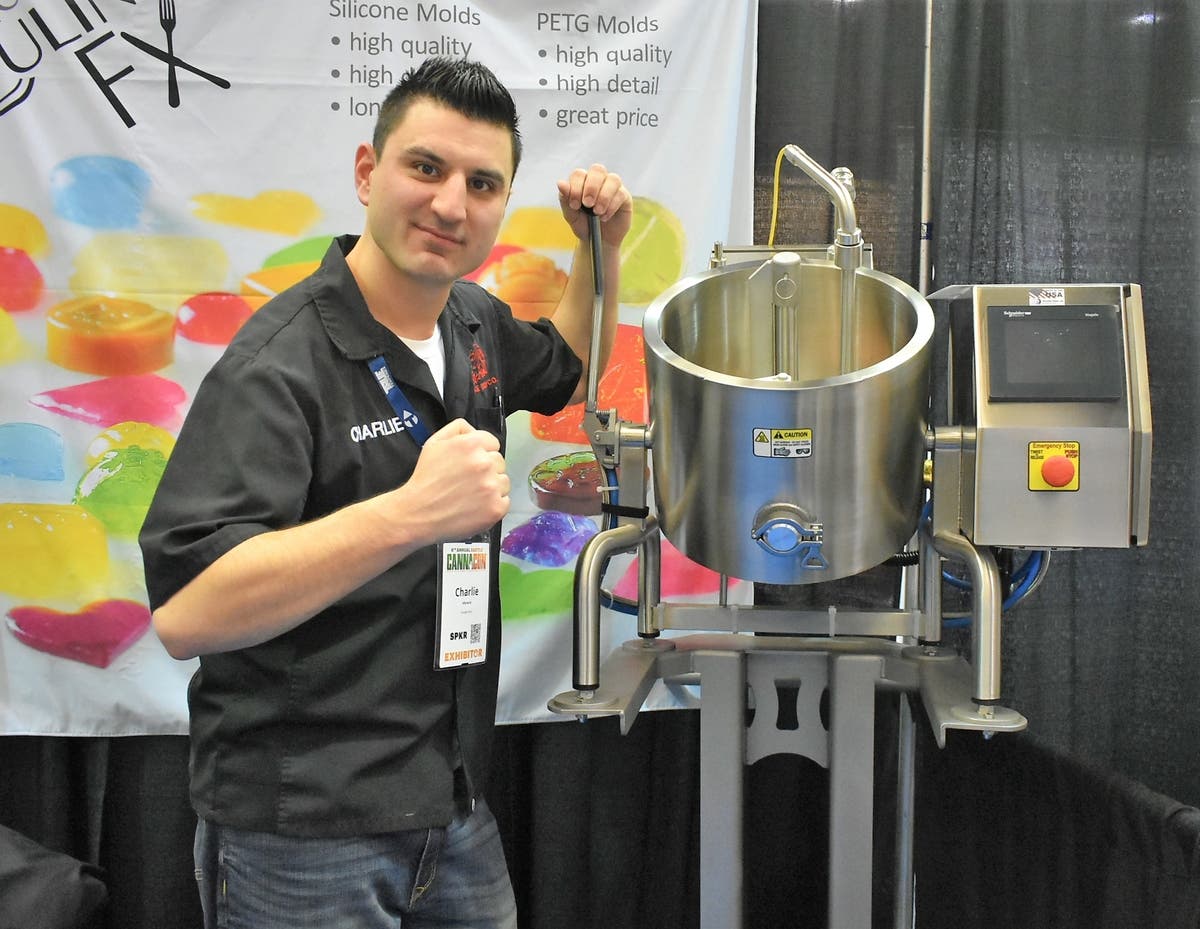
Ryan Albrecht was standing next to a big stainless steel candy kettle finishing his breakfast. He’s a salesman for Savage Bros. Co., a Chicago-area company that has been making candy machines since 1855.
“Survived the Great Chicago Fire and the Civil War,” Albrecht said.
Cannabis companies don’t make up a huge portion of the business, he said, but it’s growing as legalization sweeps the country. The company is seeing an uptick in interest from CBD candy makers especially. CBD, or cannabidiol, comes from the marijuana plant, but it doesn't get you high and is legal across North America. It's the hot new dietary supplement like goji berry and Ginkgo biloba once were.
The company manufactures its machines in Illinois, a state that doesn't yet have recreational marijuana. That means CBD and THC candy makers in recreational states are, in even a small way, ensuring Savage Bros. reaches the year 2055.
Cash machine manufacturer Cummins Allison (founded in 1887) was at CannaCon because it can benefit from a problem that plagues the industry. Major credit card companies won’t participate in marijuana transactions because of federal marijuana laws. So most retailers are cash-only. Counting cash is time-consuming and treacherous from an accounting standpoint.
Brent Haustveit, a salesman out of the Cummins Allison Tukwila office, demonstrated a counting machine by loading it with a stack of bills 5 inches high. The machine counted and sorted the money in seconds, and was even able to pick out counterfeit bills.
Haustveit said it took a little prodding to convince the company to sell to the industry, but Cummins Allison is now fully on board.
“This is an all-cash business, that’s what we do,” Senior Vice President of Marketing Carol A. Moore said.

The 20-year-old company Electric Guard Dog, based in South Carolina, came to CannaCon to sell electrified security fences for grow operations. Michael Darrington, vice president of marketing and sales, pitched the fences as a cheaper form of security compared to hiring guards.
“This is our fastest-growing category, sales are up 1,000 percent year-over-year,” Darrington said.
The company’s fences are loaded with 7,000 volts, enough of a shock to scare, not enough to kill. Darrington brought a small demonstration fence to CannaCon and was allowing people to give it a whirl.
(This reporter can confirm that 7,000 volts is an effective deterrent. The fence delivers a shock strong enough to lift you off your feet and leave your muscles tingling.)
A few booths over, Mark Branum was standing next to a model of a building made out of shipping containers. Branum, who has spent much of his career in the non-cannabis manufacturing industry, is pitching a marijuana growing system that's kind of like sharecropping.
Branum’s company, Agronomic Pod Systems, builds vertical farms made out of shipping containers. For about $180,000, a grower can buy into a turn-key marijuana grow operation housed in a shipping container. Farmers share a cut of their profits with the landlord.
He has a demonstration farm in Oregon comprised of 34 shipping containers, and 33 have already been sold, he said. The shipping containers are union-made in Georgia, and Branum can send them anywhere and in whatever quantity a customer wants.
“As far as we know, we’re the only ones doing this,” he said.

Branum has investors, customers, and workers back in Georgia. He's gambling a lot on an idea that relies on a mostly illegal product. One year ago, former attorney general Jeff Sessions rescinded the Cole Memo, an Obama-era rule that allowed states to regulate marijuana on their own. He shrugs off those concerns, way too excited about his pod marijuana farm concept.
“Any business has risks,” he says. “But there are a lot of opportunities here.”
Photos by Neal McNamara/Patch
Get more local news delivered straight to your inbox. Sign up for free Patch newsletters and alerts.