Health & Fitness
Washington Releases New Report On Coronavirus And Schools
A new report examines how to safely return students to class and the potential effectiveness of different testing strategies.


OLYMPIA, WA — State health officials on Thursday released a new report exploring the feasibility of returning more students to the classroom using various screening measures and safety precautions.
The report is the third assembled by the Institute for Disease Modeling focused on coronavirus transmission risks in schools. IDM's latest findings include some promising projections for safely resuming school in a scenario where transmission rates are less severe.
"The report supports our guidance that full in-person learning is not wise in places where COVID-19 transmission levels remain high," said Lacy Fehrenbach, the state's deputy secretary for COVID-19 response. "However, the findings of this modeling indicate that it is possible to carefully resume some in-person learning for some students, especially younger students, while keeping the risk of transmission in our schools relatively low if strong health and safety measures are in place."
Find out what's happening in Seattlefor free with the latest updates from Patch.
Here are a few of the key takeaways identified by DOH:
- If schools can implement countermeasures consistently and community transmission is low, then the value of testing people for COVID-19 is limited. The analysis looked at several different testing strategies using PCR tests and rapid antigen tests, both individually and in combination.
- Consistent with previous analyses, transmission in schools is greatly reduced through a combination of school-based countermeasures and hybrid or phased-in scheduling. Routine diagnostic screening of asymptomatic people can, however, have an impact on reducing transmission if schools are a significant source of infection. Daily symptom screening followed by diagnostic testing and contact tracing remain important along with other countermeasures.
- The number of in-person days lost compared to a typical 5-day school week is largely due to scheduling, not people staying home to quarantine or isolate. Frequent screening with antigen tests does slightly increase in-person days lost, but less than 5% of days lost are due to health concerns, including false-positive diagnostic screening results.
- The report also reaffirms the importance of reducing community transmission prior to reopening K-12 schools for in-person learning and implementing school-based countermeasures. Countermeasures include masking, cohorting students, daily symptom screening, follow-up diagnostic testing, contact tracing, physical distancing, hand hygiene, and improved ventilation. Without countermeasures, up to 45% of teachers and staff and 33% of students could become infected in the first three months; countermeasures reduce this risk to less than 2%, even with a full schedule of five days of in-person classes.
The computer simulations found in-person learning cannot be "zero-risk," but screening for symptoms and implementing other countermeasures could prove highly effective in limiting the risk of outbreaks.
Find out what's happening in Seattlefor free with the latest updates from Patch.
IDM's models showed the risk of COVID-19 did not appear to be substantially higher under hybrid-learning plans or when bringing the youngest students back to class, as long as proper steps are taken.
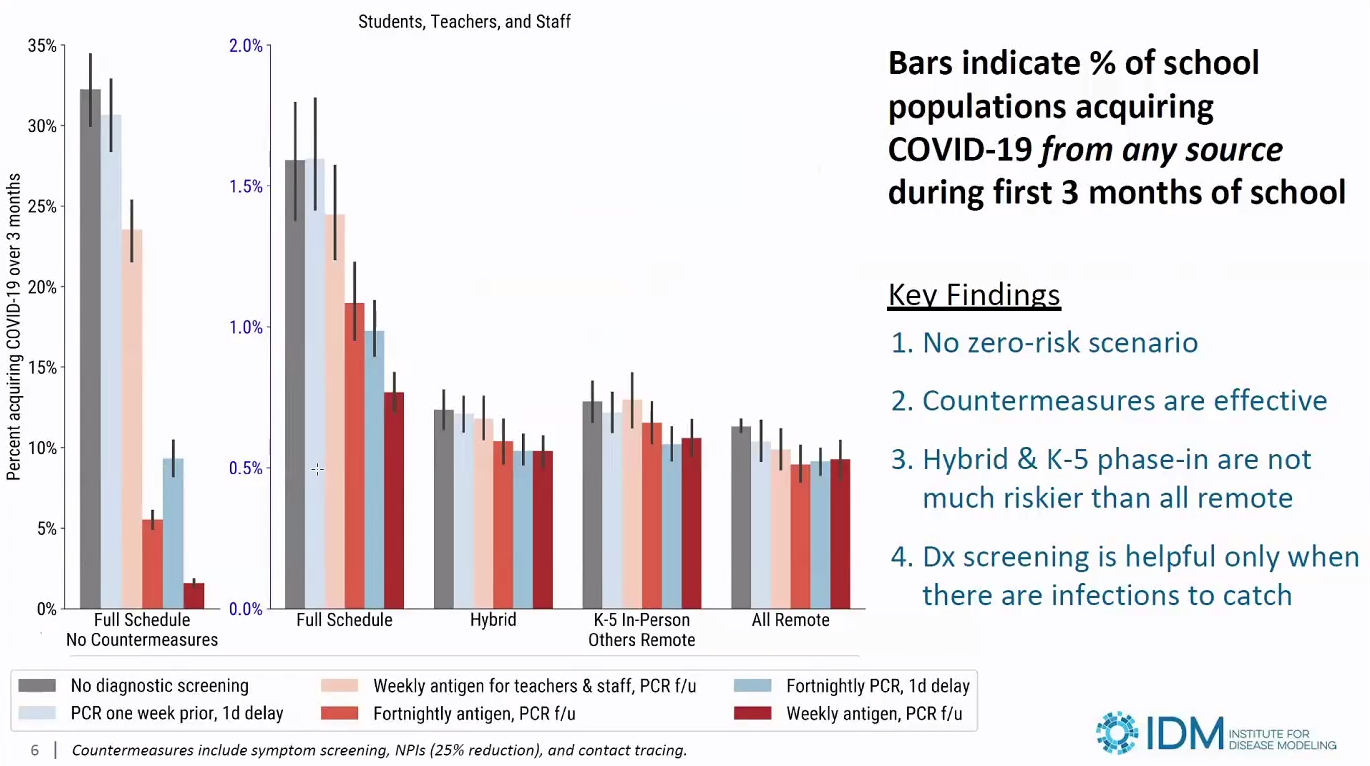
Researchers also looked at the potential usefulness of rapid diagnostic tests to supplement traditional PCR tests to help prevent outbreaks. Antigen tests, like the BinaxNOW test, can return results in under 15 minutes, but there is little research on how effective they are in detecting infections in asymptomatic people.
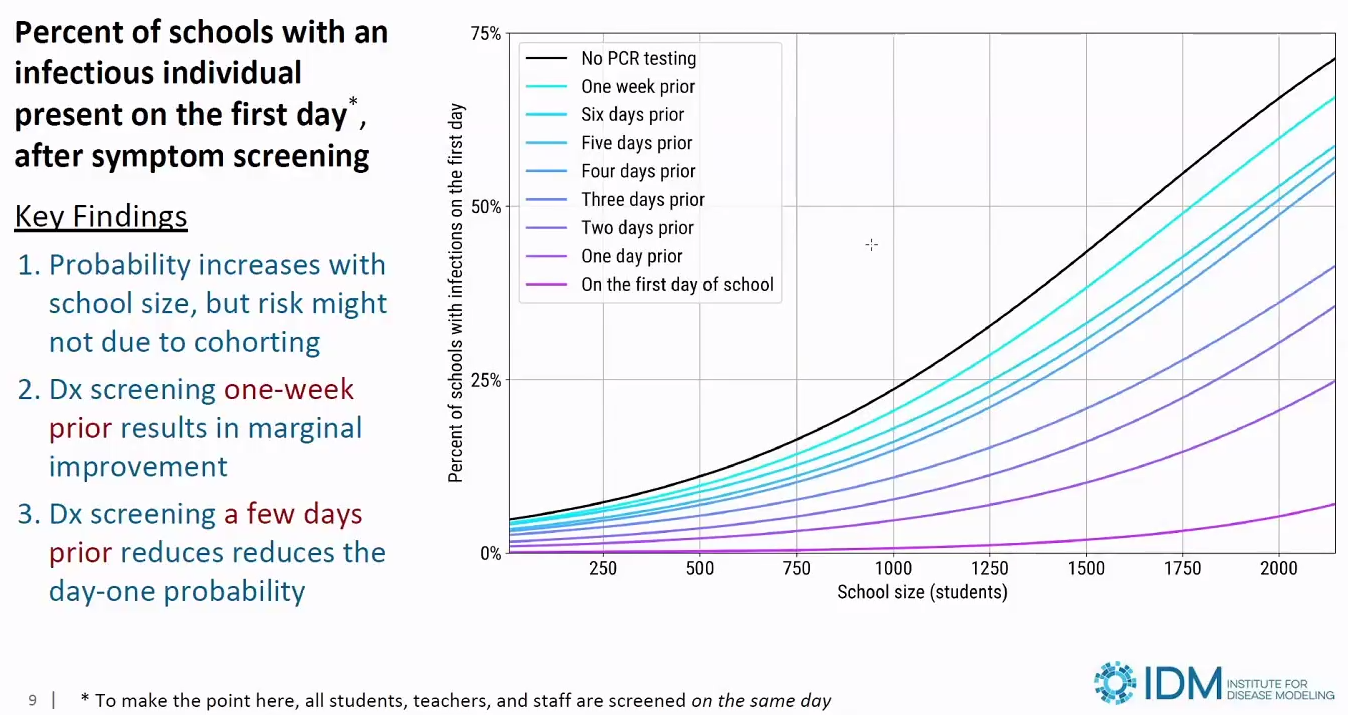
"These latest results indicate that the benefits of routine diagnostic testing will be limited if COVID-19 prevalence is low and if school-based countermeasures can be fully implemented," said Dr. Daniel Klein, senior research manager at IDM. "Of course, diagnostic testing remains valuable for disease detection and response, and for assessing school community prevalence."
Dr. Kathy Lofy, the state health officer, said the Department of Health is still considering the best way to use rapid testing in schools, and about a million of the state's stockpile had been set aside for potential future use. Others were sent out to community health centers and hospitals across Washington. Another challenge, Lofy said, is that many schools do not have nurses to perform the actual testing on-site.
While the modeling shows some hopeful prospects for resuming class in the future, it's unlikely to change the immediate outlook, as coronavirus activity continues to grow in much of the state. On Wednesday, Washington reported its highest-ever increase in cases in a single day, and about 20 of the state's 39 counties have a rate of new cases in the highest bracket.
"We are concerned about the rise in cases we are seeing generally in Washington state and across all age groups," Fehrenbach said. "When we are in a status where we are seeing a rise in cases, that's not the ideal time to be expanding learning."
State health officials continue to urge all Washingtonians to recommit to public health recommendations, especially by limiting gatherings and social activities and wearing face coverings any time you are interacting with a person from outside the home — even family and friends.
"I'm extremely concerned about our state's increasing trend in COVID-19 activity, we are clearly in our fall surge," Lofy said. "Many of the public health experts have agreed that we are in what will likely be some of the hardest months of our pandemic."
Lofy said state research has shown consistent use of face coverings when out in public, like going to the grocery store or running other errands, but very apparent gaps when it comes to wearing a mask in informal social situations, like a small gathering among friends.
Despite the latest wave of cases, health officials remain confident the trends can be reversed if everyone employs a little more caution.
"This is the result, I think, of all the decisions that we make in our personal lives," Lofy said. "I do think that we can drive our numbers down and get our kids back into school if we all can commit."
Washington coronavirus links:
Get more local news delivered straight to your inbox. Sign up for free Patch newsletters and alerts.