Schools
After Student Seen On Roof, Shoreline School Faces Inquiry
Last October, a special needs student climbed onto the roof of her Shoreline school. Now, school officials are probing the incident.


SHORELINE, WA — While cleaning windows in her apartment on Oct. 6, a woman spotted a terrifying sight at the private school next door — a young girl on the roof. She called 911 and captured the 12-year-old’s escapade atop Pacific Learning Center Northwest on her cellphone.
“So, there's a child hanging off the roof,” the woman says in the video, which was published in a Patch story.
In the video, the girl can be seen scaling the pitched roof. She got down on her belly and peered over the edge. Then, she jumped onto the roof of another building. Finally, she leaned over the edge and banged a stick against the side of the building.
Find out what's happening in Shoreline-Lake Forest Parkfor free with the latest updates from Patch.
The episode lasted about 20 minutes and ended when the girl climbing down to safety before police arrived, public records show.
The student’s rooftop ordeal that day wasn’t an isolated incident, Patch has learned. Last year, students reportedly climbed up on the school’s roof at least three times, police said.
Find out what's happening in Shoreline-Lake Forest Parkfor free with the latest updates from Patch.
And there's more. Between January 2016 and October 2017, there were more than three dozen calls to police from the school. In 2017, 13 calls dealt with issues like students running away and into traffic, threatening self-harm or damaging school property, according to records obtained through public records requests.
Now, the state superintendent’s office (OSPI) has asked Shoreline public schools, which supports Pacific Learning Center's license, to launch an inquiry into the girl-on-the-roof incident.
OSPI spokesman Nathan Olson said the request was made even though no formal complaints had been filed against the school.
“More than likely, if a public-school kid was on the roof, there would be a lot more done a lot more quickly. Our agency is reactive,” Olson said. “We’d like to know what’s going on.”
After video of the girl-on-the-roof became public last October, Pacific Learning Center’s executive director, Dan Hanson, wrote a Facebook post defending how the school handled the incident.
“The angry woman and [a reporter’s] question why we didn't go after the girl. The answer is none of their business, frankly, and probably beyond their ability to understand. We followed best practices,” Hanson wrote.
That “angry woman,” who asked to remain anonymous fearing retaliation, said she doesn’t want to see another kid playing up on the roof, or worse.
“I just want this to [shed] light, and shut this place down,” the woman said.
Staff: Roof Was Student’s “Safe Space”
Pacific Learning Center Northwest, located at 14550 Westminster Way North, has 16 staffers, including Hanson, and serves 36 students with emotional and behavioral disorders or autism. Some of the kids also have PTSD, Hanson said, and so staff treat students delicately during emotional episodes.
“Traditional, aggressive responses are not safe for kids with a heart full of terror and a past full of trauma,” he said.
In the case of the girl on the roof, Hanson insists there’s another side to the story that wasn’t caught on camera and shared on social media.
Shoreline police did not create a case file for the incident. But in an interview Hanson and school social worker Kimberly Curtner described the Oct. 6 incident this way: Teachers and staff followed school policy when they let the student leave the school while she was experiencing a crisis.
Often, students are allowed to walk out of class to find a “safe space” when they deal with a crisis. They’re also encouraged to blow off steam in the gymnasium, or relax in themed rooms in the school’s basement, Hanson said.
Curtner said the girl’s safe space is the roof, and the student’s parents allow her on the roof at home.
Around 10:30 a.m. that day, the girl scaled the fence that surrounds the school and grabbed a light fixture to pull herself up on the roof. Six teachers “monitored” the girl as she scaled the building. They put up a ladder, but the girl found her own way down before police got there.
Curtner said the girl was allowed to climb up on the roof because staff did not want to risk triggering a “PTSD flashback.”
“The chance of triggering is higher than her falling off the roof,” Curtner said. “We don’t want to push it. It could be days or weeks of dysregulated behavior had she been triggered.”
Hanson stands by the school’s policy not to physically restrain students unless they pose “a threat to themselves or others,” and insisted that wasn’t the case that day. He also says the school will usually expel a student who leaves the school without permission, but not in this student's case.
“We know she left the building. There were eyes on her,” Hanson said. “Leaving the building, she is not a threat to herself or others.”
The school's approach does have mainstream support. One influence is Dr. Ross Greene, an author and child psychologist. The school also uses techniques from the Child Mind Institute and the Post Institute.
The girl’s parents, who live in Seattle, declined an interview request through Hanson and did not respond to a second request directly from a reporter. But in an online review, the girl’s mother lauded the school’s approach.
“Our child travels 45 minutes to get to school, because we love it! The staff makes sure kids are emotionally safe first and foremost, which was something we could not get the other school to understand. They are not trying to control the kids, but to help the kids develop self-control and the skills they need to be successful,” the girl’s mother wrote.
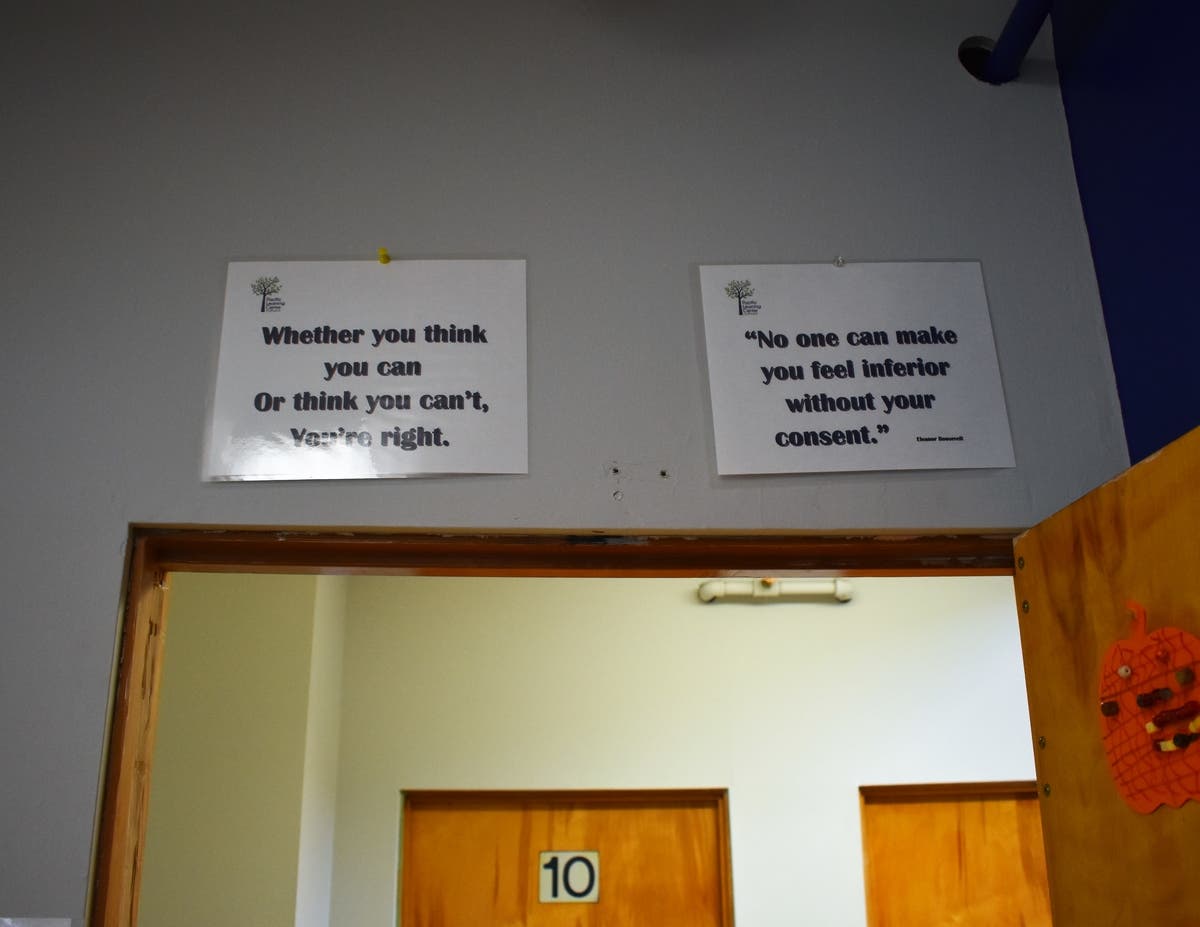
Hanson orders improvements to the school when the need arises, particularly for student safety. For instance, after the October incident, Hanson said he had staff remove the outdoor light fixture that the 12-year-old girl used to gain rooftop access. And after a different student sought refuge on the roof last year by climbing a tree, Hanson said he had the tree’s limbs trimmed.
“We try to be scrupulous and cautious in advance … We do try to maintain as much safety as possible and take care of the obvious things when they arise,” he said. “If it’s something we hadn’t noticed, we’ll respond to it.”
A Spike In Police Calls
Since 2016, police have responded to an increased number of 911 calls at Pacific Learning Center Northwest, public records show.
Indeed, police responded to 38 dispatched calls for service between January 2016 and October 2017 — compared to 17 911 calls between January 2014 and December 2015 combined, records show. Some of those emergency calls involved students getting into dangerous situations after leaving the building during school hours, including (some calls dealt with non-school issues, like people loitering in the parking lot):
- On June 19, police responded to the school after a 17-year-old student began breaking windows with rocks from the outside. The student was carrying scissors and a “stick with a nail embedded in it,” according to police records. Staff followed the student around but did not restrain him.
- On March 13, a 12-year-old student left the school and began running into traffic along Aurora Avenue and other major local streets, according to police records. The student had told staff previously that he “wanted to walk into traffic so he could get hit by a car.”
- On April 11, a 12-year-old girl climbed up on the roof and began “running around and yelling.”
- On April 20, a 12-year-old boy climbed up onto the roof and climbed down a chimney. The fire department was called, but the boy climbed out of the chimney and down off the roof before firefighters arrived.
- On Jan. 26, 2017, an 11-year-old student left the school and began running “in and out of traffic” along North 145th Street, the major four-lane artery just south of the school. The student eventually left the roadway and a parent came to get him.
A Shoreline police officer who responded to a 911 call about an escaped student in July talked to school administrators about possibly locking doors.
After that conversation, and a noticeable spike in police calls, Hanson said he met with the school's board of directors. They decided to stop accepting students with high-risk behavioral issues. Hanson said the school transitioned four of those students to a lockdown school, but did not provide written proof of a policy change.
The school’s methods do not work with every special needs student, he said, but it has worked very well for the right type. Since last spring, the school has transitioned three students back to public school and have had two graduate. The overarching goal is to rehabilitate students so they can return to public school.
“If we continued to have higher risk students, we would have to have [a locked-down school]. We are not made for students who are high-risk or a danger to themselves or others,” Curtner said. “So, we chose not to be as open to these students.”
School License Up For Renewal
Typically, the state does not have much authority to investigate private schools unless an official complaint has been filed. In Pacific Learning Center Northwest’s case, a call from a reporter prompted the move.
On Jan. 10, the state special education director asked the Shoreline School District to probe the roof incident. Shoreline officials are asking the school for information about the event and may make an on-site visit, according to spokesman Curtis Campbell.
Hanson said the investigation was unusual in his experience as an educator.
“This is the first time in 42 years [of teaching] that a student’s behavior has merited this level of attention,” he said.
“Yes, the girl on the roof was a bad thing; calls to the police for help are to be avoided; but we are considered a viable placement for some special-needs kids because of our approach, which is cognitive-behavioral and collaborative in nature," he wrote in an email.
Pacific Learning Center Northwest is certified as a “non-public agency” by the state. That designation allows private schools to receive reimbursement from public school districts for educating students (parents can also pay tuition, which fluctuates based on the student). There are only 23 NPAs statewide. Shoreline sponsored Pacific Learning Center Northwest’s 2015 certification, which is up for renewal this spring. Shoreline’s inquiry into the girl-on-the-roof incident is separate from the NPA renewal process.
Hanson said his school already faces a lot of “scrutiny” from the public-school districts it serves.
“We have a public school in here virtually every week,” Hanson said. “And we’re required to report any behavioral problems or incidents in a progress report.”
Hanson also said that he has regular contact with OSPI, but the school has never been the subject of an investigation. Hanson has said he will cooperate with Shoreline’s inquiry.
A Tour With The Girl-On-The-Roof
In November, Hanson invited a reporter to take a tour of the school. He arranged for the girl who climbed up on the roof to lead it.
The 12-year-old, animated but shy, munched on a cheese sandwich as she walked through the school’s wide, squeaky-clean hallways. She first showed the gymnasium, a bright space with high ceilings that used to be a church worship hall.
Walking through classrooms, young teachers talk with students, and classrooms are adorned with whiteboards, Ikea furniture, and flat-screen TVs. In one classroom, students played with a pair of guinea pigs. In another, students played with a puppy.
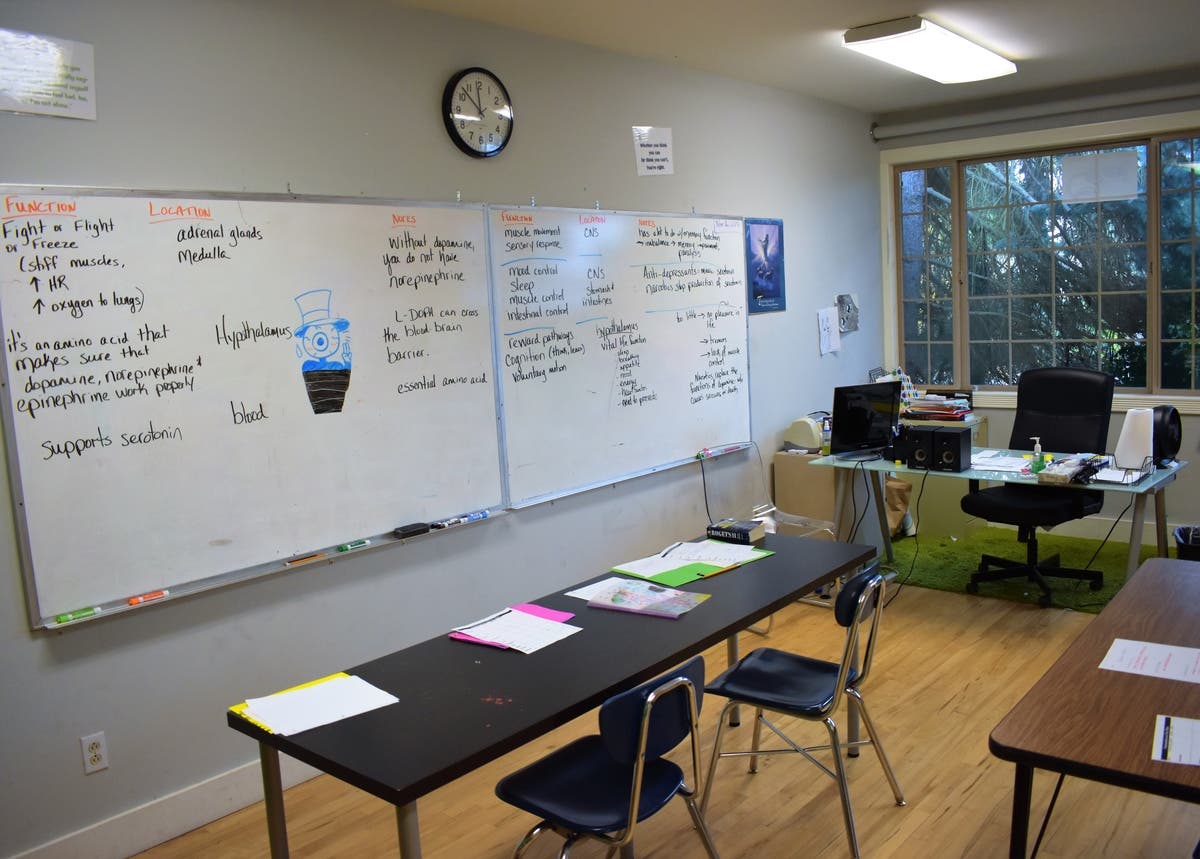
Down in the school’s basement, the girl showed off rooms where students can seek refuge including the “chillax room” — a windowless space packed with couches and a comfy rug. The girl says kids go there to calm down when they’re having a hard time.
Upstairs, she showed off the “boring room,” which looks like a regular classroom that had been emptied of everything but light fixtures. Located on the top floor, a bank of windows provides a view of the sky, but the walls are damaged and look like someone hit them with something. Curtner didn’t offer an explanation about walls. The girl says the boring room is a place she considers a punishment, like detention.
Hanson says that the boring room is a place for kids who act out. Teachers “strongly encourage” students to go there when they’re having a difficult time in class, but teachers never physically force them into the room.
The girl ended the school tour on the playground — a large space enclosed by a chain-link fence along Westminster Way. A male teacher and about a dozen students were playing merrily under a gray November sky. After chatting with her classmates for a few minutes, the girl suddenly sprinted toward a swing set.
In an instant, she shimmied up a pole. Atop the swing set, about 7-feet off the ground, she stood up and raised her hands in a “V” like a gymnast after nailing a perfect dismount.
No one asked her to get down.
Photo provided by anonymous Shoreline resident
Get more local news delivered straight to your inbox. Sign up for free Patch newsletters and alerts.