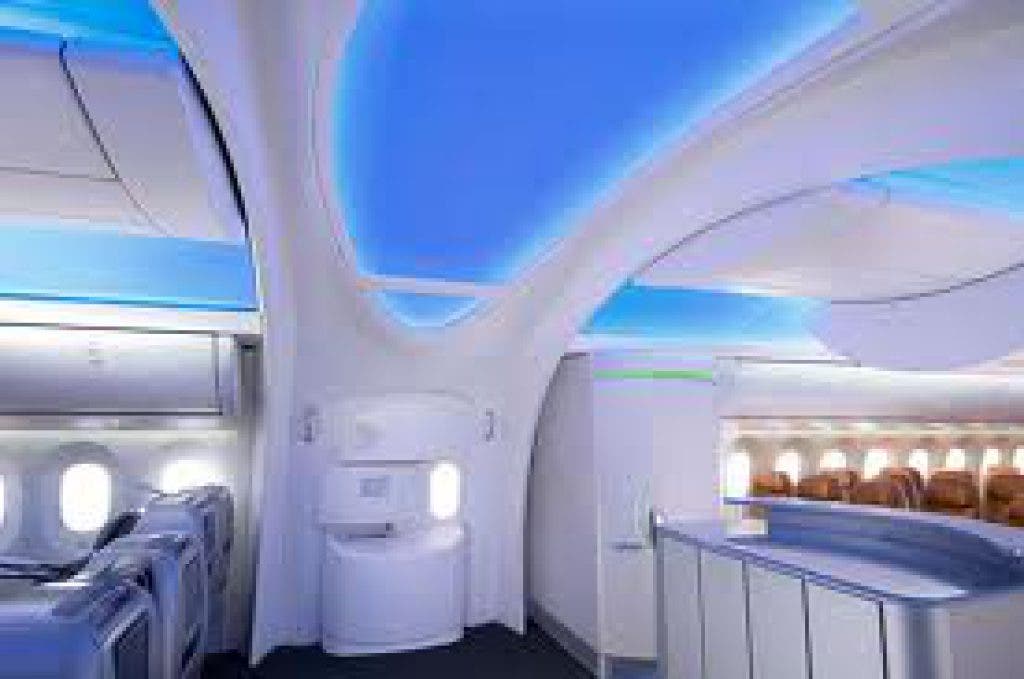


On Friday, August 26, 2011, Boeing received FAA and EASA (European) certification for commercial use of the new 787 Dreamliner! It’s been a long time coming. The plane is three years late and while it’s piled up huge orders- about 830- it’s also suffered large cancellations and huge additional costs. But now we celebrate.
There are real reasons why flying at all is environmentally unfriendly. It requires great amounts of fuel per passenger-mile, the emissions (soot, nitrous oxide, CO2, etc.), where they occur (high in the atmosphere), the cloud cover the exhaust induces, the refinement of petrofuels, the area an airport removes from biopositive uses, and all the rest make the true carbon impact of flying about twice the raw engine CO2 output, but it still makes sense to make our planes ever more efficient and green.
The Dreamliner is a significant improvement in a number of ways. It’s the first composite airliner- 50 percent by weight carbon fiber reinforced polymer- stronger than steel, lighter than aluminum. With its new engines, the Rolls Royce Trent 1000 or the GEnx-1B, it burns 20% less fuel, puts out 20% less CO2, and is 60% quieter on takeoff and landing than any other plane its size. That’s so quiet sound louder than 85 decibels never leaves airport boundaries.
Find out what's happening in Shoreline-Lake Forest Parkfor free with the latest updates from Patch.
I think of this very much like the “Cash For Clunkers” program. Each 787 put in service will replace an older, much less efficient, dirtier airliner, so not only is it better in and of itself, it eliminates what would have been emitted.
Additionally, it’s not just a matter of the plane in flight, but of how it’s made and the manufacturer’s overall environmental performance. 787 is manufactured using fewer hazardous materials and is designed to be recycled at end of service. Because of its composite construction the huge main fuselage barrel saves 1500 aluminum sheets and over 40,000 rivets and other fasteners, needs much less maintenance and all the chemical, energy, time, and financial resources that might otherwise have been required to do it. Of course, the flipside is that its components come in from all around the world, and are brought in by jet. Talk about starting out in a carbon ‘hole’!
Find out what's happening in Shoreline-Lake Forest Parkfor free with the latest updates from Patch.
Boeing is pioneering the use of biofuels to replace or at least supplement petrofuel in aircraft, and if algae-based biofuel is perfected it needn’t take a single acre out of food-plant production. They are working to restructure the air traffic control system so planes will be able to take the most efficient routes and approaches, thus saving significant time and energy. The factories, which already utilize extant heat instead of using a central heating system, and other company facilities are being remade as well to reduce their footprint.
I have no solid numbers, but I believe there must be hundreds of Boeing workers here in Shoreline/Lake Forest Park. What is certain is that this area is rich in Boeing connections, and not only because the big plants are only a few miles away in either direction. What would become Shoreline was home to William Boeing, the founder, Malcolm T Stamper, former President, and William M “Bill” Allen, former CEO, all residents in The Highlands. Indeed, what runs through The Highlands? Boeing Creek.
I’ll admit my bias: I’m a guide at the Boeing Factory Tour and I’ve been a Boeing fan for decades- not the starry-eyed kind who accepts anything management says unquestioningly (I mean Chicago? South Carolina? Really?!), but the kind who admires their technical masterworks, their commitment to the highest quality, their sense of vision and their historic flashes of daring and nerve. I really want to believe we can make planes and the aviation system so much better we can continue to fly, even if less often, and I think Dreamliner is a big step in that direction.