Health & Fitness
City of Shoreline - Local Control Versus Community Good
The benefit of local control may be outweighed by other concerns in the propose purchase by the City of Shoreline of Seattle Public Utilities.
The City of Shoreline staff has been discussing negotiating with Seattle Public Utilities (SPU) to purchase the Shoreline section of SPU water system. The justification put forth is that this would provide local control and taxes collected would go to Shoreline instead of Seattle.
The idea of local control and tax money staying local has merit. However, after examining documents obtained under the Freedom of Information Act and discussing the details of the proposal with water engineers and utility experts the benefit of local control is outweighed by other concerns.
Points of Contention on the Propose Purchase of Seattle Public Utilities:
Find out what's happening in Shoreline-Lake Forest Parkfor free with the latest updates from Patch.
Commercial costs passed to ratepayers
At a recent Pro Shoreline meeting someone asked why ratepayers should pay for the cost of upgrading the water system for commercial development.
A councilmember who was present said "that is exactly what we are asking you to do."
Find out what's happening in Shoreline-Lake Forest Parkfor free with the latest updates from Patch.
There are two problems with that.
One, it is illegal to make ratepayers pay the cost of commercial upgrades.
Second, even if the City were able to find a way to work around the law, that is no guarantee in this economy that commercial developers would then descend on Shoreline bringing jobs and businesses in their wake.
But that is what the City staff is counting on so they can collect permit fees and the increase in sales tax associated with increased business.
Unlimited taxing authority
There are limits for tax rates for many things, but there is no statutory limit on how high a city can raise the tax rate on its own water utility.
When I mentioned this to a city council member his response was if I was worried about that, then I don't trust him to keep the tax rate low.
It is irrelevant whether I trust him or not. He likely won't be on the council in 2020 when the acquisition takes place. They are asking us to trust a future council we don't know to keep taxes at a reasonable rate.
Unreliable figures
They are also asking us to vote for something when we don't know the cost. The purchase price will be at least 26.6 million we are told. Seattle Public Utilities has spent $20 million on the Aurora Corridor project and it is not finished yet. They are going to want to get as much of that back as they can.
There are many issues that could affect cost that was not examined during the Ad Hoc Committee meetings. Public Works Director, Mark Relph has said that it would cost too much money to do the due diligence required to answer those technical and budget questions. So again we are not really sure how much it is going to cost for upfront costs, separation costs and operations.
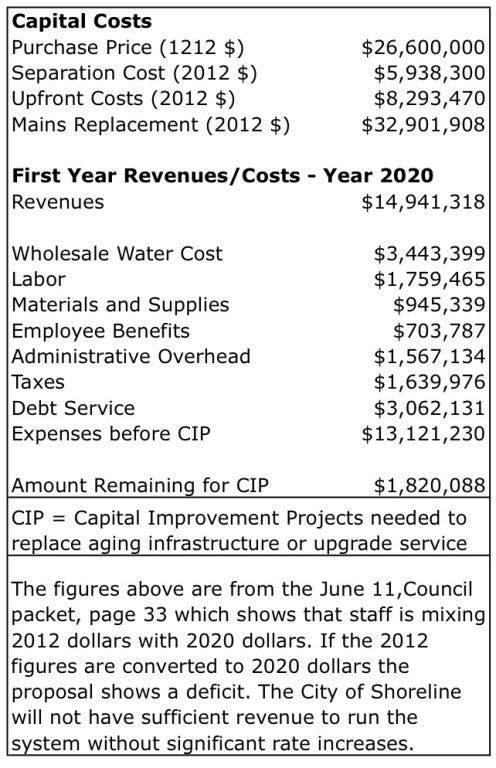
Their current estimate in 2012 dollars is $32,901,908 for purchase, separation, upfront costs and main replacement. But then add 4% per year between now and 2020 to convert to 2020 dollars it is quite a bit more.
To make the case for this Assistant City Manager Debbie Tarry mixes 2012 dollars for purchase and separation with 2020 dollars for income and operations and says the budget pencils out. If you convert everything to either 2020 dollars or 2012 dollars it does not pencil out. (see boxed figures)
So we are asked to vote for something where the current figures they have are unreliable, additional costs have not been factored in and where we are giving the city unlimited taxing authority.
Affects on current budget
The City already anticipates a budget shortfall in 2013 because Prop 1 in this economy is not bringing in the revenue city staff anticipated. In order for the City to complete the due diligence they need to determine final costs, Mark Relph has already admitted it is going to take a lot of money.
This means they are either going to have to borrow money, or reduce services they pledged to support in the Prop 1 campaign or both.
The City of Shoreline is currently on the hook for servicing bonds on City Hall from the general fund because they not collecting rent for the fourth floor as originally planned. Instead senior staff enjoys the views on the fourth floor and the third floor remains vacant in today's economy and with cheaper rents just over the border in Snohomish County. So again they have no wiggle room with regard to the current budget without cutting services, cutting staff or reducing benefits.
Lack of expertise
If the voters approve this plan we anticipate the city will start spending money immediately to determine final costs. In 2018 they plan to hire two people to job shadow SPU so they can learn how to operate a water utility. So the City is asking voters to approve purchase of SPU when they do not currently have the expertise to know what they are getting into. (Surface Water management is not the same as running a potable water supply)
Another alternative is to contract back to SPU to run the system. In that scenario we are asked to vote to buy the system so we can have local control but Seattle will still be running the system.
Other stakeholders not included
Olympic View, City of Edmonds, City of Lake Forest Park, City of Woodway and Snohomish County residence will all be affected by the purchase and they were not allowed to provide information or do more than observe during the ad hoc committee meetings. We are being asked to vote on something that will affect all of these communities. The City Council should delay voting to put this on the ballot until after all stakeholders have had a chance to provide valuable information. Shoreline's go it alone attitude sets a precedent that may make future collaborative efforts on such things as traffic and surface water management potentially contentious.
Multiple legal challenges possible
There were multiple Open Meetings Act violations during this whole process. Is it legal to financially obligate a future city council and staff to something that by 2020 may not be supported by conditions needed to follow through? The language on the ballot gives permission to purchase instead of a mandate but the city will have spent so much money on the project by then that it would be difficult to justify writing it off and abandoning the project.
As mentioned earlier it is illegal to require ratepayers to pay the cost of commercial upgrades.
Citizens on the East side will be voting on this but it will be only citizens on the west side that are footing the bill. At least at first.
Your rates will go up
Once the City owns SPU they will be able to take over Shoreline Water District (SWD) by assumption of the system. Then they will be able to raise the rates of former SWD residents to equal that of the rate payers on the west side, further allowing them to invest rate payer dollars into commercial upgrades.
SPU is planning to raise rates 3% to partially make up for the loss of revenue due to the sale. Shoreline has said they will provide service at the same cost as SPU, which means they can raise your rate 3% and still match SPU rates.
The Southeast area controlled by SPU will not be part of the purchase. The City of Shoreline reserves the right to purchase that area at a future time. Will this be financed by another bond issue or will there be sufficient revenue from taking control of Shoreline Water District and raising those rates to make the purchase? We don't know.
There is something terribly wrong with the City of Shoreline's assumption:
That they can buy and run the system for the same cost as SPU does to just run the system. SPU has the benefit of operations of scale and they already own the system. How can the City of Shoreline spend your money buying the system, spend your money separating the system out, spend your money learning how to operate the system, then operate the system all for the same amount of money SPU spends just to operate the system?
City of Seattle does not like the plan either
The City of Seattle does not like this plan any more than we do. In internal notes they anticipate that it will not pencil out. They expect this idea to die, because it does not make financial sense and because there is citizen opposition. Seattle City Councilmember Richard Conlin said at the July 17th hearing that he does not want to see the City of Seattle get between the City of Shoreline and their citizens. The City of Seattle will take a loss if this goes through but they do not want to be the reason this proposal fails.
By giving permission for the City of Shoreline to put this on the ballot they can then hope and pray that it fails at the ballot while still staying in the good graces of the City of Shoreline Staff.
Bob Ransom, former mayor of Shoreline has said that the reason the staff is so eager to get this approved now is because Mayor McGlashan and Mayor McGinn are good friends. There is a good chance that Mayor McGinn won't be re-elected and thus if this is not approved now it likely never will be.
If that is true, is that a reason to justify putting this on the ballot for citizens to approve? Shouldn't a decision of this magnitude be based on sound financial planning? We have yet to see "sound financial planning." We have seen optimistic numbers based on unrealistic expectations for future growth and Tacoma based engineering costs that outside groups with the expertise to know better say are not likely to be realized.
Take action
If you don't want this to go through please show up Monday night July 23rd at the Shoreline City Council meeting and testify. Ask the City Council to either vote this down or delay until the final costs for the system can be assessed and a State Environmental Policy Act (SEPA) review is completed.