Health & Fitness
Northwest Solar Summit Delivers
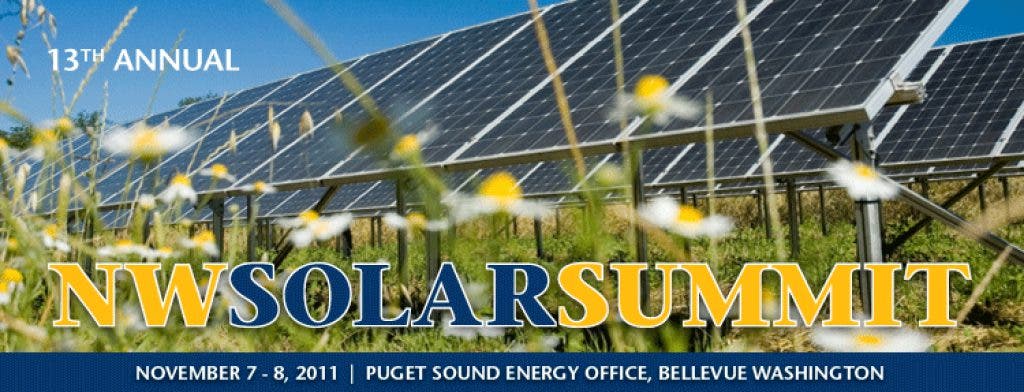
Northwest Solar Summit ended with an action plan for moving the State towards Carbon Neutrality by 2030.
Most conferences provide a "feel good" experience, people share ideas and then everyone goes home to business as usual.
NW Solar Summit was not that type of conference.
What made this conference different? On the second day participants were asked to work is small groups to identify the key elements presented from the perspective of what actions need to be taken to increase adoption of clean energy alternatives. Specifically what policy changes are needed to support the growth of the clean energy sector?
Find out what's happening in Shoreline-Lake Forest Parkfor free with the latest updates from Patch.
Participants were asked to volunteer to serve on an advisory committee at Shoreline Community College to continue the conversation and take action to promote policy changes at various levels of government.
This is relevant to small businesses because this effort can make clean energy more affordable and accessible. If done right, adoption of clean energy has associated benefits such as an increase in US manufacturing, jobs and increased revenue for business and consumers alike, not to mention balancing state budgets.
Find out what's happening in Shoreline-Lake Forest Parkfor free with the latest updates from Patch.
There were many good suggestions for policy changes. One suggestion that was mentioned repeatedly was the adoption of "Feed In Tariff" (FIT) system.
Wikipedia explains the purpose of a FIT:
"The goal of feed-in tariffs is ultimately to offer cost-based compensation to renewable energy producers, providing the price certainty and long-term contracts that help finance renewable energy investments." "It achieves this by offering long-term contracts to renewable energy producers, typically based on the cost of generation of each different technology."
Specific proposals need to be looked at to see how things would pencil out for utilities. One option suggested for study was the idea of Seattle City Light adopting a FIT and a loan program for commercial and home owner customers. The income from the loans would provide revenue to offset their cost for a FIT program. A cost benefit analysis needs to be done to better understand this option.
Smart Planet published an article about the need for Feed In Tariffs on November 9th. It gives a very clear description of how it works, why it has not been more widely used and why it is such an important tool. Paul Gipe author of "Wind Energy Basics" and one of the speakers at the conference is quoted in this article.
Another idea that rose to the surface repeatedly was to shift from prescriptive to performance based construction and land use codes as a way to embrace existing alternative energy technology and to be able to accommodate the constant influx of new innovations.
For example Dennis Hayes gave an eloquent presentation featuring the planned Bullitt Foundation building. As designed the building would not be acceptable to current City of Seattle building standards. Yet the design is vastly superior to anything acceptable under current code. The Bullitt Foundation was able to discuss the intent of the design with the Seattle building department and get the existing codes waived. Who knows if your average contractor with a great idea would get the same treatment. This is where adopting performance based code guidelines would remove a barrier to construction and remodel of superior energy efficient buildings.
The overarching message of the conference is that if we extend the 2030 Challenge (being carbon neutral by the year 2030 in the built environment) to transportation our state "can achieve a truly renewable energy economy by 2030. Sixty percent of Washington State's carbon emissions comes from transportation so it makes sense to include transportation in the overall strategy.
Turns out that is also a way for consumers to save money. According to "Washington Sunrise 2030" magazine published for the conference Washington residents use 141 million barrels of oil per year primarily for transportation. At $90 a barrel, that's 12.7 billion being pumped out of our economy, money that could be used for cleaner transportation technology.
Using solar technology for recharging electric vehicles increases the return on investment for solar installations.
According to the National Renewalbe Energy Laboratory without further subsidy, in 2020 Residential Solar will be fully competitive with utility provided hydro in Washington State. By 2025 Residential Solar will be the least cost option in Washington State.
One of the outcomes of the conference was the publication of "Washington Sunrise 2030" that aggregates the information from other studies already done from such reliable sources as the National Renewable Energy Laboratory, Northwest Power and Conservation Council, National Academy of Sciences, United States Energy Information Administration, Washington State Department of Commerce, Bonneville Power Administration and many others.
The Conference was closed on a note of hope with the intent among the attendees to keep working together for a brighter energy future.