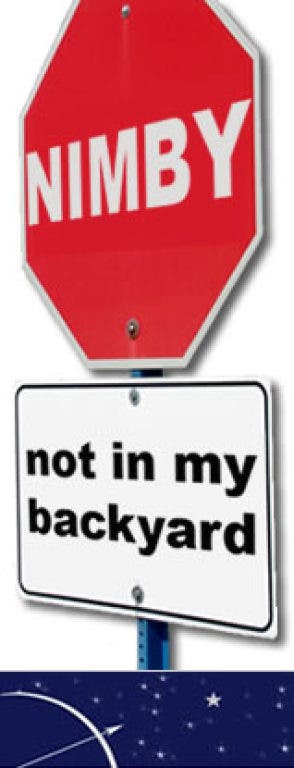
This time, let’s try a little acronym soup: NIMBY, which stands for “Not In My Back Yard”. My bias has always been against NIMBY. I’ve often said “NIMBY is never an argument!” because unless you can give rational, practical arguments as to why some public good that may impact you should be put in some other place it’s just you being selfish, but researching this piece has showed me some nuance I hadn’t considered.
According to Wikipedia, “NIMBY or Nimby is an acronym for the phrase not in my back yard. The term (or the derivative Nimbyism) is used pejoratively to describe opposition by residents to a proposal for a new development close to them. Opposing residents themselves are sometimes called Nimbies. The term was coined in 1980 by Emilie Travel Livezey…”
Peter M. Sandman wrote a wonderful piece about this back in 2008. My definition of NIMBY has always been what he describes as “The purest, most literal example of the NIMBY attitude is opposition to something that virtually everyone (including the opponents) agrees ought to be built somewhere, but virtually everyone would prefer not to live near. Examples include airports, jazz clubs, superhighways, slaughterhouses, prisons, and wind farms.”
Find out what's happening in Shoreline-Lake Forest Parkfor free with the latest updates from Patch.
He adds a number of acronyms I’ve heard rarely or never:
NIABY: Not In Anyone’s Back Yard- Used for people who oppose something not for small, local reasons but because they think a particular project shouldn’t be built at all.
Find out what's happening in Shoreline-Lake Forest Parkfor free with the latest updates from Patch.
NAMBI: Not Against My Business or Industry- Implies that a business is feigning principled umbrage, where it is only worried it may be economically impacted.
BANANA: Build Absolutely Nothing Anywhere Near Anyone- Usually used by developers complaining about resistance to their project.
PIBBY: Put In Blacks’ Back Yards- Speaks to the belief that many LULUs (“Locally Unpopular Land Uses”) are sited in minority neighborhoods through institutional racism.
FRUIT: Fear of Urbanization, Infill & Towers- Used to characterize people who don’t want any density. Intentionally coined to be insulting (“You’re a FRUIT!”) and to be seen as similar to a BANANA.
An entry in the Urban Dictionary puts it this way: “Good NIMBYism: Jane Jacobs opposing the construction of the Lower Manhattan Expressway, which would have eviscerated the present-day neighborhoods of SoHo,
Greenwich Village, and TriBeCa; Jackie Kennedy saving Grand Central Terminal from demolition and replacement with an office tower.
Bad NIMBYism: Fighting the development of a nearby tall building because it might block your view; opposing a new subway line or water tunnel, which would benefit the city for years to come, because of construction noise in your neighborhood; opposing the expansion of the museum across the street because of minor inconveniences, even though it's the primary reason that your property is so valuable. I.E.: Being selfish”
Like the rest of public discourse, Nimby sentiment can be manipulated. Stephen Lacey, on Climate Progress blog, notes “Almost half of clean energy projects proposed in recent years have been delayed or abandoned due to local opposition, according to a March report from the U.S. Chamber of Commerce. That’s a lot of development potential denied.
The causes of this opposition are diverse: Environmental concerns, worries about property values, suspicion of outside developers, and many more. Lots of these concerns are legitimate; many others come from a lack of understanding of the sector, poor communication by local officials and developers, or even from fake “astroturf” opposition funded by corporate special interests.”
So just how ‘Shoreline/LFP’ is this stuff? Let’s take a look at Pt. Wells.
Richmond Beach is all NIMBYed up over the potential development, claiming it is outscale and would dramatically impact their traffic, parking, and other
factors. I’d call this a valid protest insofar as their stated complaints are
factually based, by and large, but is underlain by a strain of ‘keep the
outsiders out’ and simple ‘it’s more change than I want’.
The has garnered plenty of NAMBI response, and a bit of general dissatisfaction with traffic disruptions, but has been broadly welcomed. The went in without huge outcry, perhaps because the city was assiduous about easing the process and demonstrating how the residents would benefit. Sound Transit’s line will likely get much more, probably tilting the choice toward the I-5 option, as there are fewer people around it to complain, despite its lack of strong connections to the rest of the city and our plans.
In Lake Forest Park everybody loves their forests and streams but nobody’s willing to get their buildings out of the way of the floods they’ve induced. Wikipedia had this ethically similar example: “In Alexandria, Virginia, a high-density development in Potomac Yard was criticized by local residents. The
developers in turn accused the residents of hypocrisy for campaigning for their own Washington Metro station while simultaneously opposing the scale of development that would allow the station's construction.”
Once terms are defined the right choice should naturally follow, but of course that’s the problem… Some of this artillery exchange will never go away because it’s often not so much a matter of getting people to agree to do what’s right, but of convincing them of what’s right in the first
place.