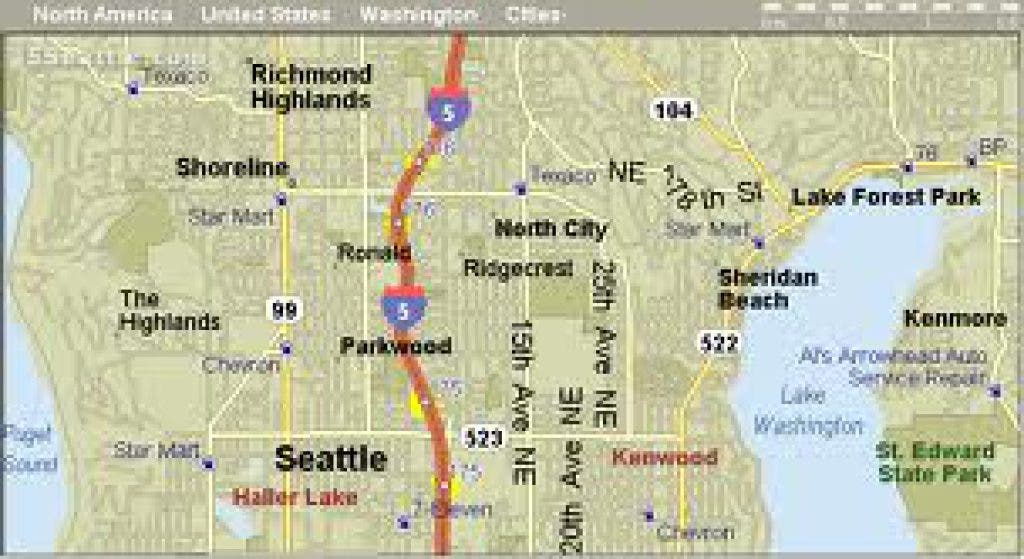
We’re playing Jeopardy, and the answer is: It’s Shoreline’s biggest road in size (eight lanes wide, minimum), in volume (160,000 to 190,000 vehicles per day), and in environmental impacts (cut streams, air pollution, petroleum runoff, tire and brake dust, noise pollution, numerous accidents, whole neighborhoods destroyed or cut off from former neighbors).
The question- What is Interstate Five?
Shoreline’s history is that of our transportation system. First it was a steamship stop, then the Great Northern Railway came through, then the North Trunk Road and the Seattle Interurban Railroad, and finally Interstate 5, each bringing waves of development. Certainly we would not be the same city without all that, but is it the best we can do?
Find out what's happening in Shoreline-Lake Forest Parkfor free with the latest updates from Patch.
If one is travelling by car and the road is wide open you are certainly going to get better mileage at a steady 60 MPH than on a surface street, and collisions are fewer per miles driven, and you can get wherever ‘there’ is faster on average by freeway- and ever faster the farther you go. But then the highway is not often wide open, and stop-and-go traffic sucks gas just as badly on I-5 as it does on surface streets, and while there are fewer crashes they tend to be at higher speeds, and therefore more injurious, and the faster a car is moving the louder it is.
Find out what's happening in Shoreline-Lake Forest Parkfor free with the latest updates from Patch.
The Arizona State Transportation Research Center produced a reporthttp://www.azdot.gov/TPD/ATRC/publications/research_notes/PDF/516RN.pdf in October 2001 on “Impact of Highways on Property Values: Case Study of the Superstition Freeway Corridor “ in the Phoenix area, and though it is mostly ‘rah rah road construction!’ the authors do concede that “While the evidence indicates that thepurchase of a home adjacent to a freeway or any major street is not a good investment in most cases, buyers of homes in the Superstition Freeway study area had access to information regarding existing and pending corridor development, and thus bear the responsibility for their investment returns.” I read that as ‘hey, you bought near it- tough!’.
The Natural Resources Defense Council is much more emphatic. Regarding an expansion of the I-710 freeway in Los Angeles, they claim “The 1.6 million residents along the I-710 Corridor are disproportionately impacted by local sources of pollution and as a result have higher coronary heart disease, emphysema and diabetes mortality rates compared to LA County. Mothers who live close to freeway traffic during pregnancy have more premature and low birth weight babies than the general population.”
In short, while the freeways increase transportation efficiency for private vehicles in regional mobility, they are nowhere near as efficient as rail or well-used transit of any kind over the same distance. Wikipedia has compiled the calculated efficiency of various methods of transportation http://en.wikipedia.org/wiki/Fuel_efficiency_in_transportation . Walking gets an effective 360 MPG and bicycling gets a wonderful 670 MPG! A two-car train of Bombardier double deck railcars as used by Sound Transit would if full get the equivalent of over 460 passenger-miles per US gallon. There are many parameters which go into the efficiency of buses, but diesels can be problematic. If full one might achieve 330 PMPG, but if only 70% capacity that drops to 231 PMPG, and if only 9 people are aboard (what a UK study determined was their average ridership) that goes down to 54 passenger MPG- equal to a single-occupant Prius.
Keep in mind, these calculations are maddeningly complex and fraught with apples-to-oranges-to blueberries comparisons, but still the message seems clear: The farther apart we are- home to school to work to shopping- the less efficient we can be. We must plan, legislate, and actively assist in densifying every incorporated city in the state, because we shouldn’t be allowing any more sprawl at all. Increase nonautomotive transportation dramatically and eliminate public spending on more roads. We’re overpaved and oversprawled as it is. NIMBY is not an argument, just whining.
We used to do most of this right. Our cities were compact and full of transit opportunities. Only the rich owned cars, or before them carriages. I’m delighted we’ve grown our economy to the point where even the nearly-poor can own their own vehicle. I own one and so does my wife, but I dearly wish for the day when I don’t have to, the day when we have reestablished transit within a few blocks of anywhere and where every neighborhood has all the amenities one needs right there. The most basic problem is we’ve sprawled out our cities so far that everyone needs a car.
One side claims ‘let the Market work’ and the other that The People demand cars. Well, yes, to some degree, but much of the demand is precisely because our cities don’t support pedestrians. We’re starting the good work with the Aurora Corridor Project and the Green Streets demonstration, but as useful as they can be under some circumstances they are a hugely wasteful addiction, too. “The Market” can be useful in this transition despite its essentially fictional nature if we level the playing field. If we systematically removed all subsidies for fossil fuel use those huge costs would no longer be conveniently invisible, but paid up front. People would ‘vote with their pocketbooks’ for the more efficient option and would wonder how foolish we were not to have built it all out before then.
We’ve seen this work. The last time gas prices spiked every transit system in the nation made ridership records, and not all those riders reverted to cars when prices eased. Key is funding transit through the transition so they’re there for us when we demand it. Let’s start by stopping all the billions of federal dollars the oil companies get each year even as they pillage our wallets. In the process we will rediscover our neighbors, reestablish our creeks, rebuild our communities, and live longer and better. A pretty good trade, I’d say.