Neighbor News
Tenth Amendment vs. the Federal Government
Does the federal government have the legal right to ban anything? The answer isn't as easy as you think.

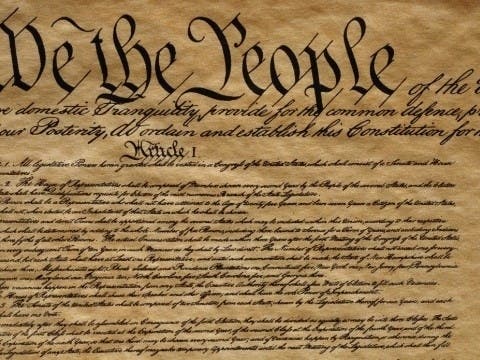
We had a couple of unfortunate incidents in Wisconsin schools recently. One with a pellet gun, one with a knife. Of course, this has rekindled the gun debate with calls for "common sense gun control" as if it isn't a violation of the Constitution. Of course, both actions violated current laws and no new law would have stopped either incident, but the gun grabbing left has never let facts ruin a good opportunity to spew their rhetoric.
This has also spurred a return to another topic that, while under covered, is just as relevant. Are any of the thousands of federal bans currently being enforced constitutional? At first blush, most people (including this author before researching) would say, "Of course. A code of laws is what a civilized society is about!" However, many of us also forget that, at the writing of the Constitution, the intent was to have a comparatively weak federal government who was mainly responsible for international relations and national defence. From the end of the Revolutionary War in 1783 until the ratification of the Constitution in 1788, we were a loose confederation of individual countries. Each state issued their own currency, made trade deals with each other, and essentially acted like individual nations. Most states wanted to keep some, if not all of that autonomy.
"Ok professor Tim...get on with it!" I know... history and backstory is a little dry, but it is important. Laurence M Vance at the Tenth Amendment Center lays out the argument quite plainly:
"Well, first of all, in Article I, Section 8, of the Constitution, there are eighteen paragraphs that enumerate the limited powers the Constitution grants to Congress. Limited powers. Very limited powers. Four of them concern money or taxes. One concerns commerce. One concerns naturalization and bankruptcies. One concerns post offices and post roads. One concerns copyrights and patents. One concerns federal courts. One concerns maritime crimes. Six concern the military and the militia. One concerns the governance of the District of Columbia. And the last one gives Congress the power “to make all Laws which shall be necessary and proper for carrying into Execution the foregoing Powers.” Since the Twenty-First Amendment Repealed the Eighteenth, nothing in any of the Constitution’s amendments gives the federal government any additional power to ban something."
Find out what's happening in Greenfieldfor free with the latest updates from Patch.
He does make a good argument. However, there are phalanxes of lawyers who are ready to take a metric buttload of cash to twist Article I, Section 8 into enough pretzels to make Mr. Salty jealous.
What do I think? I'm glad you asked. I'll freely admit I get real nervous when the extreme ends of our political spectrum start calling for bans (not nearly as nervous as when the neo-anarchist libertarians start squawking, but that's a different article) because of the precident it sets. There is something to be said for uniformity. At the rate we are going, it's hard to keep up with one state's laws, let alone 50. Interstate commerce (way more relevant today in the internet age) would be a nightmare.
Find out what's happening in Greenfieldfor free with the latest updates from Patch.
The federal government has way exceeded its authority on many, many levels. State and local governments are just as bad. If I want to sit in my front yard with an open beer and fire off my cannon on the Fourth of July, I should be able to. The problem is, where do we draw the line and how do we modify the US Code in such a way to bring it back into line with the Constitution? Is it even possible?