Schools
Whitnall Teacher Pushes Students Beyond Classroom
Laura Cerletty, a science teacher at Whitnall High School, worked closely with a software and technology company in Oregon to create an anatomy lab designed for high school students.






At first glance, there is nothing out of the ordinary about Laura Cerletty’s Anatomy and Physiology class.
Some of her students squirm when told how to crack the lab rat's jaw with a scissors, and others perk up when Cerletty told them a student in the previous class had a rat intestine more than 100 centimeters long.
The dissection and studying of rats helps students better understand how their own bodies work, but lately, Cerletty’s students are doing more than just memorizing muscles, bones and organs.
Find out what's happening in Greenfieldfor free with the latest updates from Patch.
“I don’t think the kids realized what they’ve done,” Cerletty said.
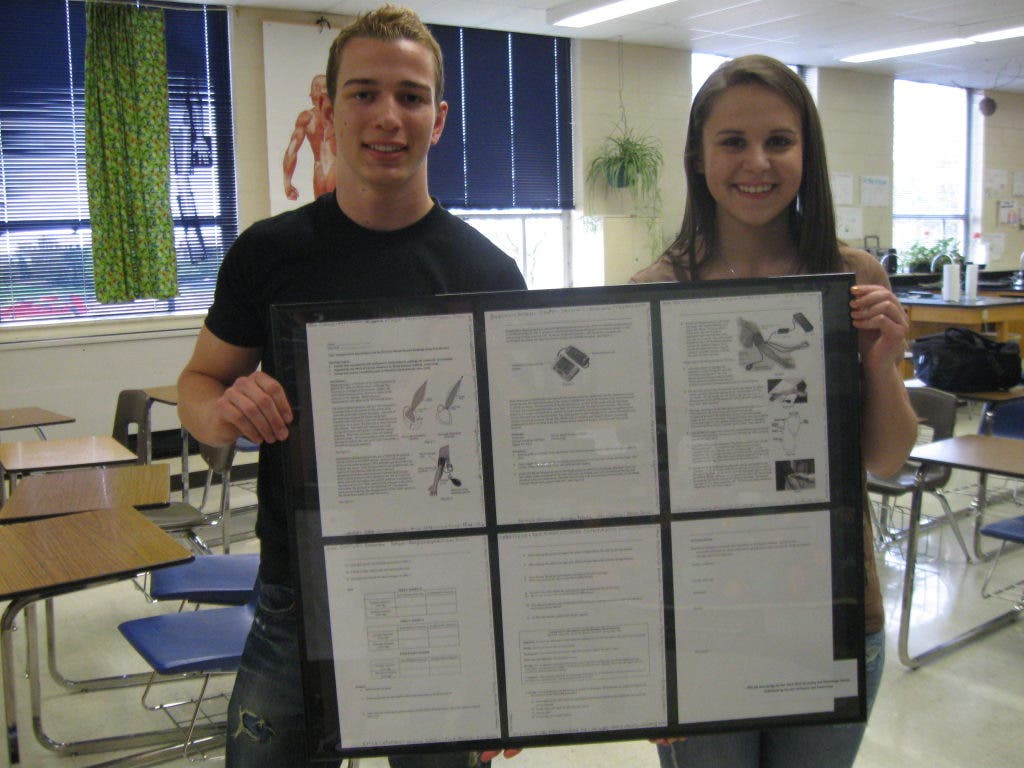
This spring, Cerletty’s classes wrote a new blood pressure-measuring lab — step-by-step instructions meant to test and expand students' knowledge base of a particular topic through experimentation and exploration — for Vernier Software and Technology, a company based in Beaverton, Ore., that specializes in scientific curriculum, interfaces, sensors and software for students around the world. The lab created by Whitnall’s students could be used in Vernier’s lab books by high school students across the country for years to come, according to Cerletty.
Find out what's happening in Greenfieldfor free with the latest updates from Patch.
Two years ago, two of Cerletty’s students created a part that Vernier is manufacturing for use in an oxygen-measuring sensor.
“Educators have to be cognizant of how creative your kids can be,” said Cerletty, who is in her 25th year of teaching and her 10th at WHS. “Kids from this class go into college confident. It’s ingrained in them that they can go do something, that they can create something.”
That trend likely started long ago but was crystallized when Cerletty and her students realized they were receiving faulty data while using Vernier’s oxygen-measuring device.
Jim Malkowski and Curtis Wigington, with their teacher’s help, decided to try to fix the problem. The students and Cerletty bought several parts from a hardware store and spent their study hall hours devising a replacement part.
“The key was realizing the oxygen sensor was too far away from the actual point of breathing,” Cerletty said. “(The connection piece) was too long, and the way the lab was written, it didn’t give time for the gas exchange in the lungs. So the boys re-wrote the lab and shortened the piece. And there they had it. It was great.
“One of them was a mechanic and one was good with computers. The point is you need a variety of people to make things happen. You need people who understand how things work.”
Cerletty sent an email to Vernier and Dr. John Melville, a physiologist, who praised the students’ findings. Two years later, the company began manufacturing the new piece, based on the Whitnall team’s findings, and acknowledged the school in its newsletter and on its website.
That experience put Cerletty’s students on Vernier’s radar. Last year, Melville emailed Cerletty and asked if her students could “use data markers to compare auscultatory and oscillometric blood pressure” and write a lab to coincide with the results.
Cerletty’s reaction was, “Huh?”
“I didn’t want to look like an idiot so I looked up what the two were and I happened to find a study done with school-aged children comparing the two methods,” Cerletty said. “It turns out the auscultatory blood pressure is the kind done with a stethoscope in a doctor’s office and oscillometric is measured by a machine.
“I thought, ‘We can do that.’”
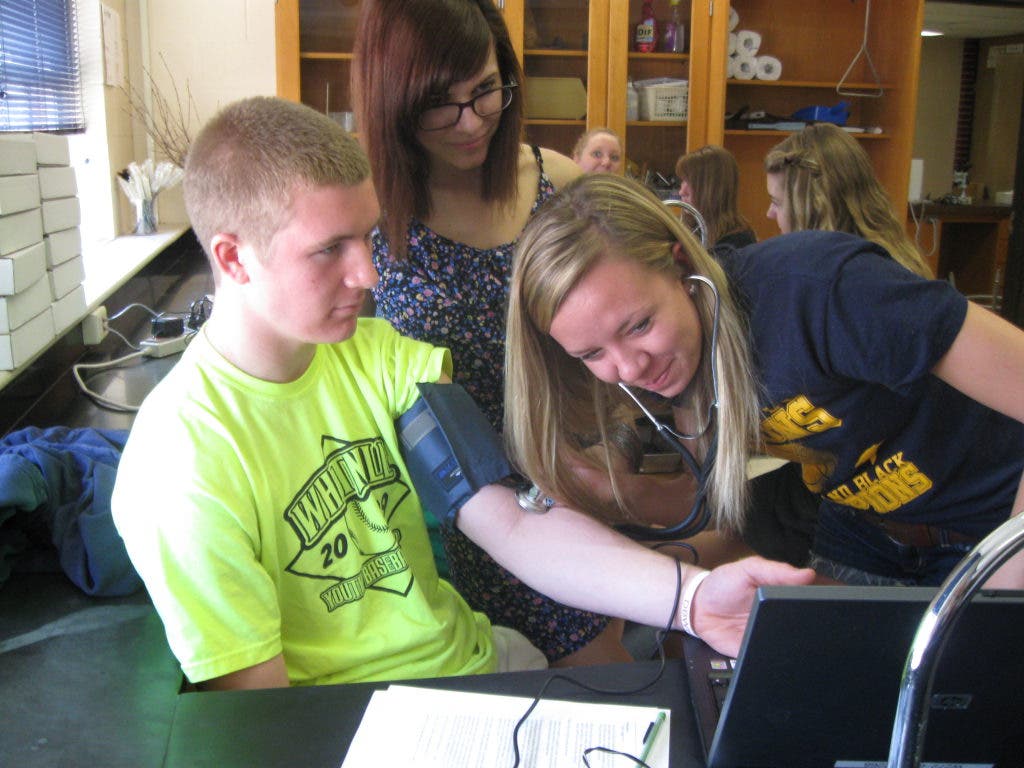
After a few emails and conversations with Melville, Cerletty put her students to work. She first had them research the difference between the two through YouTube and other internet resources; basically, they taught themselves how to take blood pressure readings.
From there, the trials began. Her anatomy students took blood pressure readings of 65 subjects and recorded the data. Turns out their findings proved both auscultatory and oscillometric measurements produce the same results, contrary to the study Cerletty had familiarized herself with.
But the students weren’t done. After researching the various methods used to take blood pressure and figuring out how to use the equipment, they used an old template to create a new lab, obtained data, drew conclusions and then published their findings.
After all 104 students, working in groups of two, submitted labs, Cerletty went through each one, pulled out the best elements and compiled it into one, comprehensive lab and analysis.
“I couldn’t have done it without all of them,” Cerletty said.
The students, of course, needed someone like Cerletty guiding the way.
“She’s extremely instrumental,” in preparing students for college, senior Lauren Engel said. “Without her, we wouldn’t have an anatomy class. She’s such a good teacher. She pushes us in the right direction, and it’s nice to be able to help other students around the country instead of just doing it for ourselves and our benefit.”
Said senior Mason Howard, “She pushes you a little beyond other, normal classes. Creating this lab was more geared toward real-world situations.”
Cerletty’s anatomy classes have become popular since she began offering them at WHS. Enrollment in the capstone class that combines physics, chemistry and biology, has jumped from 30 to as many as 130 kids. Some students take it because they need it to graduate, others hope to be orthopedic surgeons.
Many students won’t have a class like Cerletty’s until college, if at all, but those in her class are on task, engaged and a part of an electric environment thanks to the rapport established with Cerletty, according to Whitnall High School Principal Anthony Brazouski.
“What Mrs. Cerletty brings to her classroom are authentic experiences where students are not simply ‘doing’ science but are, in fact, being scientists,” Brazouski said.
“Mrs. Cerletty's personality and approach attract students of all ability levels, all of whom experience success in a rigorous and challenging environment. She sets high expectations and allows students to achieve by making them constantly appear achievable.”
Get more local news delivered straight to your inbox. Sign up for free Patch newsletters and alerts.