Health & Fitness
St. Croix Valley Economic Dashboard Released
The May 2012 St. Croix Valley Economic Dashboard has been released. The Dashboard has been expanded and will now include data on Dunn County.


The May 2012 edition of the St. Croix Valley Economic Dashboard has been released by the Center for Economic Research (CER) at UW-River Falls in partnership with St. Croix Economic Development Corporation (SCEDC). The dashboard is a snapshot of the economic condition of the labor, consumer and housing markets in the seven county St. Croix Valley, which now includes the Wisconsin counties St. Croix, Pierce, Polk and Dunn, as well as the Minnesota counties Chisago, Ramsey and Washington. It presents the latest available data in one convenient package (note: most regional data is available with a one or two month delay).
The Dashboard can be viewed on CER’s website at www.uwrf.edu/cer.
Starting with this edition, the St. Croix Valley economic development partnership now includes Dunn County, Wisconsin. The Dashboard will now include data on Dunn County.
Find out what's happening in Hudsonfor free with the latest updates from Patch.
Dr. Logan Kelly, director at CER, conducts research for the Dashboard and offered his observations:
State and National Indicators
Find out what's happening in Hudsonfor free with the latest updates from Patch.
“Nationally, the economy grew at a seasonally adjusted annually rate of 2.2 percent during the first quarter of 2012, up 1.85 percentage points from the previous quarter. Nonfarm payroll employment rose by 120,000 in March, and the unemployment rate, at 8.2 percent, is 0.7 percentage points below the March 2011 rate. Job gains occurred in manufacturing, financial activities, professional and business services, education and health services, and leisure and hospitality, but there were job losses in retail trade. The public sector was relatively unchanged posting a loss of about 1,000 jobs.”
“Wisconsin’s unemployment rate slightly decreased to 6.8 percent in March, which was caused by a 0.2 percent increase in employment and 0.2 percent increase in labor force, according to the Bureau of Labor Statistics (BLS) survey of households. The BLS survey of households finds that Wisconsin has gained 18,498 jobs over the last year. However, the BLS survey of employers finds that Wisconsin lost 23,900 jobs over the last year. The two surveys seem to indicate much of improvement in the Wisconsin labor market is driven by job creation in neighboring states, not within Wisconsin.”
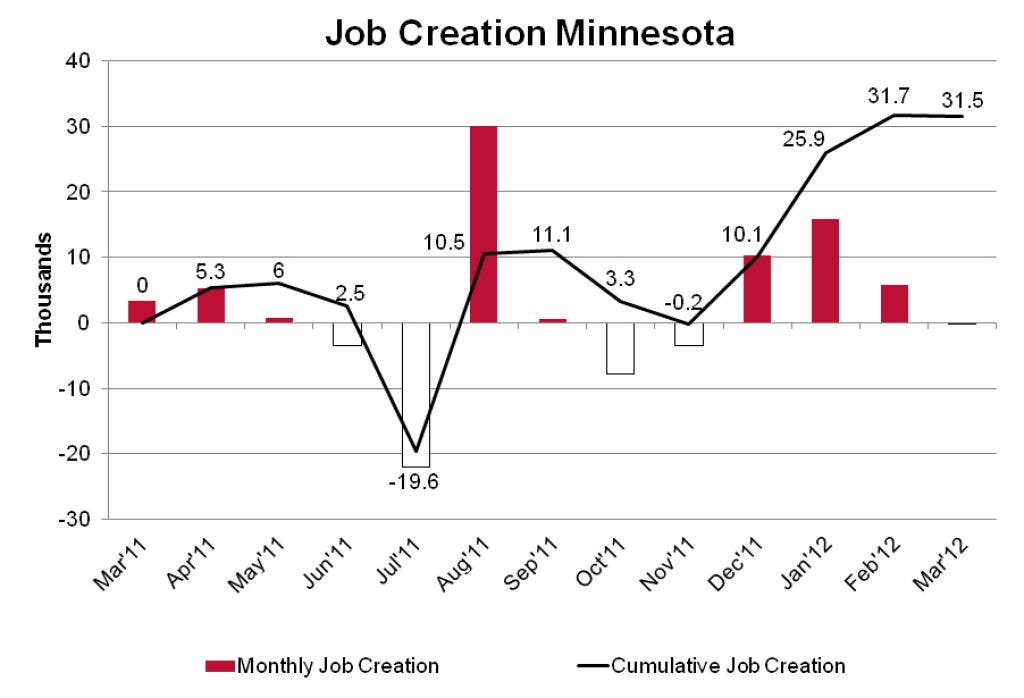
“Minnesota’s unemployment rate was up slightly to 5.7 percent in March, which was led by a 0.1 percent decrease in employment and almost no change in labor force, according to the BLS survey of households. The BLS survey of employers finds that Minnesota gained 31,500 jobs over the last year.”
“The Philadelphia Fed’s Coincident Index of economic activity indicated the Wisconsin economy grew at a seasonally adjusted annual rate of 2.93 percent in March 2012. The Leading Index is predicting a positive annual growth rate of 1.14 percent over next the six months, which is still too low to expect meaningful labor market recovery. The Minnesota economy grew at a seasonally adjusted annual rate of 4.62 percent, and the Leading Index is predicting a positive annual growth rate of 2.4 percent over next the six months.”
Labor Market
“The Wisconsin economy lost 4,500 jobs (net) in the month of March and has lost 23,900 jobs since March 2011. The Minnesota economy gained 200 jobs (net) in March and has gained 31,500 over the last year.”
See Wisconsin and Minnesota Job Creation Tables
“The month of March had many more job losses than gains for Wisconsin. Wisconsin has continued to lose jobs in the public sector, losing 200 in March and 17,800 jobs over the last year. Wisconsin also lost jobs in education and health services, professional and business services, financial activities, trade, transportation & utilities, and construction. The most significant of those job losses came in construction which lost 4,500 jobs in March. Minnesota also had job loss in the public sector of 1,800 jobs in March, and has lost some 7,600 jobs over the last year. Minnesota also lost jobs in other services, professional and business services, information, manufacturing, construction and mining and logging.”
“In Wisconsin, there were gains in other services, leisure and hospitality, information and manufacturing. The largest gains for Wisconsin came in leisure and hospitality which added 3,500 jobs and manufacturing which added 2,000 jobs. In Minnesota there were gains in leisure and hospitality, education and health services, and trade, transportation & utilities. The largest job gains were in trade, transportation & utilities which added 2,500 jobs and leisure and hospitality which added 1,200 jobs.”
See Wisconsin and Minnesota Job Creation by Sector Tables
“Conditions in the regional labor market are faring better than the state average. The regional unemployment rate rose in February by 0.3 percentage point to 6.5 percent, lower than the state average in Wisconsin of 6.9 percent, greater than the Minnesota average of 5.7, and comparable to the Minneapolis-St. Paul-Bloomington MN-WI Metropolitan Statistical Area (MSA) unemployment rate of 6.2 percent. The data suggests that the St. Croix Valley’s relative economic strength due to proximity to the Twin Cities.”
The Wisconsin/Minnesota St. Croix Valley is comprised of St. Croix, Polk, Pierce and Dunn counties in Wisconsin and Chisago, Ramsey and Washington counties in Minnesota. Five of the seven counties are located along the Wisconsin-Minnesota border. Four of the seven counties, St. Croix, Pierce, Chisago, Ramsey and Washington, are included in the Minneapolis-St. Paul-Bloomington MN-WI MSA, a 13-county region with of population of 3.3 million residents. For additional information on the May edition of the St. Croix Valley Economic Dashboard, contact Dr. Logan Kelly at cer@uwrf.edu or (715) 425-4993 or William Rubin at bill@stcroixedc.com or (715) 381-4383.