Community Corner
Human Doctors Save Critically Ill Milwaukee Zoo Bonobo
Bonobos are our closest cousins. When a young bonobo nearly died of pneumonia, a team from the Medical College of Wisconsin stepped in.


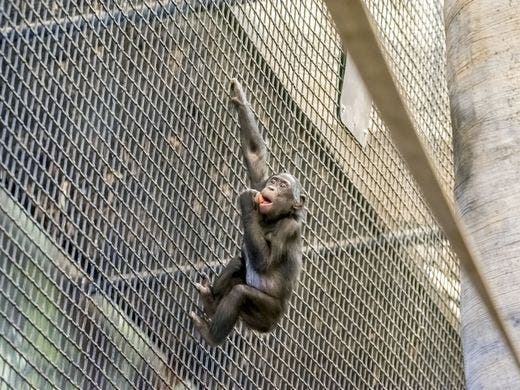
MILWAUKEE, WI — There aren’t many bonobos left in the world. They’re found only one place on Earth in the wild — the Democratic Republic of Congo — so when a member of the endangered species becomes ill in a zoo, it’s a huge deal. When all of them become ill, it’s a crisis.
That’s what happened last fall at the Milwaukee County Zoo, which, with a troop of about two dozen, has one of the largest groups of captive bonobos in North America. Dr. Rainer Gedeit, a professor of pediatric critical care at the Medical College of Wisconsin, got an urgent call from the zoo: A young bonobo named Noelle was critically ill after pneumonia spread through the group and several bonobos fell ill. It had already claimed the life of an adult.
As her mother cradled her in her arms, Noelle was listless and in significant respiratory distress, and she was breathing through a tube the zoo staff had inserted. She was blue from lack of oxygen and in septic shock, a medical emergency. Gedeit, pediatric critical care clinical director and respiratory care services medical director at Children’s Hospital of Wisconsin, knew he could help, according to a release on the college website.
Find out what's happening in Milwaukeefor free with the latest updates from Patch.
With the help of Children’s Hospital of Wisconsin’s respiratory care service’s Khris O’Brien and clinical engineering department’s Joe Kau, they obtained a retired Children’s ventilator and brought it over to the zoo.
“I really had to rely a lot on the physical examination to evaluate,” Gedeit said, according to the news release. “It was an opportunity to get back and use the skills you have as a physician.”
Find out what's happening in Milwaukeefor free with the latest updates from Patch.
When Gedeit first examined Noelle, she weighed about 16 pounds and was a bit smaller than an average 2-year-old human child. (Bonobos and humans aren’t all that different, sharing about 98.7 percent similar DNA. In fact, bonobos and chimpanzees are more closely related to humans than they are to gorillas and orangutans, the other two types of great ape.)
“It’s amazing,” Gedeit said. “Doing a physical exam was not a challenge. You’re looking at the same thing as a child — but a little hairier.”
The greater challenge was getting the little bonobo on a ventilator, which needs both oxygen and air flow to operate. The zoo wasn’t set up to deliver the air portion of the equation, and some consideration was given to ordering air tanks from a medical gas supplier.
O’Brien had a better idea, using equipment that was already existing at the zoo — a nebulizer, which is typically used to deliver medication through an inhaled mist.
The team hooked the nebulizer to the ventilator, then got Noelle on the ventilator.
The little bonobo had a rough first night, but she was stabilized. Within 48 hours, she was breathing without assistance. A human child as ill as Noelle was would have been sick for much longer, though the bonobo still faced several rounds of antibiotics after the breathing tube was removed. Her appetite returned, and her appearance improved.
“She was very blue before we got her on the ventilator,” Gedeit said. “I was worried she was going to be on there for days.”
Gedeit visited the zoo a few weeks ago and had difficulty picking Noelle out of the group. She was zipping around like any other young bonobo, and signs of her illness were gone.
5 Things To Know About Bonobos
Most people would never have an opportunity to see a bonobo if not for the Bonobo Species Survival Plan. Headquartered at the Milwaukee County Zoo and coordinated by Dr. Gay Reinartz, the Bonobo SSP works to ensure genetic diversity in breeding and the long-term survival of bonobos, among other things.
There are about 80 bonobos at seven zoos in the United States, including the Milwaukee County Zoo. Other bonobos live at the Cincinnati Zoo and Botanical Garden and Columbus Zoo and Aquarium, both in Ohio, the Fort Worth Zoo in Texas, the Jacksonville Zoo in Florida, the Memphis Zoo in Tennessee and the San Diego Zoo in California. There are approximately 86 bonobos in European zoos.
Bonobos are endangered and are found only in the forests south of the Congo River in the Democratic Republic of Congo. Getting an accurate count on how many remain is difficult because of the remote nature of their habitat, the patchiness of their distribution and years of civil unrest in their home range, but current estimates are there may be fewer than 100,000 bonobos left, according to the African Wildlife Foundation.
Here are five things you should know about bonobos:
1. Bonobos weren’t recognized as a distinct species until 1929. They are similar in appearance to chimpanzees, though smaller, leaner and darker, and they were called pygmy chimpanzees. German anatomist Ernst Schwartz is credited as the first Westerner to recognize that bonobos are distinct, based on the analysis of a skull that was thought to belong to a juvenile chimpanzee. A more detailed analysis by American anatomist Harold Coolidge in 1933 elevated bonobos to a separate, distinct species. Further studies by American psychologist and primatologist Robert Yerkes revealed some of the major differences between bonobos and chimpanzees.
2. Bonobos and chimpanzees may look similar, but their behavior is vastly different. For one thing, bonobos live in matriarchal, female-led social groups and are generally peaceful. Male-dominated chimpanzees are more violent, often lethally so. Another big difference is that infanticide is common among chimpanzees to reduce competition for reproduction. It’s typically male-led, but female-led infanticide has been reported in some areas of Uganda. Infanticide among bonobos is rare, though in an even more rare occurrence, the esteemed Max Planck Institute for Evolutionary Anthropology in Leipzig, Germany, documented an instance of cannibalism among bonobos, in which group of wild bonobos were seen feasting on the corpse of the 6-year-old daughter of one of the females, also involved in the cannibalism.
3. A bit more about peaceful bonobos, which are known as the “hippie ape”: Scientists think one reason for their peaceful demeanor is that highly promiscuous bonobos diffuse tension with almost constant sexual acts rather than physical fights, which occur commonly among chimpanzees, and their frequent sex is also believed to strengthen bonds within their social orders. Bonobos have a wide repertoire of sex acts, which includes both heterosexual and homosexual unions, oral sex and rituals known as “penis fencing” among male bonobos and “genital-genital rubbing” among females. Chimpanzees, on the other hand, have sex only for procreation.
4. Bonobos and chimpanzees are believed to have split about 2 million years ago. Both species lived in the tropical forests near the Zaire River, but a prolonged drought 2.5 million years ago wiped out the preferred food sources for gorillas. Once the lush forests returned, the gorillas did not. Chimpanzees living north of the river had to compete with the larger primates for food to find enough to eat, and had no time to form social bonds. But those south of the river were largely without competition and could travel in larger, more stable parties and form strong social bonds. As a result, scientists believe, they became bonobos.
5. By far, the greatest threat to bonobos is illegal poaching to supply the commercial bushmeat trade, according to the International Union for the Conservation of Nature, which lists bonobos as endangered on its Red List of threatened and endangered species. It’s estimated that nine tons of bushmeat are extracted daily from bonobos’ home range. Bushmeat, whether from great apes or other species, is thought to have been the bridge that caused Ebola to jump from animal species to humans.
Photo of Noelle courtesy of Joel Miller/Milwaukee County Zoo
Get more local news delivered straight to your inbox. Sign up for free Patch newsletters and alerts.