Weather
Northern Lights Visible Again Saturday Night In WI: What To Know
"We should get another opportunity to run it back tonight," the National Weather Service said.


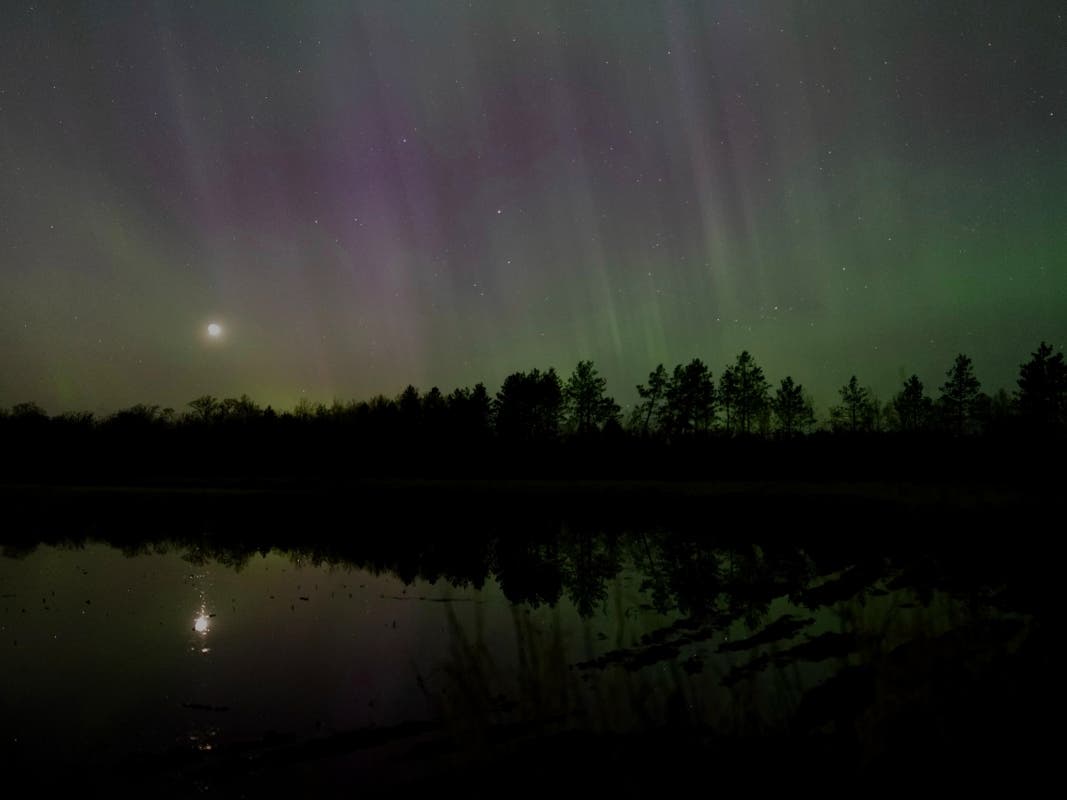
WISCONSIN — If you missed the show last night, there's another good chance Wisconsin residents could see the dazzling aurora borealis, also known as the northern lights, this weekend if the weather cooperates, according to space weather forecasters.
"Didn't get a chance to catch the show last night? We should get another opportunity to run it back tonight," the National Weather Service said.
The current NWS forecast out of the Milwaukee Airport states: "Mostly clear, with a low around 47. Northwest wind 5 to 10 mph becoming light and variable in the evening."
Find out what's happening in Milwaukeefor free with the latest updates from Patch.
.jpg)
‘Magnetically Complex’ Sunspot Clusters
The National Oceanic and Atmospheric Administration said in a "rare" and "severe" level G-4 geomagnetic solar storm watch the northern lights could be seen this weekend as far south as Alabama.
The watch comes after two massive sunspots merged, spitting at least two X-class (the largest class) and M-class (the second-largest class) solar flares that are sending a mass of supercharged plasma hurtling toward Earth in a coronal mass ejection, or CME. Another sunspot released strong CMEs earlier this week.
Find out what's happening in Milwaukeefor free with the latest updates from Patch.
NOAA said at least five Earth-directed CMEs will collide with Earth from midday Friday through Sunday. The sunspot clusters are “magnetically complex and much larger than Earth,” the Space Weather Prediction Center said, noting continued growth in both the area of the sun experiencing flares and an increase in complexity have created “a higher threat of increased solar flare risk.”
‘An Unusual Event’
“Watches at this level are very rare,” NOAA said. “This is an unusual event.”
The last time NOAA issued a watch for a “severe” geomagnetic storm was in January 2005.
The Kp Index Is High
The Kp index, the measure of the strength of a burst of solar energy, is predicted to be at 8 overnight Friday. Auroras become likely with a Kp index of 5.
Communication Problems Possible
A severe geomagnetic storm can also trigger GPS problems, interfere with satellite communications and cause high-frequency blackouts.
“Of course, NOAA doesn’t issue this kind of watch just for the benefit of stargazers. Since geomagnetic storms can impact infrastructure in near-Earth orbit and on the surface, potentially disrupting communications, the electric power grid, navigation, radio and satellite operations, the agency uses these watches to notify the operators of these systems so they have time to take protective action,” Chris DeWeese, a senior writer for The Weather Channel, said in the company’s Friday Morning Brief newsletter:
Dig Out Eclipse Glasses
The Weather Channel says viewing conditions should ideal in some of the areas that do not normally see the northern lights, including the West Coast, parts of the South, and the Central and Northern Plains.
Even if you can’t see the northern lights, you can see what is happening on the sun to trigger them. Under clear skies, put on glasses acquired for the April 8 total solar eclipse so you can take a safe look at our bright star. The geomagenetic storm is so big, that it may be visible to the naked eye with proper protection, The Weather Channel said.
- You May Also Like: 2024 Guide To Meteor Showers, Supermoons And More
Get more local news delivered straight to your inbox. Sign up for free Patch newsletters and alerts.