Politics & Government
Here Are The Top 20 Provisions In Tony Evers' $83 Billion Budget
Wisconsin Gov. Tony Evers rolled out his proposed 2019-20 state budget. Here are its top 20 provisions:


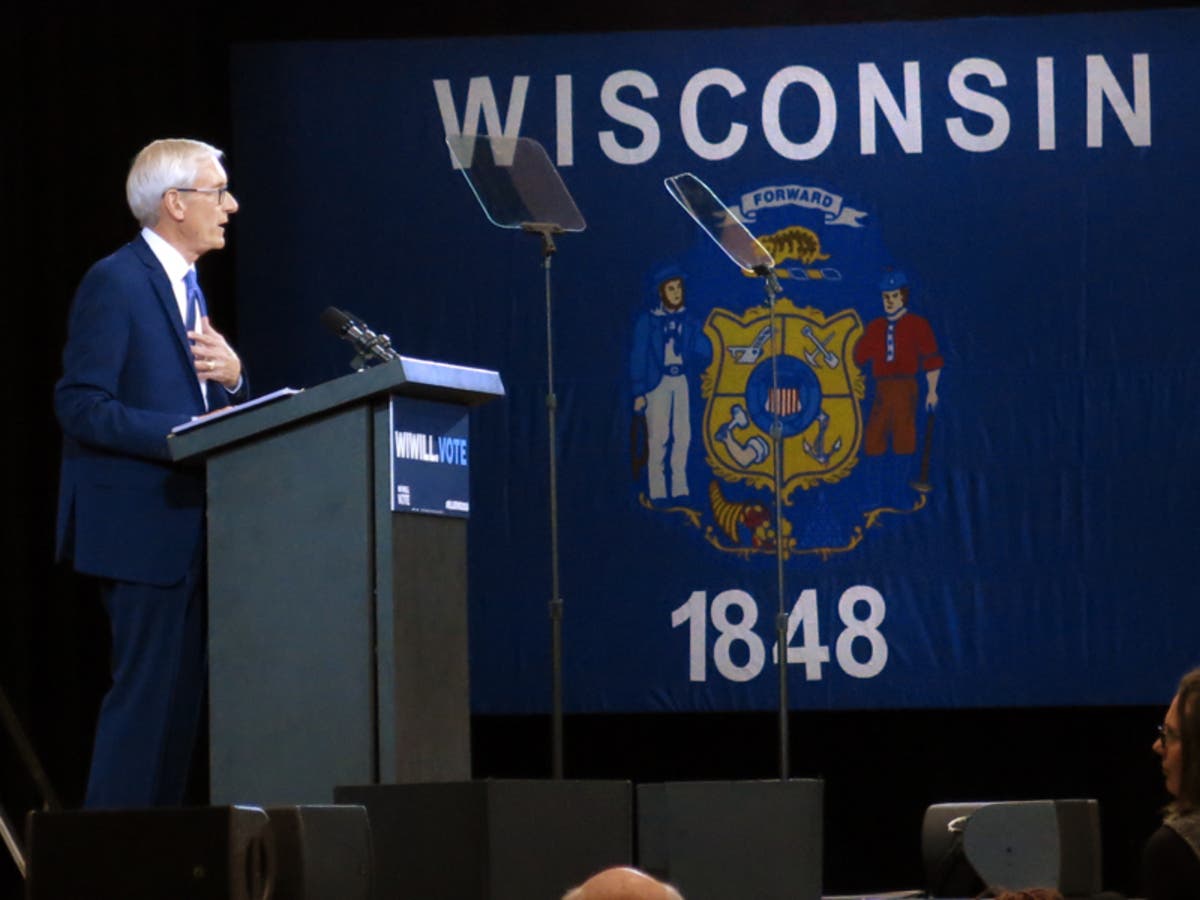
WISCONSIN — Wisconsin Gov. Tony Evers rolled out his proposed 2019-20 biennial budget for Wisconsin Thursday night, calling for a number of things that have long been on state Democrats' wish lists over the years.
“At the end of the day, our budget is about putting people first,” Evers said of the proposed $83.5 billion budget in an address Thursday night. “It’s about creating a Wisconsin that works for everyone — a Wisconsin for us. This isn’t the Tony Evers budget, the Democratic budget, the speaker’s budget, or the Republican budget — this is the people’s budget. And it’s one that we crafted together.”
Legislative Republicans, who control both the State Senate and Assembly, pilloried the Governor's proposed budget.
Find out what's happening in Mount Pleasant-Sturtevantfor free with the latest updates from Patch.
“The problem with Tony Evers’ budget is it just spends too much, it spends way more than Wisconsin can afford,” Assembly Speaker Robin Vos (R-Rochester) said.
Related Reading
Find out what's happening in Mount Pleasant-Sturtevantfor free with the latest updates from Patch.
2019-2020 Budget In Brief: Official
In a statement, Rep. Jessie Rodriguez (R-Oak Creek) said: "His budget includes billions in new spending, raises taxes on hardworking families and drastically grows the size of government. This budget is anything but bipartisan and ignores those outside of Milwaukee and Madison.”
It's common knowledge that Evers will not be able to get most of what he wants, and it's also clear that Evers will likely veto large swathes of a Republican-authored budget later this year.
Here are the top 20 provisions in Tony Evers 2019-2020 budget:
1. Medicaid Expansion
The Governor's proposed budget calls for the state to expand Medicaid under the federal Affordable Care Act by covering all low-income Wisconsin residents who earn incomes between 0 and 138 percent of the federal poverty level.
The Governor's office said that a Medicaid expansion will provide healthcare coverage to 82,000 state residents while saving $320 million over the next two years.
2. Preexisting Conditions Coverage
In his budget, Evers wants to establish a requirement across all health insurance exchanges that guarantees health insurance for those with preexisting conditions.
3. Medical Marijuana
In the proposed budget Evers is calling for the state to establish a medical marijuana program to help people suffering from debilitating medical conditions.
He wants to provide $840,600 in 2019-20 and $400,600 in 2020-21 as well as 4 full-time positions to operate the medical marijuana program.
4. Decriminalizing Marijuana
In his state budget, Evers wants to decriminalize small amounts of marijuana by eliminating the penalty for possession, distribution or manufacture of 25 grams of marijuana or fewer.
Under the proposed budget, a person serving a sentence or on probation for the possession, distribution or manufacture of 25 grams of marijuana or fewer may request dismissal of the conviction. Provide a means for persons convicted under prior law to petition a court for the expungement of their conviction.
5. Youthful Offenders
Evers wants to raise the age of adult jurisdiction in circuit and municipal court to 18 years of age, effective January 1, 2021.
6. Local District Attorney's Offices
Evers, citing a need to help local District Attorneys' office with workload issues, wants to provide additional assistant district attorney positions across the state by providing an additional 19.6 full-time assistant district attorney positions in each
fiscal year; providing 6.9 full-time positions to increase part-time positions in 14 counties.
7. Gas Taxes and Motor Fees
To set the state's transportation system on a new path to improved roads across our state, Evers recommends:
- Raising the Motor Fuel Tax by 8 cents per gallon and eliminating the minimum markup on motor fuel, raising $485 million.
- Increasing Heavy Truck Registration Fees by 27 percent, raising $36 million over the biennium.
- Increasing the title fee on original or transfer vehicle titles, raising $36 million over the biennium.
- Collecting the Hybrid Vehicle fee, raising $9.7 million over the biennium.
- Eliminating the 0.25 percent general fund tax transfer to the Transportation Fund.
8. Right To Work
Evers is calling for the elimination of the state's"right to work" law, which prohibited labor unions and employers from entering into private agreements regarding the use of unionized workers on a project. This change also permits employers to require union membership or affiliation and related dues.
9. Middle Class Tax Cut
Gov. Evers wants to provide a 10 percent cut in individual income taxes for most middle-class filers. Individuals with incomes below $80,000 and married-joint filers with incomes below $125,000 will receive a nonrefundable credit equal to
10 percent of their remaining net tax liability or $100, whichever is greater.
The credit phases out gradually for individuals between $80,000 and $100,000 in adjusted gross income and for married-joint filers between $125,000 and $150,000 in adjusted gross income, the Governor's office says.
The credit would provide more $400 million in total income tax relief annually to the middle class with $421.5 million in fiscal year 2019-20 and $412.0 million in fiscal year 2020-21, the governor's office says.
10. School Choice
Gov. Evers recommends freezing the number of slots available in the Milwaukee parental choice program, which are almost entirely state funded, in fiscal year 2020-21 and thereafter based on fiscal year 2019-20 pupil headcount.
The freeze will not end the program; as students graduate high school or choose to return to public schools, slots will open. The freeze results in GPR savings of $3 million in fiscal year 2020-21.
11. Racine Parental Choice Program
Evers wants to freeze the number of slots available in the Wisconsin and Racine parental choice programs in fiscal year 2020-21 and thereafter based on fiscal year
2019-20 pupil headcount.
Under current law, new students in these programs are funded through general
aid reductions, which a school district may recoup through property taxes. The
decision to freeze enrollment reduces property taxes by $24.9 million in fiscal
year 2020-21.
12. School Choice Educators
In his budget, Evers is in favor of requiring teachers at a school participating in a
private school choice program to be licensed as of July 1, 2022.
Currently, teachers who work at private choice schools that participate in a private choice program are not required to be licensed by the Department of Public Instruction, unlike teachers in public school districts. Experienced teachers who have continuously taught in a participating private school for at least five years may
apply for a waiver.
13. School Funding
In his proposed budget, Evers wants to provide $618,822,000 in state general aid across the biennium.
14. Two-Thirds Funding
Evers wants to restore the requirement that the state provide at least two-thirds funding of partial school revenues. The Governor's budget would achieve this benchmark in both years of the biennium, according to the Governor's office.
15. Special Education
In his budget, Evers wants to increase special education aid by $75,060,900 in fiscal year 2019-20 and $531,060,900 in fiscal year 2020-21 to reimburse eligible special education costs at 30 percent and 60 percent in those fiscal years, respectively.
State funds available for reimbursement have remained unchanged since fiscal year
2008-09 while eligible expenses have increased, resulting in a current
reimbursement rate of 25 percent.
16. Students' Mental Health
In his proposed budget, Evers wants to increase funding to address the need for access to mental health services for school-age youth as follows:
- $22,000,000 in each year to expand the mental health categorical aid program to include reimbursement for expenditures for any school-based pupil services in schools.
- $7,000,000 in each year to increase the number of school-based mental health collaboration grants provided.
- $2,580,000 in each year to expand training for school personnel in various mental health interventions.
- $150,000 in each year for data system to store results of the youth risk behavior survey.
17. Reduce Lead Poisoning
In his proposed budget, Evers wants to reduce the incidence of childhood lead poisoning in Wisconsin by increasing blood lead testing; creating a health service initiative to provide funding to abate lead hazards in homes where Children's Health Insurance Program participants reside; providing a grant for lead abatement in non-CHIP eligible homes; providing 1.14 full-time positions to administer the health service initiative and expanding Birth-To-3 services to children that are lead poisoned.
The governor's office said the state would fund these initiatives with $24,996,000 in fiscal year 2019-20 and $27,158,700 in fiscal year 2020-21.
Evers also wants to authorize $40 million in bonding for the replacement of up to
50 percent of the cost to replace lead service lines through the Safe Drinking
Water Loan Program.
It is estimated that there are 170,000 lead service lines in Wisconsin. The lead service line program would be structured as a forgivable loan.
18. 2018 Lame Duck Legislation
Evers in his budget wants to unravel actions by former Gov. Scott Walker and Republican legislators made during the extraordinary legislative session in Dec. 2018 including:
- Advice and consent of the Senate in relation to gubernatorial nominations
- Ability of the Legislature to retain legal representation for legislators, legislative staff and the Legislature.
- Administrative rule and guidance documents modifications
- Additional requirements for agency publications
- Approval of Capitol security changes.
19. Gerrymandering
Evers wants to direct the nonpartisan Legislative Reference Bureau to redraw legislative and congressional redistricting maps.
20. Homelessness
Increase funding for the following homeless prevention programs, consistent with
the recommendations of the Interagency Council on Homelessness:
- $500,000 in each fiscal year for the Homelessness Prevention Program and $300,000 in each year for the creation of a new diversion program.
- $500,000 each fiscal year for the State Shelter Subsidy Grant.
- $900,000 in each fiscal year for the Housing Assistance Program.
- $500,000 in each fiscal year for the Homeless Case Management Services Grant.
- $250,000 in each fiscal year for the Skills Enhancement Grant at the Department of Children and Families.
- $500,000 in each fiscal year to create a new Housing Quality Standards grant.
- $300,000 in each fiscal year to create a grant for housing navigation.
Get more local news delivered straight to your inbox. Sign up for free Patch newsletters and alerts.