Politics & Government
Wisconsin Supreme Court Says 'Lame-Duck' Laws Are Legal
The laws, deemed by their critics as "lame-duck laws," were signed by former Gov. Scott Walker just days before he left office.


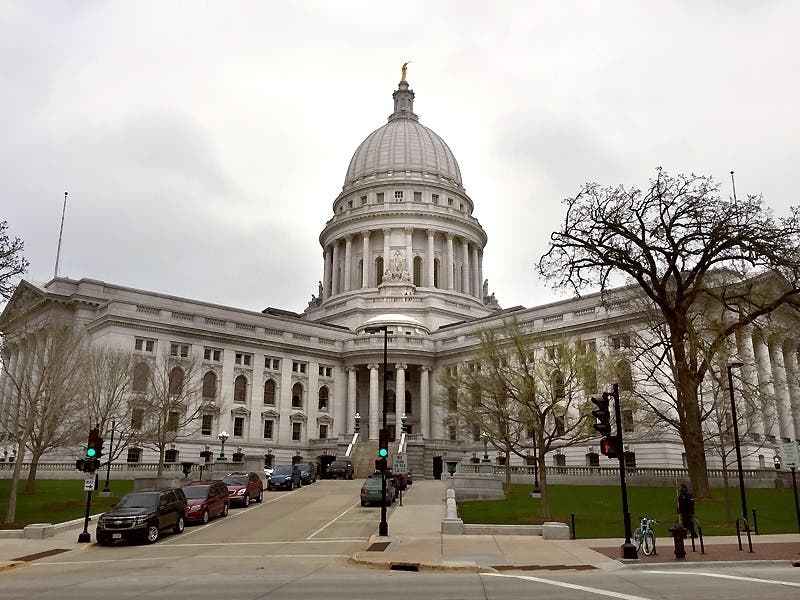
MADISON, WI -- Citing the Wisconsin State Legislature's ability to set its own schedule under state constitutional law, the Wisconsin Supreme Court upheld a raft of laws signed into law during Republican Gov. Scott Walker's final days in office.
The laws, deemed by their critics as "lame-duck laws," were aimed at re-instituting a number of controls on the governor's office just days before Democratic Governor Tony Evers was sworn into office. Aimed at weakening Gov. Evers and Democratic Attorney General Joshua Kaul's constitutional powers, they effectively prevent Evers from backing out of lawsuits without legislative approval, such as Wisconsin's participation in a multi-state lawsuit opposing the Affordable Care Act.
On Friday, the Wisconsin supreme court ruled 4-3 in favor of keeping the laws in place.
Find out what's happening in Mount Pleasant-Sturtevantfor free with the latest updates from Patch.
In conservative Justice Rebecca Bradley opinion, she wrote that: "The extraordinary session comports with the constitution because it occurred as provided by law. The terminology the Legislature chooses to accomplish the legislative process is squarely the prerogative of the Legislature. The Wisconsin Constitution itself affords the Legislature absolute discretion to determine the rules of its own proceedings."
In her dissenting opinion, Judge Rebecca Dallet said the legislature was already finished with its session and had no legal standing to start back up again for the extraordinary session. "
Find out what's happening in Mount Pleasant-Sturtevantfor free with the latest updates from Patch.
On March 22, 2018, the Legislature adjourned sine die, or ceased to exist, as there were no future scheduled meetings of the regular session laid out in JR1.5," she wrote. "Therefore, there was no authority for the majority of members of two committees to convene a previously unscheduled meeting of the full Legislature in early December 2018."
In a statement issued June 21, Assembly Speaker Robin Vos (R-Rochester), lauded the State Supreme Court's decision.
“We are pleased by the Supreme Court’s common sense decision. The Court upheld a previously non-controversial legislative practice used by both parties for decades to enact some of the most important laws in the state."
In late March, a Dane County judge issued a temporary injunction, effectively blocking the raft of Republican-authored legislation which had been signed into law just days before Gov. Scott Walker left office during an extraordinary session.
Days after hearing oral arguments from both sides, Dane County Circuit Judge Richard Niess issued the injunction, refusing the Republican-controlled State Legislature's request to delay the order.
According to a Wisconsin Public Radio report, the legal challenge to the lame-duck legislation was brought by the League of Women Voters of Wisconsin, Disability Rights Wisconsin Inc. and Black Leaders Organizing for Communities. They contended that the lame-duck session was unlawful "because legislators met in "extraordinary session," which isn't explicitly allowed under the state constitution."
Wisconsin lawmakers pilloried the legal challenge. According to a U.S. News report, Misha Tseytlin, an attorney for Republican lawmakers said that the court should toss the suit on the basis that the Legislature has been able to meet when it chooses since 1968.
The Laws In Detail
Wisconsin's so-called "lame duck" laws tackle a number of executive functions and powers. Here are the most prominent ones in brief.
Limit the power of the Attorney General.
When Wisconsin Attorney General Brad Schimel lost the Nov. election to Democratic candidate Josh Kaul, Walker appointed Schimel to the Waukesha County Circuit Court. Republican lawmakers then sought to restrain Schimel's Democratic successor.
At the time, critics of this bill would give Republican lawmakers the ability to block any changes to the state's legislative districts — which currently face a legal challenge in court. Republican legislators would gain the power to intervene in any litigation when a state law is challenged, and they would be able to appoint their own attorneys, instead of having the case handled by the attorney general. Republican lawmakers want to make sure the GOP-controlled legislator would have control of how to spend money from court settlements.
Block Healthcare changes
Republican lawmakers wanted to change who can approve withdrawing from lawsuits. They would shift that power from the governor to the Legislature's GOP-controlled budget committee, effectively preventing Evers from ordering Kaul to fulfill one of his primary campaign promises - withdrawing the state from a multi-state legal challenge to the Affordable Care Act.
Block the Governor from WEDC control
Former Gov. Walker's Wisconsin Economic Development Corporation has primary oversight over the state's $3.3 billion contract with Taiwanese electronics manufacturer Foxconn.
GOP lawmakers moved to prevent Evers from making changes to the WEDC. Under the new laws, the governor also would no longer be able to choose who leads the WEDC, which oversees Foxconn, in addition to other taxpayer-funded incentive packages provided to businesses in exchange for job creation. Evers had promised to disband the WEDC and replace with a state Commerce Department.
Get more local news delivered straight to your inbox. Sign up for free Patch newsletters and alerts.