Crime & Safety
Class Notes: Muskego Citizen's Academy Talks Communications and Patrols
A web of information and assistance help Muskego Police get the job done, 24/7

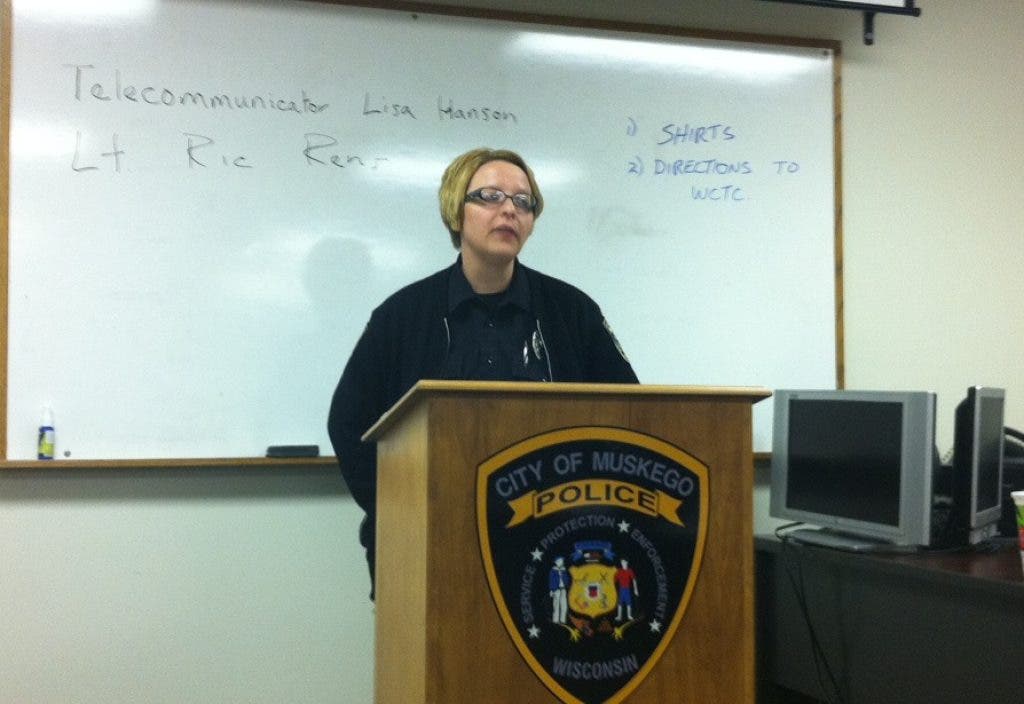


The second installment of the Citizen's Academy gave us a closer look at the role of communications and patrolling to responding to and preventing crime.
Lisa Hanson, a telecommunicator in the dispatch center walked our class through the myriad of things she must do during a call for assistance, including listening to the caller, locating and dispatching squads and keeping an ear open for the mutual aid radios that may also request assistance.
In addition, any call coming into the center, whether on the 9-1-1 line or the 'non-emergency' must be answered and prioritized simultaneously. On a slow Tuesday afternoon, it's perhaps not an issue, but on the night shift, the skill of multitasking isn't just valuable, it can mean the difference between an officer making it home at the end of his or her shift...or not at all.
Find out what's happening in Muskegofor free with the latest updates from Patch.
"It can be very stressful, with the phone and radio requiring your attention at the same time, but ultimately the officers come first," Hanson said. "Our goal is to have everyone go home at the end of the day, because we all have families."
Dispatchers could be talking with patrols, fire and rescue, flight for life and outside law enforcement agencies on a single call, while keeping an ear for what the caller is saying. Most of this communication is unknown to the caller, as they are muted. These periods of silence sometimes are viewed as indifference or rudeness, but dispatchers say they are hearing you, no matter what appearances may seem.
Find out what's happening in Muskegofor free with the latest updates from Patch.
While Hanson receives word from an officer on a traffic stop, she is sending another officer to head in that direction, just in case the stop 'goes bad.' When most shifts feature 3-4 officers, multiple stops can mean that outside assistance is required. In addition, with the increase in contact officers have had with drug-influenced drivers, a routine stop for speeding or weaving is anything but.
On the patrol side, Lieutenant Richard Rens told the class that traffic stops are always viewed with extreme caution, which explains why they park the way they do when they've pulled someone over.
"People often wonder why our vehicles are parked partially in the road, and it's because it allows the engine block of our vehicle to stop a bullet," he explained. "If we park directly behind a car, a driver has a clear lane to shoot."
For felony or more high-risk stops, the car is parked much further back, as it's impossible to determine how a suspect will react. The goal of any encounter, Rens said, is to stop the threat.
"We never want to kill anybody," said Rens, who in 20-plus years has fired his weapon once, and not at a person. "Often we'll have a person who is looking to fight with us, and as officers we are trained to fight, but we're not trained to fight fair and that is designed to stop the threat before it escalates and endangers the officer."
Rens also dispelled a myth perpetuated by TV and movies.
"We aren't trained to use our weapons to shoot at people's legs. Our training helps us to determine when deadly force is necessary, and if so, we're aiming either here (pointing at the middle of the chest) or here (between the eyes)."
During peak times, dispatchers work with patrols to determine when mutual aid (Suburban Mutual Aid Response Team, or SMART) is required, and all law enforcement operates with this same 'code of honor.' The term literally means that an outside agency is given full authority in the city to respond and arrest as if they were a member of the MPD. A similar system exists for fire and rescue calls (Mutual Aid Box Alarm System, or MABAS).
Where outside assistance is causing some friction comes in with the current 9-1-1 response system. While Muskego could take all 9-1-1 calls made within the city directly, they are currently sent to the Waukesha County Communications Center first, then dispatched to Muskego. However, the time to reach Muskego dispatch lags by as much as 82 seconds versus a direct call, and the Department is hoping to wrest that responsibility from the County in order to improve response times. (Calls from land lines go direct, but fewer residents are keeping their land lines.)
Patrol officers carry about 20 pounds of equipment around their waist and under their uniform they all sport protective vests. Equipment includes a knife, taser, flashlight, radio, sidearm (either a 9mm revolver, 40 or 45), knife, handcuffs, baton and two types of gloves.
"A lot of the people we need to handle don't always have hygiene as a high priority," Rens said.
The squads themselves are rolling offices, featuring a camera and laptop, part of about $10,000 in equipment to allow every officer to be ready to respond to anything from a traffic situation to a water rescue.
Readiness, training and communication are the best tools the department can possess, and Rens said that "with officer homicides way up this year, officer safety is paramount. The state requires a minimum of 24 hours training for officers, and our department probably has at least 100 hours every year that our officers participate in."
As citizens, Hanson and Rens urged us to become actively involved in Neighborhood Watch programs, and reiterated last week's plea to call whenever something doesn't look right. Information sharing is just part of the 'web' the police rely on to prevent crime, and it's something we are all armed with.
Get more local news delivered straight to your inbox. Sign up for free Patch newsletters and alerts.