Politics & Government
Local Police Consider Merits of License Plate Scanners
Some departments in the Milwaukee area are installing automated camera systems that can read and react to problem plates in an instant; Saukville and Port police chiefs offer their take on the technology.


Suppose you are a police patrol officer.
As you cruise the streets — even the highway — you keep your eyes safely on the road, both hands firmly on the wheel.
At the same time, you scan every approaching car, every car in front of you, every car parked along the side of the road.
Find out what's happening in Port Washington-Saukvillefor free with the latest updates from Patch.
You know in an instant when any one of those cars, even in heavy traffic, even in very fast traffic, has so much as an expired registration.
You know in an instant when one of those cars has been reported stolen, or that it was seen as the getaway car in an armed robbery.
Find out what's happening in Port Washington-Saukvillefor free with the latest updates from Patch.
Are you some kind of super-cop? No, no human has that capability.
But, Wauwatosa police officers soon will be able to patrol the streets in this way, with technology that up to now has been beyond the reach of most smaller police departments.
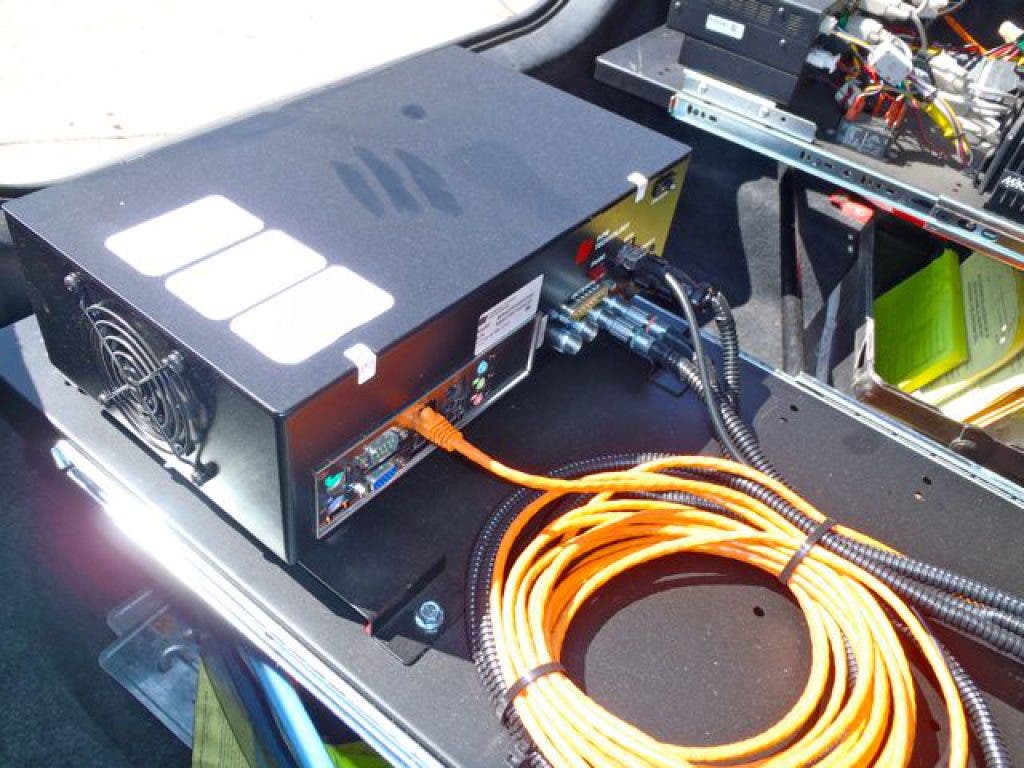
The "automated license plate recognition systems" — license readers, for short — use high-tech cameras mounted on the car roofs that scan every plate they pass and send instant alerts to the officers.
Local Departments Considering Scanners
Saukville Police Chief Bill Meloy said he had seen the scanners demonstrated, and planned to do more research about whether they would be worth the money. He said he also worried they could bog down communications systems, such as the Badger Net Line that the shares with other communities and the .
"That takes up so much bandwith," Meloy said. "Going through on 33, scanning each plate would bog the whole system down."
When a plate is scanned with a license reader, it goes through the state's Transaction Information for the Management of Enforcement (TIME) system to look for information like registration and criminal activity, according to Dana Brueck, communications officer for the Wisconsin Department of Justice.
The TIME system, at least, will not be affected by the increased activity, Brueck said, because the plate searches will access an extracted file from the data base that is updated twice daily and loaded onto the agencies’ network.
Port Washington Police Chief Kevin Hingiss said he had not heard of the technology, but would likely look into it. He wondered how much of a help it would be, though, over the current system of manually entering the plate number.
"We already get that information if we run the license plate, and we get that back pretty instantaneously," Hingiss said.
Wauwatosa Adopts the Technology
The will soon install the license plate readers on two squad cars. And as the price comes down, more police departments will be adopting it.
“We’ll outfit two squad cars, each with dual cameras,” said Sgt. Salvatore “T.J.” Alioto. “There are actually two cameras inside each of those, one color camera for daylight and one infrared for night.
“The system senses the reflectivity of the license plate, but it captures the whole car. Then it crops down to the license plate and reads it.”
It does that in much less time than it takes you to blink.
“And the response is instantaneous,” Alioto said. “It provides instant notification to the officer.”
That same patrol officer on the street now, without this system, has to decide which, if any, vehicle he or she thinks might be worth checking out. There is a measure of intuition, of suspicion, of having a hunch, of luck.
There is also the matter of time.
The advantage of automatic reading
Now, an officer has to decide which cars to check, get a good enough look to get the license number, then manually enter it into the computer with one hand while driving with the other. Then, before taking any action, the officer has to wait for a visual readout, again taking eyes off the road. It’s all akin to texting while driving.
“You run a plate, and by the time you get a response – whoops, he’s long gone,” Alioto said. “It’s time-consuming and dangerous.
“With this system, they can keep both hands on the wheel. There’s an audible signal as well as a visual one.”
Wauwatosa officers rode along with Milwaukee police who already have the system in place, to see what it could do.
"That's Milwaukee," Alioto said. "Theirs was just ding-ding-ding-ding."
Alioto said that the license readers, manufactured by Federal Signal, scan at rates in the thousands per minute and can read a plate at a combined speed of 160 mph – for instance, a squad car and an approaching car each traveling at 80 mph.
Again, compare that to an officer’s current situation. He or she almost has to be following a car to get a license number and enter it. At any reasonable road speed, it is nearly impossible to check the number on even one rapidly approaching vehicle – much less every one, at any conceivable speed.
Big Brother is watching - and that's OK, so far
If that were all the system could do, it would be like putting many extra eyes on the road. But that isn’t all.
“It’s not only running the plate, it’s also geo-tagging it,” Alioto said. “It can plot that reading on a map, date and time-stamped.
“We can see where and when it’s been seen. Because of this, you have a picture of that person’s activities – or at least that vehicle.”
That raises red flags for some people. Anybody could be driving the same car that is implicated in a crime investigation. And what if every car is suspect, even when on private property?
“The ‘Big Brother’ factor – it’s already been tested in the courts,” Alioto said. “Public areas, streets and parking lots, are not protected.
“It’s set up not to capture cars in driveways, and the data is not used except in an investigation.”
The capabilities of the system make it not only a powerful tool for the patrol officer but also for the detective – or even the cop enforcing overnight parking.
“Suppose you’re on the third shift,” Alioto said. “Part of your job is parking enforcement, and people have called in for overnight parking permission.
“You can upload that list, and if there’s a car not on it – ding!
“You’re just driving down the street, not having to focus on whether a car is called in or not. Now the officer can concentrate on patrolling.”
But suppose there’s something much more serious involved.
“Say you have a sex offender,” Alioto said. “We can set up a geo-fence that tells us, ‘Hey, you just crossed over the line, over that border.’
"Again, we wouldn't necessarily use that just because someone drove down the street once. But twice, three times – in the parking lot...?
"Hey, you're not supposed to be here.”
Ding.
It's on a 'need to know' basis, and you don't...
The system can even keep the patrol officer in the dark, Alioto said, when it suits the needs of investigators.
Suppose detectives are watching someone suspected of a crime, whom they believe may frequent a particular place or area, but they are not yet ready to pounce.
The last thing they want is for a diligent patrol officer to scrooge the investigation by pulling over the prime suspect before they’ve amassed enough evidence to make a charge stick.
“We can program it to seek a ‘person of interest,’” Alioto said. “But it can be set up so the officer on the street doesn’t even know that. He or she doesn’t get pinged.
“But the lead investigator knows – they get an email or text immediately,” as to the suspect's whereabouts.
Coming soon to another jurisdiction near you
Right now, the Milwaukee Police Department, the Milwaukee County Sheriff’s Department and the Franklin Police Department are using the system.
Wauwatosa is spending about $29,000 to install systems on two squad cars – “Those two squads are going to be very busy,” said Alioto’s boss, Capt. Dale Weiss.
Part of the cost, Alioto said, is the software system, so adding additional mobile units – camera-equipped squads – could be around $10,000 per car.
Soon, Alioto said, other jurisdictions in Southeast Wisconsin may purchase license readers and form a joint alert system, then it could go statewide, and there’s talk of a national alert system.
"We've already had cases where Milwaukee has been able to say to, say, Greenfield, 'Hey, we've seen this car you're looking for 10 times in the same neighborhood in the past week.' That's really valuable.
“We’re talking about a huge database of information,” Alioto said, “and it’s just recently gotten to the price point where we could afford to do it.”