
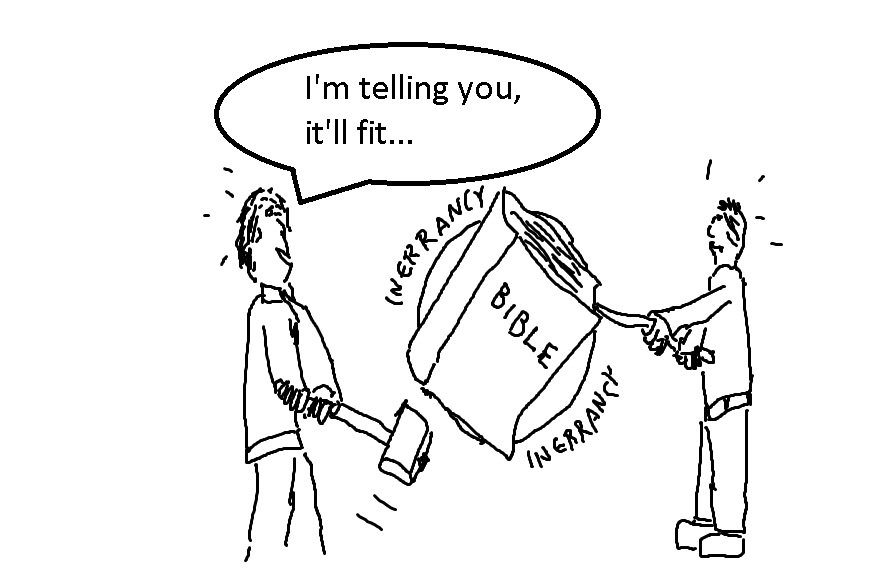
The controversy surrounding the statements made by Phil Robertson of “Duck Dynasty” fame in his recent interview with GQ, is just the latest public example of wrong headed interpretations of the Judaic/Christian Bible. A collection of documents and texts that have taken at least four millennium to craft is hardly a reliable source of inerrancy and the direct word of the Supreme Creator.
From the Jewish perspective, we have a broad range of interpretations of the Jewish written bible (Tanakh). The range is from those that interpret it as inerrant to those who look at it as a collection of allegories, metaphors and mythologies. For those that are unfamiliar with Jewish teachings and understandings, the Torah (the first five books attributed to Moses) is only the written part of our scriptural inheritance. There are many other facets of our Jewish tradition that are included as the oral tradition and teachings, which are not found in any other sources. Theses oral traditions carry as much weight as the written traditions and in many ways clarify the meaning of the writings.
In the first place, the Torah was written in Hebrew and Aramaic and most of the Christian literature taken from it was taken from the Septuagint, which was a Greek translation of the Torah. The Septuagint, just as any other translation contains many mistranslations. This is understandable since Hebrew is a complex language, containing no vowels, where one must know the context of content to accurately translate. In addition, there are words that appear in Hebrew that have no equivalent in any of the European languages, including Greek and Latin. For example: the word Gehinnom has no equivalent in Greek and was mistranslated to mean hell, which is a Greek concept. Again making the translation completely out of context.
Find out what's happening in Shorewoodfor free with the latest updates from Patch.
The Tanakh was not canonized until sometime around the 3rd century C.E. (Current Era) and the current accepted text, the Masoretic texts, were completed somewhere around the 8th to 10th century C.E. This is only the latest interpretation of the scriptural texts and the process continues to this day. New scholars come along and add to the richness of the interpretations and aid in to the relevance of modernity.
Christian texts are not something that I feel qualified to speak to other than from a historical view. Judaism and what would become to be known as Christianity separated early and have steadily grown apart for two thousand years. It is clear to me that historically that Christianity, if it were to survive and prosper, needed to separate from the rebellious Jews of the mid 1st century C.E. and by the early 2nd century they were two unrelated movements. Christianity left Judaism behind when Paul and Peter determined that gentiles didn't need to go through a Jewish conversion prior to becoming Christians. The observance of Jewish law would be a hindrance since all males would need to be circumcised and the following of Jewish dietary laws. Hence the claim of passing on from the “old covenant” to the “new covenant” as outlined by the early Apostles, most prominently Paul.
Find out what's happening in Shorewoodfor free with the latest updates from Patch.
The “new covenant” and the associated textual interpretations have built the western civilizations on the ashes of the old Roman Empire. As far as the validity of the Christian faith and the scriptural texts, that is not my concern except for only as it applies to non Christians, atheists and agnostics. For someone like Phil Robertson to make the statements he did and the support that he has received by a number of public and private figures brings to question how widely are these beliefs held. Does this man speak for all American Christianity?
From my reading, it would appear that a number of political conservative voices have come out in support of his statements based on exercise of his 1st amendment rights. But, is his statement to be interpreted politically or is it to be interpreted as religious statements of a particular dogma? He claims to be a man of faith, but that doesn't make him right nor does it make him supportable politically. Thankfully he's not running for political office. Quite frankly I can't see much difference in his statements from those of a fellow Louisianian David Duke.
Should we paint all who support Phil Robertson with the same brush of intolerance, bigotry and prejudice?