Politics & Government
Public Safety Committee Discusses Police Pursuit Options
Members of the Public Safety Committee recommended changes to the Shorewood Police Department's pursuit policy at a Nov. 1 meeting.


SHOREWOOD, WI — The Shorewood Village Board Public Safety Committee discussed and recommended changes to the Shorewood Police Department's vehicle pursuit policy during its Nov. 1 meeting.
Members of the Committee said part of the policy regarding officer discretion should be drafted to be less vague and Shorewood Chief of Police Thomas Liebenthal agreed to draft possible changes to that end. No immediate changes come from the meeting, but the Committee's recommendation signals future policy changes may be on their way for wider approval and implementation.
The meeting's recommendation comes as a continuation of the discussion around a private consultant's police organizational study ordered by the Village in 2020. Two other topics from the organizational study were slated for discussion at the meeting, but time cut the discussion short to just pursuit policy.
Find out what's happening in Shorewoodfor free with the latest updates from Patch.
Liebenthal said in the meeting that officers believe the current policy is fair and strict, but Committee Chair and Village Trustee Wesley Warren expressed concern with the amount of discretion available to officers.
"I am not saying that there is a current issue with this... ...but I kind of look at it a different way. When you have all that discretion, it opens you up to allegations that the discretion has been misapplied," Warren said. "I feel like putting more structure around when pursuits happen— if you're more prescriptive and you say this is when pursuits happen and when they don't happen, I feel like that leads to less subjectivity in the process."
Find out what's happening in Shorewoodfor free with the latest updates from Patch.
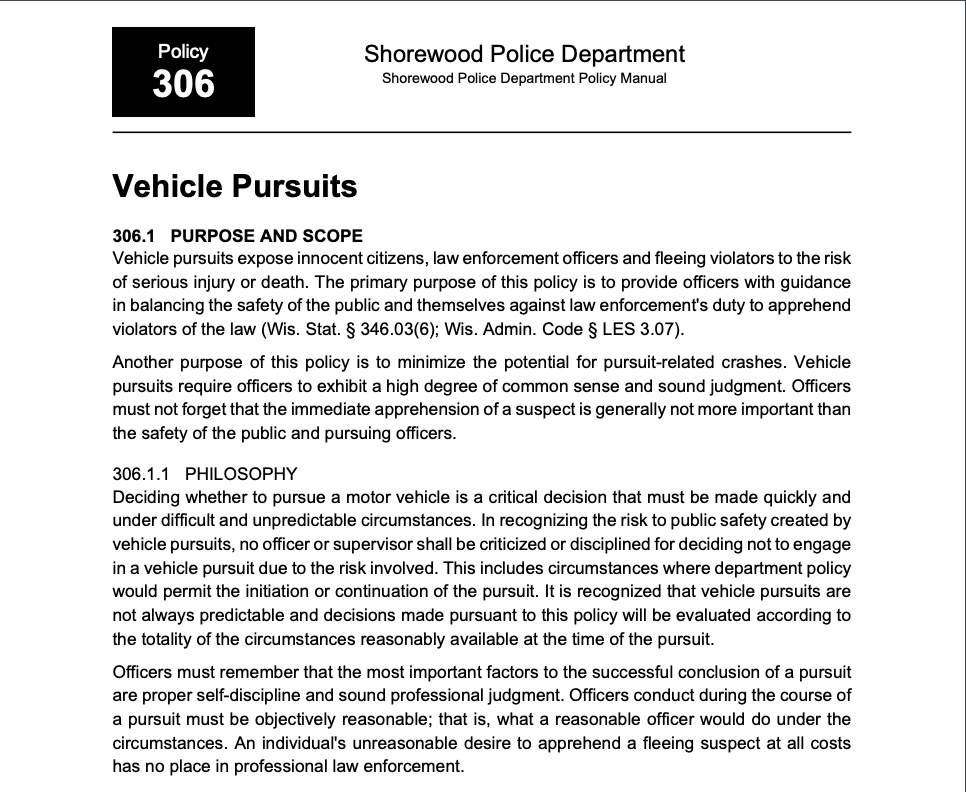
At present, SPD policy authorizes officers to start a pursuit when it is "reasonable to believe a suspect is evading arrest or detention by fleeing in a vehicle that has been given the signal to stop." Policy also dictates officers should take multiple factors into consideration when deciding to pursue someone.
Current policy also discourages extended pursuits for more minor violations such as traffic violations and misdemeanors, and pursuits are supposed to be ended when the risk of a chase outweighs the risk of a suspect escaping.
Extended police pursuits in Shorewood are rare compared to other parts of the North Shore. Shorewood Police only engaged in 12 between January 2020 to October 2021, and of those chases, nine were ended early by officer discretion and two ended in crashes. Only one ended in a person actually stopping for police, an unusual occasion, Liebenthal said in the meeting.
The two Shorewood chases that ended in crashes were related to a robbery and a recklessly endangering public safety incident. Over the same time frame, Glendale police conducted 180 pursuits and Brown Deer police conducted 68. In Whitefish Bay, there were 17 pursuits, according to Liebenthal.
The study that prompted the Nov. 1 conversation — conducted by Alexander Weiss Consulting and commonly known as the Weiss report — said the department should consider only allowing pursuits for serious felony type incidents and that a supervisor's approval should be required for each pursuit.
Interim Police Chief Thomas Liebenthal explained, though, the changes recommended by the Weiss report could have other unintended consequences or they may be out of touch with how the department already operates, citing data from other departments around the North Shore and meetings with Shorewood Police officers.
"A supervisor actually getting on the air at that point and making verbal approval, it's kind of not really feasible because you want to keep those [radio] airwaves free," Liebenthal said. "Our pursuit policy is probably the most strict of all seven municipalities within the North Shore at this time."
Prior to the meeting, Liebenthal met with officers of the Shorewood Police Department to discuss the possible changes laid out in the Weiss report. Village President Ann McKaig said she was also present in those meetings.
Liebenthal then presented the findings of those meetings to the Public Safety Committee meeting on Nov 1:
"Officers stated they felt that crime could potentially increase in Village if it was common knowledge that the police could not pursue offenders who committed certain levels of offenses. They also stated that the public may view the police officers and the service they provide in a negative light if they witnessed an officer observe a crime take place and fail to take any enforcement action on that offense."
"Officers acknowledged that the current Shorewood Police Department pursuit policy is the most restrict policy of all the North Shore police agencies yet stated that the policy works well for them and that they would not change it. Officers stated the current policy is fair, allows for some officer discretion, and already has supervisory overnight [sic] built in."
"Officers stated that the current pursuit policy provides the flexibility to gather additional information to aid them in their decision making in these incidents so they can make the best possible decision for public safety. Officers cited the built-in checks and balances within the policy, post-pursuit supervisory reviews and post-pursuit debriefs as a reason they like the current policy."
"Officers expressed that they recognize the inherent dangers involved in police pursuits and felt that it was important for the public to know that they are constantly reevaluating the need to pursue based upon the information they have at that point in time."
Liebenthal said in the meeting the current Shorewood policy has guidelines for a supervisor to notify the Bayside Communications Center and officers involved in the pursuit of their presence. The supervisor is then supposed to continuously assess the situation and risk factors to ensure the pursuit is within guidelines. Those risk factors include time of day, how the weather is, how many pedestrians there are, what type of car is involved and how much traffic there is.
"I have a problem with requiring the shift supervisor to condone the pursuit, I can see the downside of that." Village Trustee Kathy Stokebrand said in the meeting about the supervisory suggestion from the Weiss report. "If a supervising officer thought it shouldn't be going on they would say no, stop."
Liebenthal added to Stokebrand's point that supervisors may not be able to visually see everything with a pursuit and they can only go off of the information they're being given.
"I personally have been in the situation of being a shift supervisor when we have pursuits and if I feel that I'm not getting enough information or the information timely enough, I'll start to try to prompt to get that information and if I'm not getting it then I'll order it to be terminated because I can't justify what's going on at that time if I don't have that information," Liebenthal said.
The question then came down to the policy's language around when to start a pursuit. Members agreed the current language is vague.
"Setting some parameters or some definition I think, if nothing else would help communicate what the standards are," Village Trustee Jim Arndorfer said in the meeting.
Trustee Warren said he would like to see policy only justify pursuits in incidents of violent crime and serious felonies, although he said he can't necessarily speak for the other members of the board.
In the end, Liebenthal agreed to draft a possible pursuit policy with more specific parameters and language defining when a pursuit can be started. The drafted policy would then be discussed in a future meeting of the entire Village Board.
Community discussion on the topic is slated to continue at the Nov. 11 Shorewood Human Relations Commission meeting.
Get more local news delivered straight to your inbox. Sign up for free Patch newsletters and alerts.