Crime & Safety
Southold Police Chief Sheds Light On Heroin Epidemic, Immigration Fears, New Technology At Headquarters
BREAKING: "If they'e blowing through a couple hundred dollars of heroin a day and don't have a job, the money has to come from somewhere."


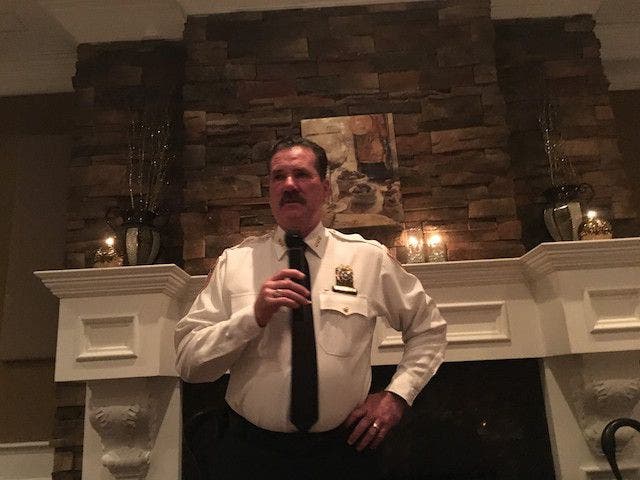
MATTITUCK, NY — A growing heroin epidemic, immigration concerns, and cutting edge technology were some of the topics on the agenda as Southold Town Police Chief Martin Flatley spoke before a crowd at the North Fork Chamber of Commerce's meeting Monday night.
The meeting, which was held at Michelangelo's in Mattituck, brought together concerned business owners who had a series of questions for the chief.
Flatley began by describing two big projects, regarding technology upgrades, the police department has embarked upon.
Find out what's happening in North Forkfor free with the latest updates from Patch.
The first, he said, is a $400,000 project involving police radio communication upgrades; the project involves changing antennas and plans for towers, "so police can communicate effectively and without losing transmission," Flatley said.
The second project, which officially kicks off Tuesday, involves redoing the police dispatch room. "We start ripping things up tomorrow," he said.
Find out what's happening in North Forkfor free with the latest updates from Patch.
The town's police department covers Laurel to Orient Point and through to Fisher's Island, Flatley said. The dispatch room also fields calls from Shelter Island, Plum Island, and eight or 10 fire departments, as well as 911 calls, he said.
"We're like a one-stop shop for fire, EMS and police on the North Fork and Shelter Island," Flatley said.
The project involves moving the entire dispatch room into the basement, including camera systems and the 911 lines.
"Tomorrow is D Day. It's a really big move," Flatley said.
Once all is moved, the room will be remodeled with new furniture slated to arrive at the end of the month.
"We're talking about dispatchers who are sitting for eight hours at a time, at least. This will make it easier," Flatley said.
New furniture will include collapsible stations where dispatchers can stand up, or which can be used at any level.
Other upgrades include moving from the current system, where dispatchers push buttons to answer calls, to a full desktop computer operation.
The upgrades were made possible due to a$340,000 donation from the Reichert Foundation; Charles Reichert owns IGA. "We're eternally grateful for that," Flatley said.
The chief then described how technology has changed the face of the police department.
Car video systems, in place for approximately 10 years, activate each time a police officer turns on emergency lights and include video spanning the time from the moment of the arrest, to watching a defendant in the backseat as he's transported to headquarters, and then, when he's let down the hallway to be processed, Flatley said.
"That's big for us. So if we get a complaint or if someone says, 'The police were roughing me up,' or 'The handcuffs were too tight,' we can watch the video from the very beginning right into that jail cell," Flatley said.
In addition, while police officers used to use pen and paper to record police and accident reports, now, laptops and printers exist in cars; tickets can be generated immediately with arrest reports sent directly and electronically to New York State.
"When that ticket is written it's sent straight to New York State. We don't even touch it," Flatley said, totally erasing any situation where a person could say, "I got this ticket, what can you do for me?" That ticket is already in the state system, Flatley said.
The laptops can be used to scan license plates and auto feed all information, he said. The computer system also has an automatic vehicle locator system, so at headquarters, officers can see where all cars are located on the North Fork, where calls are pending, and also, help an officer, via a navigation system, how to get to a call, Flatley said.
License plate reader technology is also used, he said. "If a crime is committed, we can track all that information coming in and out of town and we can go back and build a database," Flatley said.
License plate readers are useful during an Amber Alert or if a larceny has been reported stolen. "You can drive through, collect as many plates as you can, and see if you can get a description of the car," Flatley said. "It's a good tool."
The ever-changing landscape is well-served by the emerging technologies, the chief said.
"Technology is changing the face of what we do, just like in private business," Flatley said.
Lavender farm woes
The group then asked Flatley about various issues of concern to residents.
One woman asked about the lavender farm in East Marion that sparked traffic concerns last summer; she said she felt sorry for the business owners and asked why similar complaints were not lodged against pumpkin pickers or Christmas tree shops.
Flatley said the issue is basically a "two week a year problem," with the lavender crop blooming only a few weekends a summer. "The problem was last year it happened on July 4 weekend," he said. "That's a tough weekend for us because on July 4 all our resources are at the max."
The business, he said, is "bringing in scores of people from the city with no instructions on where to park. They're freezing in the roadway; they totally jammed up the roads."
Flatley said police and town reps have meet three or four times with property owners, who have agreed to add another 100 parking spots this year. He added that property owners have considered buying another parcel. "But do you spend over $1 million to alleviate parking for two weekends a year?" he asked.
Heroin use on the rise
Paul Romanelli of Suffolk Security Systems said the types of burglaries seen on the North Fork have changed.
"A few years back, you saw a lot of burglaries of TV and stereo systems. That doesn't happen anymore. Now you see a lot of burglaries for small, portable items, including drugs from medicine cabinets," he said.
"A lot are heroin users," Flatley said. "When you're blowing through a couple of hundred dollars worth of heroin a day, and you don't have a job, the money has to come from somewhere."
Thieves steal drugs from medicine cabinets and precious metals, he said, "something they can sell really quickly. It's isn't so much about cleaning out a house."
And, he added, the robberies are not "confrontational" and are usually done when no one is home. Many of those thefts are reported in the springtime when seasonal homeowners are opening their homes and realize they've been broken into, Flatley said.
Red light cameras
The chief was asked how he felt about red light cameras.
"I'm not a big fan of those. I think they're more of a revenue generator," police said.
Immigration fears
Another resident asked how the climate was with immigration concerns on the rise. "Are you finding the community a little on edge?"
Flatley said it's a tremendous concern; the town has done Synergy events at both the Peconic Recreation Center and recently, in Greenport. "That topic took over the whole meeting," he said.
He added, "It's tough right now. Our department, local law enforcement, is not set out to do immigration work. I don't know what the future holds for us. Mandates have changed for us."
Immigration agents have been seen locally recently, but they were "looking for someone who was deported for a violent crime, who was in the country illegally then re-entered, a violent gang member. It seems like everyone has agreement that we don't want someone like that," Flatley said.
On Thursday, Flatley said, he'll take part in a webinar with the New York State Attorney General.
"Everything is changing and the Hispanic population is definitely on edge," Flatley said.
Counterfeit bills, gunpoint robbery
Tom Scalia of the North Fork Chamber of Commerce said many of the group's members, such as store and bed and breakfast owners, handle cash every day; he asked what they should do if they are victims of a crime.
Rita Winkler of Vines & Branches reminded that in October, nine business owners were victims in just a few hours, when a woman with a child in tow passed off counterfeit $100 bills.
"Definitely make out a report," Flatley said. He added that security systems are critical, with surveillance cameras and video essential during an investigation.
"This was a situation so bizarre," Winkler said. "It was heartbreaking. Businesses such as Goldsmith's, a toy shop, have never had this happen. This was a woman with a young child. She waited till the end of the day, on a Sunday. She went to nine establishments and spent the equivalent of $900, with nine counterfeit $100 bills, and got the equivalent of that cash back."
Flatley said Riverhead also has thefts all the time at places such as Tanger.
Winkler said she learned the counterfeit bill, which passed the marker test, was fraudulent when she went to use it at 7-Eleven the next morning.
Magic Fountain holdup
Footage with the image of the suspect in recent Magic Fountain gunpoint robbery, who is still at large, was captured with a surveillance system, Flatley said. That footage enabled his image to be spread via Suffolk County Crime Stoppers and local media, the chief said.
David Perrin, owner of Cedar House on Sound B&B and the Bay Breeze Inn & Bistro in Mattituck, said many have small children and asked what could be done as community and parents with a heroin epidemic sweeping its way out to the North Fork.
Flatley said incidents such as the armed robberies of Magic Fountain and GameStop are "very few."
But, he said, the issue is complex.
"Most of this crime is driven by illegal drug use," Flatley said. "There is a lot of heroin use on Long Island . . . it's a very tough crime to address. You get calls where a 25, 26-year old has overdosed in the bedroom. They're under the radar, not out on the street corner."
While he said he could not comment on cases where arrests had not yet been made, Flatley said robberies at places such as "gas stations, where cash is readily available, seem to be by users."
Drinking on the North Fork
Perrin then asked what he could tell guests who say, "How bad is it if we taste wine, and then drive?"
"You're probably talking to the wrong person," Flatley said. "It's our job to arrest them when they drink too much wine."
But, he added, small tastings are far different from wineries that market themselves as a "destination" and people stay there for a length of time, and "are partying for four hours."
He did not mention the name of one well-known winery where he said that behavior exists.
The chief said local taxi companies are adding cars to the fleet, and suggested that taking a taxi was the best answer.
Get more local news delivered straight to your inbox. Sign up for free Patch newsletters and alerts.