Community Corner
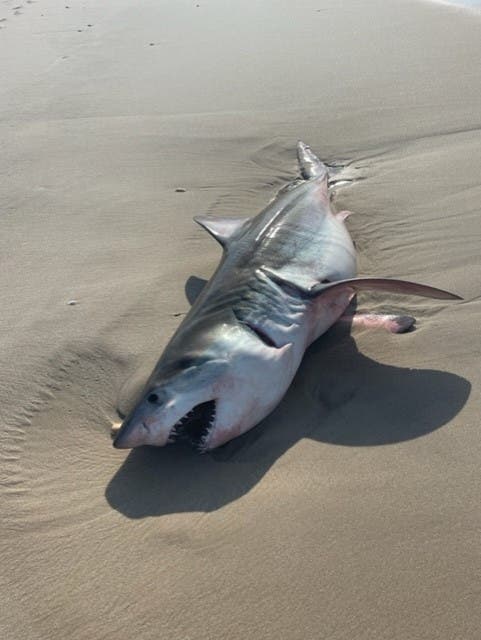
Dead Juvenile Great White Shark Found On LI Beach
Police said a resident spotted the body of the juvenile great white shark, which was between 8-feet and 9-feet long.


QUOGUE, NY — A dead juvenile great white shark washed up on the beach in Quogue Wednesday morning, police said.
According to Quogue Village Police, at 9:33 a.m., the shark was seen on the beach between 80 and 90 Dune Road.
The shark, between 7-feet and 8-feet long, was reported by a Dune Road resident, police said. The shark washed out to sea before police could secure it, officials said.
Find out what's happening in Westhampton-Hampton Baysfor free with the latest updates from Patch.
Quogue Village Police said they were in touch with the South Fork Natural History Museum's shark research and education program, which was attempting to monitor the situation along with law enforcement.
The New York State Department of Environmental Conservation is also responding,cc officials said.
Find out what's happening in Westhampton-Hampton Baysfor free with the latest updates from Patch.
According to Dr. Alisa Newton, chief veterinarian at OCEARCH, during this time of year, white sharks are moving through the New York area, "transitioning from their over-wintering area, which extends from the Carolinas to South Florida. They are moving toward summer feeding areas in Cape Cod and Nova Scotia, with "animals this size" likely moving toward a summer location, she said.
"At this time we are cautioning swimmers and boaters in the area to be aware of this ongoing situation, and to keep distance to allow law enforcement to monitor this event, police said.
If a shark is spotted, call Quogue Village Police at 631-653-4791.
After a spate of shark bites on Long Island in recent days, including two shark bites reported at Smith Point County Park and one off Fire Island, Gov. Kathy Hochul directed state agencies Monday to enhance shark monitoring.
A shark was also spotted Tuesday at East Atlantic Beachand reportedly, close to shore in Westhampton, according to a video circulating on social media.
Hochul directed the Office of Parks, Recreation and Historic Preservation, the Department of Environmental Conservation, and the New York State Police to implement heightened patrols and surveillance of shark activity, including drone and helicopter monitoring, along Long Island State park beaches due to "recent shark encounters in the Atlantic Ocean waters off of the South Shore."
Expanded public outreach is also planned to provide education on shark safety resources, Hochul said.
"As New Yorkers and visitors alike head to our beautiful Long Island beaches to enjoy the summer, our top priority is their safety," Hochul said. "We are taking action to expand patrols for sharks and protect beachgoers from potentially dangerous situations."
As part of the effort, state parks will increase lifeguard staffing through overtime at ocean beaches by 25 percent, Hochul said, a measure that equates to two to four lifeguards within each field.
The increase, she said, will boost surveillance for sharks and other marine life from the shore, by surf boats, and through an enhanced drone beach surveillance program.
In addition, drones will increase from one to three at Jones Beach State Park and one to two at at Robert Moses State Park — and Hither Hills State Park will be assigned its first drone, Hochul said.
Park police also have one drone available to respond as needed. Drone surveillance capabilities at Long Island state park beaches will also expand from the current four miles to 11 miles.
Also, state parks have received extra drone batteries and rapid battery chargers to extend the duration of available drone surveillance; Long Island state parks have 13 certified drone operators, with six more operators expected to complete certification soon, Hochul said.
Hochul also announced plans to deploy park police patrol boat to search the water, along with New York State Police helicopter patrols over South Shore waters. The state will also provide outreach materials focused on education via social media, DEC listserv, and its website.
An effort is also underway, Hochul said, to shore up federal, state, county, and local partnerships with an eye toward sharing resources and information about potential shark sightings and to better support correct identification of sharks and other fish.
Hochul also outlined what happens when a shark is sighted at a New York State facility: Under state park shark safety guidelines, swimming is suspended following a shark sighting so the shoreline can be inspected by drone, she said.
Swimming is only allowed to resume at least an hour after the last sighting in order to better protect beach visitors. All sightings are referred to the Long Island Coastal Awareness Group, which consists of 180 individuals from municipalities, agencies, and private beach operators from Queens through Long Island. State park lifeguards are continuously scanning and patrolling the waters and are on the lookout for any sharks or other potentially dangerous marine life, Hochul said.
Hochul also provided the New York State Department of Environmental Conservation's shark safety tips:
- Avoid areas with seals.
- Avoid areas with schools of bait fish, often characterized by fish splashing on the surface, diving sea birds, or the presence of marine mammals such as dolphins.
- Avoid areas where people are fishing.
- Avoid swimming in the ocean at dusk, dawn, or nighttime.
- Avoid murky water.
- Avoid isolation. Swim, paddle, kayak, and surf in groups.
- Swim close to shore, where your feet can touch the bottom.
- Always follow the instructions of lifeguards and [arks staff.
- Adhere to all signage at beaches.
With three shark bites reported in Suffolk County waters in recent days, and another recorded in Nassau County, officials have directed efforts to keep swimmers safe in the water.
The Suffolk County Parks Department also listed tips on social media Friday:
"As shark and marine life activity has increased in the waters around Suffolk County this year, we wanted to share some important tips to help keep you safe as you enjoy the beach this season. Remember, we share these waters with a variety of marine life and it's important to stay alert and pay attention when entering these habitats," the post said.
Suffolk County Steve Bellone said the shark bites were "unprecedented."
He added that before the three recent bites — including two at Smith Point County Park and one off Fire Island— there had not been a shark bite recorded in Suffolk County since Smith Point opened in 1959.
And now, there were two reports at Smith Point last Tuesday alone, he said, including a lifeguard who has since returned to work.
Bellone emphasized that the ocean was a marine environment. "Sharks are here. What we are experiencing may have become the new normal, with more interactions — that remains to be seen, but from what we have experienced so far this season, that is very possibly the case."
The county executive also described some of the enhanced efforts ongoing to protect beachgoers, including drones providing visuals and lifeguards out on jet skis, paddle boards and surfboards in response to the "spate of shark bites in Suffolk County waters."
Bellone urged swimmers to avoid dusk and dawn, not wear shiny jewelry and not go into the water if bleeding, all common sense measures; also, he said, go into the water with someone so if a person is in distress, help is close.
In addition to the Suffolk reports, a 37-year-old man suffered a cut to his right foot while swimming in the ocean at Jones Beach recently, police said.
Sharks have become a more visible presence on the East End in recent years: In 2016, a great white shark nursery was found in the waters off Montauk, according to Ocearch founder Chris Fischer.
According to Ocearch Chief Operating Officer Fernanda Ubatuba at the time — Ocearch is a nonprofit organization dedicated to shark research — shark attacks on humans are extremely rare — the odds are about one in 12 million. Most shark attack victims survive; bites on humans by sharks are normally exploratory.
Worldwide, 200,000 sharks are killed per day; in contrast, about 10 to 12 human lives are lost yearly as a result of shark attacks, researchers told Patch.
Sharks, experts agree, are far less of a danger to people than mankind is to sharks.
Joe Yaiullo, curator and co-founder of the Long Island Aquarium and Exhibition Center, has told Patch in previous interviews that there are precautions swimmers can take, such as not going into the water at dawn or dusk when bait fish, such as bunker, are being fed upon. "Avoiding that situation is always wise," he said.
Sharks, Yaiullo said, don't have fingers to feel; instead, they "mouth" things, and many times, a shark attack is "just them being inquisitive, asking, 'Is this something I want to eat?' Most shark attacks are not a person getting eaten, it's usually a bite, and the shark swims off, leaving the person intact for the most part."
Caution is key, Yaiullo said. "It's something to be aware of. Just as if you were going to walk into the plains of Africa, you'd be wary of a lion," he said.
Shark sightings are actually a good thing, he said. Sharks are a sign of a healthy ecosystem with plentiful fish, clean water and less pollution, an indicator that the United States is doing a good job of managing its fisheries, he said.
"People have this fear of sharks," Fischer said in a prior interview. "They look out and see a little 4- or 5-foot shark, eating something the size of menhaden or a small squid or mackerel — it's not something you need to be too worried about."
It's not until sharks are much older and about 10 to 12 feet long that they begin to target larger prey such as seals, he said.
Common sense in the water is key, Fischer said: "Don't go swimming looking like a seal," he said. "But people do that every day. They put on wetsuits, dressed up like shark food, when they are going swimming with real shark food. Those are the kinds of things you want to avoid."
Fischer added: "Be practical, look at what's going on. Make good, safe decisions, use common sense — and enjoy the ocean."
Get more local news delivered straight to your inbox. Sign up for free Patch newsletters and alerts.